LinkedIn’s profile name extraction rules are a critical foundation for legal and efficient professional data collection, combining platform-specific naming norms and cross-border data privacy compliance requirements—any violation can lead to IP blocking, account restrictions, or even legal risks. Based on LinkedIn’s official user agreement, global privacy regulations (GDPR/CCPA), and landmark legal cases (HiQ Labs v. LinkedIn), this article breaks down the non-negotiable core rules for profile name extraction, with practical guidance for compliant operation.
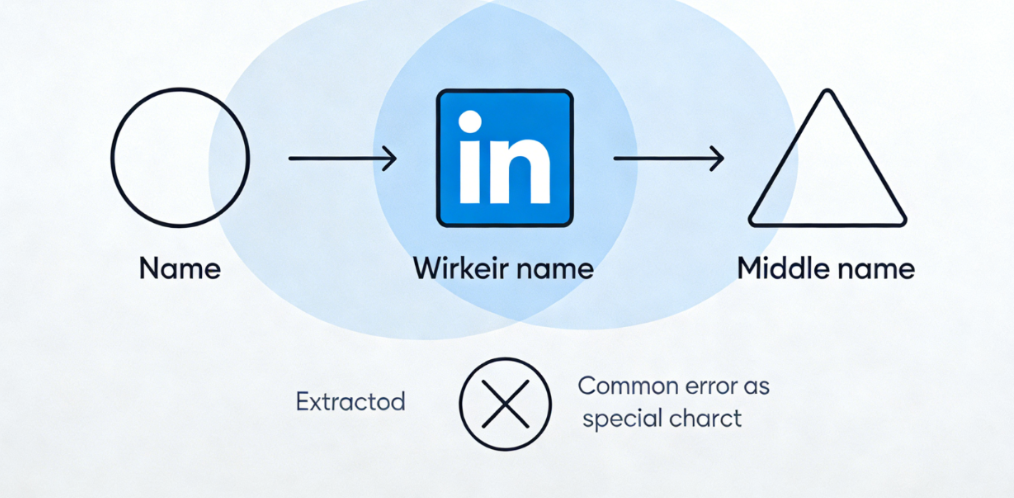
LinkedIn’s Official Profile Name Field Rules: No Room for “Creativity”
LinkedIn enforces strict norms for the profile name field (the core source of name extraction), clearly stipulating that the field may only contain real/preferred professional first, middle, last names and pronouns . Any non-compliant content will result in profile restrictions and invalid extraction results, with key prohibitions including:
- No special characters, emojis, flags, or marketing messages (e.g., adding a company logo or job title to the name field) ;
- No pseudonyms, fake names, business names, or organizational names—names must match real professional identity (and passport for profile verification);
- No email addresses, URLs, or irrelevant symbols—violations lead to temporary or permanent profile bans.
For extractors, this rule means only structured name data (first/last/pronouns) from compliant profile name fields is valid; extracting names from non-compliant fields not only yields useless data but also risks triggering LinkedIn’s anti-scraping alerts.
Public vs. Private Data: The Fundamental Boundary for Name Extraction
LinkedIn divides profile data into public (no-login accessible) and private (login-only accessible) categories, with starkly different extraction rules for names :
- Public data: Full names (and headlines/locations) visible without logging in—technically legal in most regions (per HiQ Labs v. LinkedIn) but explicitly prohibited by LinkedIn’s platform rules; automated extraction of this data may trigger IP rate limits or blocks.
- Private data: Any name-related data only accessible after logging in (e.g., name aliases in mutual connection notes)—strictly forbidden to extract via any automated tool; this violates LinkedIn’s user agreement and constitutes a breach of contract, with severe consequences including permanent account bans and legal claims .
A critical practical tip: Even for public name extraction, avoid bypassing LinkedIn’s technical controls (e.g., cracking login barriers)—this crosses the legal line under the CFAA (Computer Fraud and Abuse Act) .
Global Compliance Rules: GDPR/CCPA Raise the Bar for Name Extraction
Beyond LinkedIn’s platform rules, extractors must adhere to regional data privacy regulations, with GDPR (EU) and CCPA/CPRA (California) being the most impactful:
- GDPR: For EU resident LinkedIn users, explicit consent is required to store or use extracted name data—even if the name is public; failure to obtain consent results in fines of up to 4% of global annual turnover.
- CCPA/CPRA: California users have the right to request the deletion of their extracted name data; extractors must establish a clear data deletion process to avoid non-compliance.
All extracted name data must be used only for the stated professional purpose (e.g., recruitment, B2B outreach) and cannot be sold, shared, or used for unauthorized marketing—this is a universal compliance requirement across all regions.
IPFLY Proxies: The Core Enabler of Compliant LinkedIn Name Extraction
Compliant extraction alone is not enough to avoid LinkedIn’s technical restrictions—IP quality and behavior simulation are equally critical. LinkedIn’s IP reputation scoring system flags data center IPs (e.g., cloud service provider IPs) and shared IPs as high-risk, leading to immediate blocks for any extraction attempt. IPFLY’s proxy solutions address this pain point with genuine, high-purity IP resources that align with LinkedIn’s detection logic:
- IPFLY Static Residential Proxies: 100% ISP-allocated genuine residential IPs, exclusive to individual users, with no abuse or shared usage. These IPs mimic real user network environments, ensuring that compliant public name extraction requests are not marked as “suspicious” by LinkedIn’s IP reputation system. With permanent validity and unlimited traffic, they are ideal for long-term, fixed-region LinkedIn name extraction (e.g., EU/US regional recruitment data collection).
- 99.9% Uptime & High-Standard Encryption: IPFLY’s fully self-built high-performance servers guarantee stable connection for continuous extraction, while bank-level encryption protects extracted name data from leakage, fully complying with GDPR/CCPA data security requirements.
- 190+ Country/Region Coverage: IPFLY’s global IP pool covers all major LinkedIn target markets (EU, US, APAC), enabling compliant name extraction for regional professional data collection without geographic IP restrictions.
Ready to conduct compliant, low-risk LinkedIn profile name extraction without IP blocks or compliance risks? Register your IPFLY account today to access genuine ISP-allocated static residential proxies—exclusive, high-anonymity IP resources that mimic real user behavior, 190+ global regional coverage for cross-border extraction, and 99.9% uptime for stable operation. Configure IPFLY’s proxies with just a few clicks, and start extracting LinkedIn profile names in full alignment with platform rules and global GDPR/CCPA compliance requirements—no more worrying about IP reputation issues or data security risks!