The Moment Everything Stopped Working
It was 3 AM when Sarah realized her data collection pipeline had collapsed. For three weeks, her market research firm had relied on a cheap proxy service to gather competitive pricing data across European markets. The initial setup seemed fine—until the CAPTCHAs started appearing, then the complete IP bans, and finally, the embarrassing call from a client wondering why their market analysis report was three days late.
Sarah’s story isn’t unique. In the world of web intelligence, e-commerce operations, and digital marketing, the difference between success and failure often hinges on one critical decision: choosing among the best residential proxy providers rather than settling for budget alternatives that promise the moon but deliver headaches.
The proxy market has exploded with options, each claiming massive IP pools, unbeatable speeds, and guaranteed anonymity. Yet beneath these marketing claims lies a reality that separates genuine quality from cleverly disguised mediocrity. Understanding these differences isn’t just technical knowledge—it’s business survival.

What “Residential” Actually Means (And Why It Matters)
Imagine walking into a high-security building. You have two options for entry: wear a uniform that clearly marks you as “visitor from a corporate office,” or arrive dressed like someone who actually lives there. Data center proxies are like that corporate uniform—functional, but immediately recognizable as different from regular traffic. Residential proxies, conversely, make you indistinguishable from the millions of genuine internet users browsing from their homes.
When evaluating the best residential proxy providers, the authenticity of their IP sources becomes paramount. True residential proxies originate from real devices connected through legitimate Internet Service Providers—actual home computers, smartphones, and tablets whose owners have opted into proxy networks. This authenticity explains why quality residential proxies bypass sophisticated anti-bot systems that immediately flag data center traffic.
However, not all providers maintain ethical sourcing standards. The proxy industry’s shadow side includes operations that compromise devices without consent or recycle abused IPs that appear on countless blacklists. This reality makes provider selection about more than features and pricing—it becomes a question of operational integrity and long-term reliability.
The Three Pillars of Proxy Excellence
Through years of industry evolution, three fundamental criteria have emerged that distinguish the best residential proxy providers from the merely adequate:
Pillar One: The Authenticity of Identity
The most sophisticated websites don’t just check IP addresses—they analyze behavioral fingerprints, connection patterns, and reputation histories. A genuine residential proxy from IPFLY carries the complete digital identity of a real household: the specific ISP allocation, the consistent geographic location, the natural usage patterns that signal “this is a person, not a server.”
IPFLY’s approach exemplifies this authenticity through its multi-layered filtering mechanism. Rather than aggregating any available IP, their proprietary big data algorithms evaluate each address against quality metrics including blacklist status, connection stability, and geographic accuracy. This rigorous selection means users receive IPs that websites trust implicitly, not addresses that trigger security protocols.
The difference manifests in practical outcomes. Where low-quality providers see 30-40% block rates on sensitive platforms, rigorously filtered residential proxies maintain success rates exceeding 99%. For businesses, this translates directly to operational efficiency—fewer failed requests mean faster data collection, more reliable automation, and ultimately, better service delivery to end clients.
Pillar Two: Scale Without Compromise
Industry newcomers often assume that bigger IP pools automatically equal better service. The reality proves more nuanced. A provider offering 100 million IPs means little if those addresses are oversubscribed, geographically concentrated, or technically compromised. True scale requires both quantity and intelligent distribution.
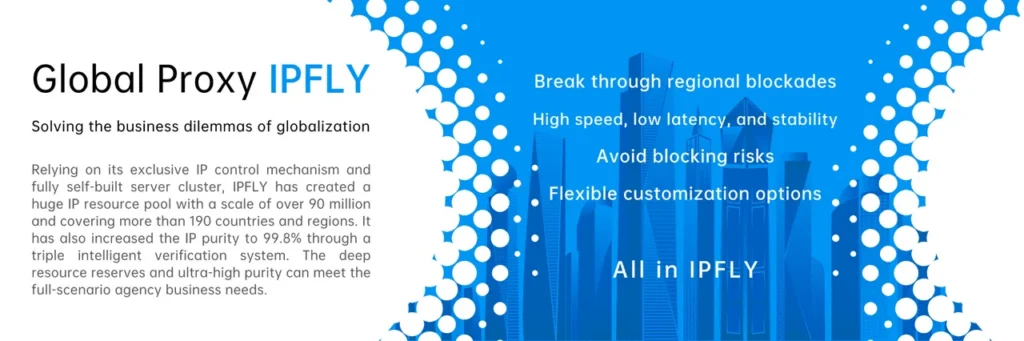
The best residential proxy providers maintain global coverage that reflects actual internet demographics. IPFLY’s network spans 190+ countries and regions, but more importantly, it provides granular targeting capabilities down to city and ISP levels. This precision matters profoundly for use cases requiring authentic local presence—verifying how advertisements display in specific metropolitan markets, testing localized pricing strategies, or managing region-specific social media accounts.
Consider a travel company monitoring hotel rates across Southeast Asia. Generic “Asia-Pacific” proxies might route through overloaded Singapore servers, triggering rate limits. Precisely targeted residential IPs from Bangkok, Jakarta, or Manila appear as genuine local searches, yielding accurate, unthrottled data. This geographic intelligence separates professional-grade providers from those simply reselling bulk bandwidth.
Pillar Three: Adaptability to Workflow
Different operations demand different proxy behaviors. A social media manager maintaining long-term client accounts needs persistent IP addresses that remain stable for days or weeks. A market researcher scraping millions of product listings benefits from rotating IPs that distribute requests across thousands of identities. The best residential proxy providers accommodate both scenarios without forcing artificial compromises.
IPFLY addresses this adaptability through distinct service tiers. Their static residential proxies provide permanently active IPs directly allocated by ISPs—ideal for scenarios requiring consistent identity such as e-commerce account management or financial service access. These addresses replicate genuine residential environments so completely that they support unlimited traffic without the throttling common to shared services.
For dynamic requirements, IPFLY’s rotating residential proxy pool offers over 90 million addresses with customizable rotation intervals. Users configure changes per request, timed intervals, or session-based triggers—flexibility that prevents the pattern recognition that triggers anti-abuse systems. This dual approach ensures that whether your operation requires stability or anonymity, the infrastructure adapts rather than constrains.
When Proxies Become Business Infrastructure
The evolution of proxy services from technical novelty to business-critical infrastructure reflects broader digital transformation trends. Modern enterprises don’t use proxies to “hide”—they use them to operate at scale while respecting platform boundaries and maintaining ethical data collection practices.
The E-Commerce Intelligence Example
Consider a mid-sized retailer competing against Amazon and Walmart. Manual price monitoring across thousands of SKUs proves impossible, yet automated collection triggers defensive mechanisms without proper proxy infrastructure. By implementing IPFLY’s residential proxies, this retailer routes automated requests through genuine consumer IP addresses, appearing as organic browsing behavior rather than corporate scraping.
The business impact extends beyond data collection. Stable residential IPs enable the retailer to maintain persistent sessions on competitor sites, tracking inventory fluctuations and promotional timing without repeated authentication challenges. This intelligence feeds dynamic pricing algorithms that adjust offerings in real-time—a competitive advantage impossible without reliable proxy infrastructure.
The Global Content Creator Scenario
Digital creators managing presence across multiple platforms face unique challenges. TikTok’s algorithm favors accounts with consistent geographic signals; sudden IP changes trigger security reviews that throttle reach. YouTube’s monetization policies scrutinize traffic sources for authenticity. For creators building international audiences, residential proxies become tools for legitimate market expansion rather than circumvention.
Using IPFLY’s static residential proxies, creators establish persistent presences in target markets—authentic German IPs for Berlin-based content, Japanese addresses for Tokyo audience development. This geographic consistency satisfies platform algorithms while enabling genuine cultural engagement. The unlimited traffic allowances mean creators never face bandwidth constraints during high-engagement periods, and 24/7 technical support ensures that technical issues never interrupt content schedules.
The Hidden Costs of Poor Proxy Choices
Sarah’s 3 AM crisis illustrates a pattern repeated across industries: the true cost of inadequate proxy services extends far beyond subscription fees. When evaluating the best residential proxy providers, smart buyers calculate total cost of ownership including:
Operational Disruption: Every blocked request, CAPTCHA challenge, or connection timeout represents staff time diverted from productive work to troubleshooting. At scale, these interruptions compound into significant productivity losses.
Data Integrity Compromise: Inconsistent proxy performance introduces data quality issues—gaps in price monitoring, incomplete market research, skewed competitive analysis. Decisions based on partial data carry inherent risks.
Reputation Exposure: Shared proxy services expose users to “bad neighbor” effects. When other subscribers abuse IPs for spam or fraud, subsequent users inherit blacklisted addresses and damaged reputations.
Security Vulnerabilities: Free or ultra-cheap proxies often monetize through data harvesting, injecting advertisements, or selling user traffic patterns. The “savings” from budget providers frequently cost more in security exposure than premium services charge upfront.
IPFLY’s exclusive IP allocation model eliminates these hidden costs. By providing dedicated resources rather than shared pools, they ensure that user activities never intersect with potentially malicious actors. The high-standard encryption and proprietary filtering mechanisms protect data integrity while maintaining the performance consistency that business operations require.
Making the Selection: A Practical Framework
Choosing among the best residential proxy providers requires structured evaluation beyond marketing claims. Consider this decision framework:
Verify Source Authenticity: Ethical providers transparently explain IP acquisition methods. Look for partnerships with ISPs and consent-based user networks rather than vague “peer-to-peer” descriptions that may mask compromised devices.
Test Geographic Precision: Request specific location targeting during trial periods. Quality providers deliver city-level accuracy; inferior services offer only country-level approximation that fails for localized use cases.
Evaluate Rotation Logic: Sophisticated rotation isn’t just about changing IPs—it’s about mimicking natural usage patterns. The best providers offer intelligent rotation that considers session duration, request frequency, and platform-specific behaviors.
Assess Support Quality: Proxy issues don’t respect business hours. 24/7 technical support with rapid response capabilities indicates providers that understand their infrastructure’s critical role in client operations.
Calculate True Scalability: “Unlimited” claims often hide throttling mechanisms. Test performance under realistic load conditions to ensure that high-volume operations maintain consistent speeds.
IPFLY’s infrastructure satisfies these criteria through fully self-built servers that eliminate third-party bottlenecks, proprietary algorithms that optimize IP selection in real-time, and professional support teams that understand complex use cases rather than reading from scripts.
The Future of Residential Proxy Services
As online platforms deploy increasingly sophisticated detection systems, the gap between premium and budget proxy providers widens. Machine learning algorithms now analyze thousands of signals to distinguish genuine users from automated traffic—signals that simple IP rotation cannot mask.
The best residential proxy providers respond by deepening their authenticity rather than just expanding scale. This means investing in genuine residential partnerships, developing intelligent traffic pattern matching, and providing the granular control that sophisticated operations require.
For businesses and professionals, this evolution reinforces the importance of choosing infrastructure partners rather than commodity vendors. The proxy service that suffices for casual browsing fails under enterprise demands. The provider that cuts corners on IP quality creates cascading costs that dwarf subscription savings.
Beyond the Transaction
Sarah eventually found her solution—not through another budget provider, but by investing in quality infrastructure that treated her business needs seriously. Her data collection pipelines now run continuously, her client reports arrive on schedule, and her 3 AM emergencies have become distant memories.
The best residential proxy providers understand that they’re not selling IP addresses—they’re enabling business operations, protecting professional reputations, and removing technical barriers to digital success. This perspective shift changes the evaluation criteria from “cheapest per gigabyte” to “most reliable for mission-critical workflows.”
In a digital ecosystem where authenticity determines access, quality residential proxies have become essential business infrastructure. Providers like IPFLY represent this infrastructure evolution: combining massive scale with intelligent filtering, offering both stability and flexibility, and backing technical capabilities with professional support that understands real-world use cases.
The question isn’t whether your operations can afford quality residential proxies—it’s whether they can afford the alternative.