If you’ve ever bought proxies, you’ve probably seen providers advertise “10,000 IPs” or “100,000 IPs” as their biggest selling point. It’s easy to assume that more IPs mean better performance, fewer blocks, and more anonymity. But this is one of the biggest myths in the proxy industry.
The truth is that 10,000 IPs all from the same few subnets are worse than 1,000 IPs spread across 1,000 different subnets. Websites don’t just judge your traffic by your individual IP address – they judge it by the entire network neighborhood it belongs to, created through IP subnetting.
In this guide, we’ll explain IP subnetting in plain terms, why it’s the most important factor in proxy performance, and how to avoid wasting money on proxy pools that will get you blocked within hours.
How Websites Actually Judge Your Traffic
When you send a request to a website, it doesn’t see you as a person. It sees a collection of signals that it uses to decide whether you’re a legitimate user or an automated bot. Your IP address is the most obvious signal, but it’s far from the only one.
Modern anti-abuse systems look at the context around your IP address, including:
- Who owns the network the IP belongs to
- What type of network it is (residential, mobile, or datacenter)
- How many requests have come from nearby IP addresses recently
- Whether the same browser fingerprint has appeared across multiple IPs in the same range
- The reputation of the entire subnet, based on past activity
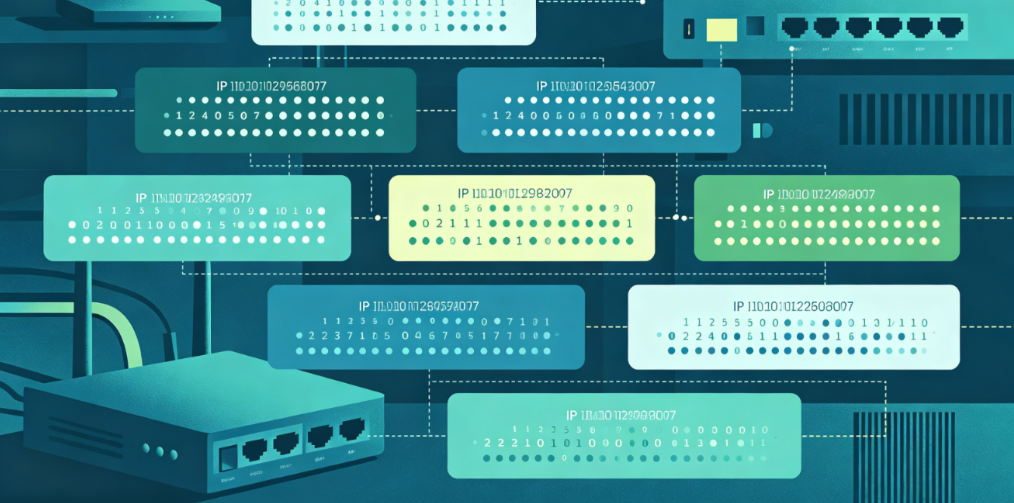
This last point is the most important. If 10 different IPs from the same subnet have been used for spam or scraping in the last 24 hours, every IP in that subnet will be treated as suspicious. Websites don’t have the time or resources to evaluate every single IP individually – they make decisions at the network level.
Subnetting in Plain Terms: The Neighborhood Analogy
If you’ve ever found subnetting confusing, you’re not alone. But you don’t need to be a network engineer to understand how it affects your proxies. The simplest way to think about subnetting is as a neighborhood.
An IP address is like a street address: 123 Main Street, Apartment 4B. The subnet is the entire neighborhood: Main Street between 1st and 2nd Avenue. All the houses on the same street share the same neighborhood identity.
Technically, a subnet is a block of IP addresses that share the same network prefix. The size of the subnet is defined by a CIDR notation:
- A /24 subnet contains 256 IP addresses (the most common subnet size)
- A /16 subnet contains 65,536 IP addresses
- A /8 subnet contains over 16 million IP addresses
When a website blocks a /24 subnet, it’s blocking every single house on that street. When it blocks a /16 subnet, it’s blocking the entire town.
Why IP Rotation Alone Fails Against Subnet Blocks
This is why aggressive IP rotation often doesn’t work. If all your proxies are from the same few subnets, rotating IPs is like moving from one house to another on the same street. The website still sees you as coming from the same suspicious neighborhood.
You might get away with it for a little while, but once the website notices a pattern of bot-like behavior from your subnet, it will block the entire range. At that point, every single IP in that subnet becomes useless, no matter how many times you rotate them.
This is the classic “burned pool” scenario that every proxy user has experienced. You buy a pool of 10,000 IPs, everything works great for the first day, then suddenly you start getting CAPTCHAs on every request. Nothing changed on your side – the website just blocked the entire subnet your pool was using.
Full-Industry Proxy IP Application Solutions
Power scalable growth for every cross-border business scenario with IPFLY’s reliable global proxy network
The #1 Mistake Proxy Buyers Make
The biggest mistake people make when buying proxies is focusing solely on the number of IPs and the price per IP. They see a provider offering 10,000 IPs for $99 and think it’s a great deal, without checking how those IPs are distributed across subnets.
In reality, that 10,000 IP pool might be concentrated in just 10 different /24 subnets. That means you only have 10 distinct network identities, not 10,000. Once those 10 subnets get blocked, your entire pool is worthless.
A much better deal is a provider offering 1,000 IPs spread across 1,000 different subnets. This gives you 1,000 distinct network identities, making it 100x less likely that you’ll get hit with a subnet-level block.
How to Inspect Your Proxy Pool’s Subnet Diversity
You don’t need to be a network expert to check the subnet diversity of your proxy pool. Follow these simple steps:
1.Take a random sample of 20-50 IPs from your pool
2.Use a free tool like bgp.he.net or ipinfo.io to look up each IP
3.For each IP, note the network range (subnet) and ASN number
4.Count how many unique subnets and ASNs you have in your sample
If most of your IPs share the same few subnets or ASNs, your pool has poor diversity and will be vulnerable to subnet-level blocks.
Reputable proxy providers like IPFLY will share detailed subnet and ASN distribution reports for their pools, eliminating the need for manual checks. IPFLY designs its proxy pools with intentional subnet diversity, ensuring that even within a single country, IPs are spread across thousands of distinct subnets and hundreds of ASNs. This means rotating IPs through IPFLY gives you genuine network diversity, not just different addresses on the same street.
Proxy IPs matter, but they are not the whole story. The next time you’re shopping for proxies, don’t ask “how many IPs do you have?” Ask “how many unique subnets and ASNs do you have?”
By thinking in terms of networks instead of individual IP addresses, you can avoid the most common proxy mistakes, save money, and build more reliable scraping and automation workflows.