Why IP Quality Evaluation Requires More Than Surface-Level Checks
In modern digital operations, IP quality plays a critical role in:
- Account stability
- Advertising validation
- Market research accuracy
- Platform trust evaluation
Many users rely on public IP checking tools.
However, these tools often depend on:
- Static IP databases
- Delayed update cycles
- Simplified classification logic
As a result, their output may not reflect how platforms actually evaluate network identity.
At IPFLY, we focus on a different standard:
→ Real-world performance under platform trust evaluation systems
Our Approach: Internal Quality Standards First
Third-party tools can provide basic reference.
But they do not fully represent:
- Dynamic IP reputation scoring
- Behavioral analysis models
- Traffic legitimacy evaluation
This creates a mismatch:
→ An IP label in a public database does not always reflect its real operational performance.
For this reason, IPFLY applies a stricter internal verification system, designed to align with real platform environments.
IPFLY 5-Layer IP Quality Verification System
Every IP must pass a multi-layer validation process before entering our resource pool.
1. Real Network Environment Validation
We verify that each IP:
- Originates from a legitimate ISP
- Belongs to real network infrastructure
- Reflects authentic user traffic patterns
This ensures network authenticity and identity consistency.
2. Reputation and Blacklist Screening
Each IP is evaluated against:
- Global reputation datasets
- Historical risk indicators
- Known abuse records
Only IPs with clean reputation profiles are retained.
Result:
→ Improved IP reputation score within platform trust systems.
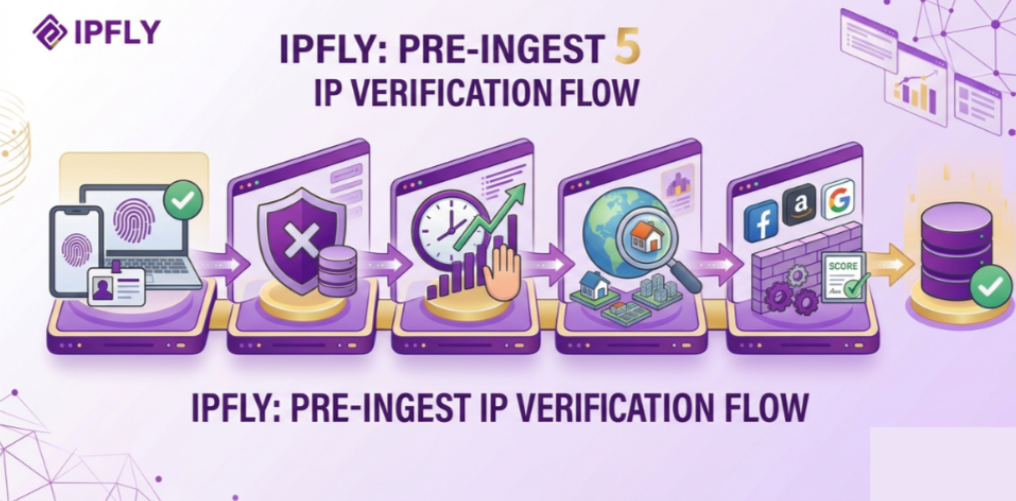
3. Usage Pattern Analysis
We assess:
- Historical usage intensity
- Traffic distribution patterns
- Behavioral consistency signals
IPs showing abnormal usage patterns are excluded.
Result:
→ Stable and predictable operational performance.
4. Geo-Accuracy Validation
Accurate location data is essential for:
- Advertising verification
- Localization testing
- Market research workflows
We validate:
- Country-level accuracy
- City-level precision
- ISP-region consistency
Result:
→ Reliable geo-targeting and data accuracy.
5. Platform Trust Simulation Testing
This is the most critical stage.
We simulate real platform environments to evaluate:
- Login consistency
- Session stability
- Traffic alignment with platform expectations
Result:
→ IPs that meet platform trust evaluation criteria.
Why Public Detection Tools May Show Different Results
Users sometimes observe inconsistencies between IPFLY resources and third-party tools.
This is due to differences in evaluation methods.
Limitations of Public Detection Systems
Most tools rely on:
- Static classification models
- Historical IP mapping
- Limited behavioral analysis
They do not fully reflect:
- Real-time network changes
- Hybrid ISP infrastructure
- Platform-level behavior modeling
Common Misclassification Scenarios
Certain IP types are frequently misclassified:
- Mobile network IP ranges
- Dynamic ISP allocations
- CPE (Customer Premises Equipment) devices
- Base station network outputs
These IPs may appear as “non-residential” in outdated systems.
However:
→ Platform trust systems often recognize them as legitimate user traffic.
Key Insight
Public tools evaluate labels.
Platforms evaluate behavior and trust signals.
This difference explains why:
→ IP classification results may vary, while real performance remains stable.
Why IPFLY’s Internal System Is More Reliable
IPFLY focuses on practical usability and stability, not static classification.
Our system:
- Prioritizes behavioral validation
- Uses real scenario simulation
- Continuously updates IP reputation data
Result:
→ Strong alignment with platform trust evaluation frameworks.
What This Means for Your Operations
Using IPFLY residential IPs provides:
- Stable network identity conditions
- Consistent behavior signals
- Reliable long-term performance
These benefits are critical for:
- Cross-border eCommerce
- Advertising validation
- Market research automation
- Data collection workflows
- Multi-account management under platform policies
Our Commitment to Quality
At IPFLY, any IP labeled as “residential” must meet strict internal criteria:
- Verified ISP origin
- Clean reputation history
- Proven behavioral consistency
- Validated platform compatibility
Our objective is clear:
→ Deliver IP resources that perform reliably in real-world environments.
Compliance and Responsible Use
IPFLY services are designed for legitimate and compliant use cases, including:
- Cross-border eCommerce operations
- Advertising verification and localization testing
- Market research automation
- Public data collection in accordance with platform policies
IPFLY does not support:
- Unauthorized system access
- Violations of platform terms
- Fraudulent or abusive activities
Final Thoughts
IP quality cannot be judged by surface-level labels alone.
It requires:
- Multi-layer verification
- Real-world validation
- Continuous optimization
IPFLY’s internal quality system is built on these principles.
This is why our standards go beyond typical third-party testing tools.
FAQ
Why do IP check tools show inconsistent results?
Because they rely on static databases, while platforms use dynamic trust evaluation systems.
Does IPFLY rely on third-party validation?
No. External tools are only references. Internal verification is the primary standard.
Are all residential IPs equally reliable?
No. Quality depends on source, history, and validation process.
How does IPFLY ensure quality?
Through a 5-layer verification system, including platform simulation testing.
What use cases benefit most from high-quality IPs?
eCommerce operations, advertising validation, and market research automation.