Why IP Quality Defines Business Stability
In cross-border eCommerce, social media operations, and market research, platforms no longer evaluate actions alone.
They evaluate identity.
Modern systems use multiple signals:
- IP source (ISP or data center)
- Behavior patterns (frequency and access paths)
- Device and browser environment
- Connection consistency over time
These signals form a network identity profile.
If the profile does not align with a real user:
→ Platform risk control systems may reduce trust or limit access.
Evolution of Platform Risk Control Systems
Traditional systems relied on simple rules.
Today, platforms use advanced frameworks:
- Behavioral analysis models
- Traffic evaluation systems
- IP reputation scoring
These systems:
- Build long-term behavior baselines
- Detect abnormal changes
- Evaluate IP reputation using large datasets
In this environment, network legitimacy becomes critical.
Root Causes of Early Account Instability
Common issues include:
- Verification at first login
- Frequent access restrictions
- Inconsistent request success rates
The root cause is often:
→ Low IP reputation score
For example:
- Data center IPs are often classified as non-user traffic
- Shared proxies carry mixed historical activity
This reduces platform trust from the beginning.
Why Static Residential Proxies Are Now Essential
Modern platforms expect:
- Stable identity
- Real network origin
- Consistent behavior patterns
Static residential proxies provide:
- Fixed IP identity over time
- ISP-based network legitimacy
- Stable behavioral signals
This improves alignment with platform trust evaluation systems.
What Are Static Residential Proxies?
ISP Proxy Architecture: Real Identity with Stable Infrastructure
Static residential proxies (ISP proxies) combine:
- IP addresses registered with real Internet Service Providers
- Hosting on high-performance infrastructure
This creates two key advantages:
- Authenticity: Traffic appears as real user activity
- Stability: Performance matches server-level reliability
Static vs Dynamic Proxies: Identity Consistency
The key difference is identity persistence.
- Dynamic proxies rotate IPs frequently
- Static proxies maintain a fixed identity
Dynamic proxies are suitable for large-scale data collection.
Static proxies are ideal for:
- Account management
- Long-term sessions
- Consistent workflows
A stable IP builds a predictable behavior profile.
Four Requirements for Stable Operations
- IP Reputation (Trust Level)
A high-quality IP should:
- Originating from a real ISP
- Maintain a clean usage history
- Be assigned to a single user
- Behavioral Consistency
Platforms expect:
- Stable login locations
- Predictable activity patterns
- No sudden environmental changes
- Environment Isolation
Each account should operate with:
- A dedicated IP
- An isolated browser environment
- Scalability
The system must support:
- Multiple accounts
- Long-term workflows
- Growing operational demand
IPFLY Static Residential Proxy Features Explained
Each feature addresses a specific infrastructure challenge.
Dedicated Static IPs (Improving IP Reputation)
Shared IP environments create risk:
- Mixed usage history
- Unpredictable reputation scores
IPFLY provides:
- Dedicated IP allocation
- No shared usage
Result:
→ Improved IP reputation and stable trust evaluation.
Fixed IP for Long-Term Use (Ensuring Behavioral Consistency)
Frequent IP changes may:
- Trigger verification processes
- Disrupt behavior continuity
IPFLY enables:
- Long-term IP binding
- Persistent session stability
Result:
→ Consistent behavior aligned with platform expectations.
Real ISP-Based IPs (Enhancing Network Legitimacy)
Data center IPs are often classified separately.
ISP-based IPs:
- Belong to real network providers
- Reflect natural user traffic patterns
Result:
→ Stronger alignment with platform trust models.
Environment Isolation Support (Reducing Account Linking Risk)
Account linking occurs when:
- Multiple accounts share infrastructure
- Behavioral patterns overlap
IPFLY integrates with tools such as AdsPower:
- One IP per account
- Isolated operating environments
Result:
→ Reduced cross-account risk exposure.
Global Geo-Targeting (Ensuring Data Accuracy)
Location affects:
- Ad display results
- Pricing data
- Search engine rankings
IPFLY provides:
- Country-level and city-level IP selection
Result:
→ Accurate local data and reliable testing environments.
Stable Connection and Low Latency (Supporting Natural Behavior)
Connection instability can cause:
- Session interruptions
- Inconsistent requests
IPFLY infrastructure ensures:
- High availability
- Low latency
Result:
→ Smooth and predictable operational performance.
Multi-Protocol Support (Ensuring System Compatibility)
Supported protocols include:
- HTTP / HTTPS
- SOCKS5
This allows integration with:
- Browsers
- Automation tools
- Data systems
Scalable IP Resources (Supporting Growth)
As operations expand:
- More accounts are required
- More IP resources are needed
IPFLY provides:
- Large global IP pool
- Flexible scaling capability
Result:
→ Sustainable long-term growth.
Real Business Applications
Cross-Border eCommerce
Challenge:
- Store accounts become linked
Solution:
- Assign dedicated IP per store
Result:
→ Improved account stability and reduced linkage risk.
Social Media Operations
Challenge:
- Multiple accounts operate under shared infrastructure
Solution:
- Isolated environments with dedicated IPs
Result:
→ More stable account lifecycle.
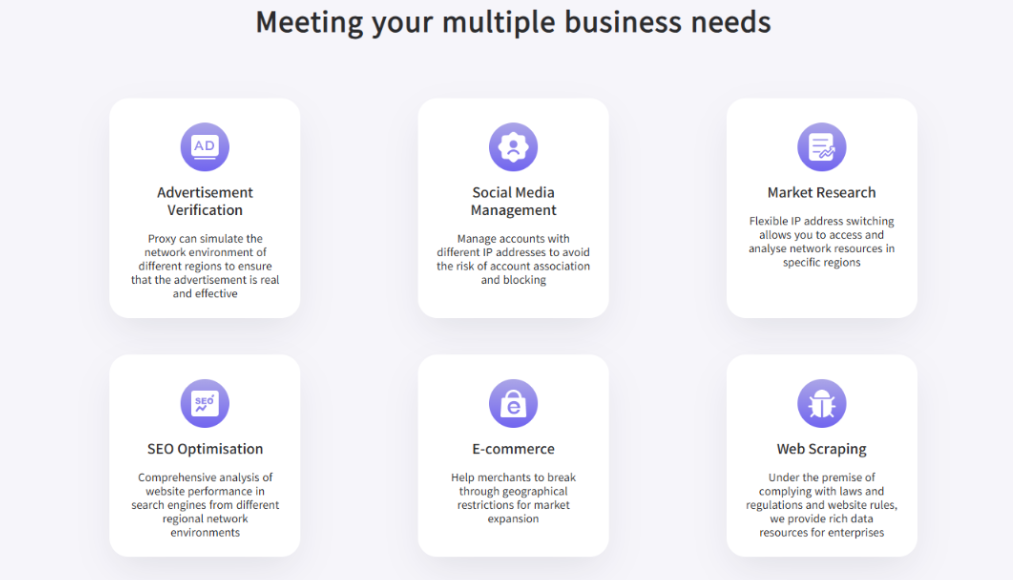
Advertising Verification
Challenge:
- Ads vary by region
Solution:
- Use local IP for validation
Result:
→ Accurate representation of user-side content.
Market Research and Data Collection
Challenge:
- Inconsistent data access
Solution:
- Use stable, high-reputation IP
Result:
→ Reliable and repeatable data collection workflows.
When to Use Static Residential Proxies
Compared to Dynamic Proxies
- Static: best for identity persistence
- Dynamic: best for large-scale rotation
Compared to Data Center Proxies
- Data center: cost-efficient but less trusted
- Static residential: higher legitimacy
Compared to Unverified Proxy Sources
Unverified sources often lack:
- Stability
- Security
- Predictable performance
They are not suitable for production environments.
How to Evaluate a Reliable Provider
Key criteria include:
- Dedicated IP allocation
- Real ISP-based resources
- Long-term stability
- Global coverage
- High-performance infrastructure
IPFLY meets these standards.
Compliance & Acceptable Use
IPFLY services are designed for legitimate business use cases, including:
- Cross-border eCommerce operations
- Advertising verification and localization testing
- Market research and data collection
- Multi-account management in compliance with platform policies
IPFLY does not support or encourage:
- Activities that violate platform terms of service
- Unauthorized access to restricted systems
- Fraudulent or abusive behavior
Final Thoughts
Proxy services have evolved from simple tools into core infrastructure.
Static residential proxies provide:
- Trusted network identity
- Consistent behavior signals
- Scalable operational support
IPFLY focuses on these core principles, making it suitable for long-term and large-scale digital operations.
FAQ
Are static residential proxies completely risk-free?
No. However, they significantly improve alignment with platform trust systems.
Why is a fixed IP more reliable?
It supports consistent behavior patterns over time.
What is the difference between ISP and residential proxies?
ISP proxies offer higher stability. Residential proxies offer more flexibility.
Should each account use a separate IP?
Yes. This improves environment isolation and reduces linkage risk.
What are static proxies best used for?
They are ideal for long-term operations, account management, and stable workflows.