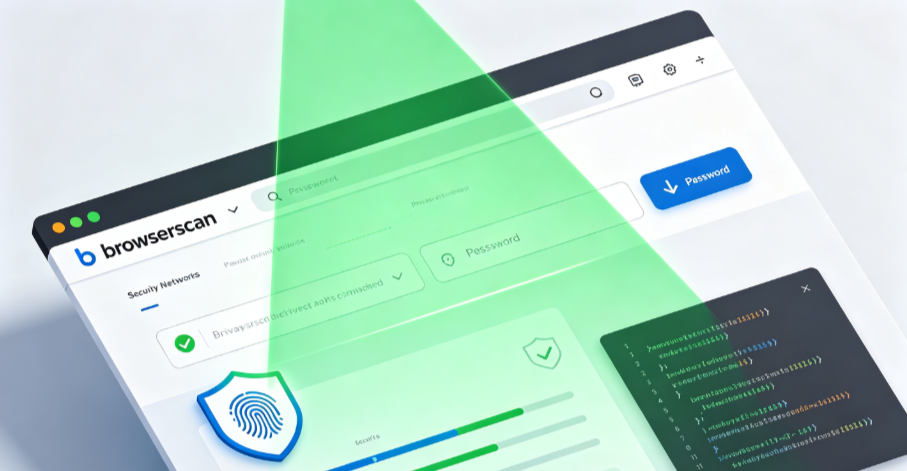
Every time you visit a website, your browser reveals a vast amount of information about you and your device. Websites, advertisers, and platforms have become experts at identifying users online—even if you change your IP address with a proxy or Free Proxy, your browser leaves behind a unique “fingerprint” that can still expose your identity. This fingerprint is made up of dozens of data points—fonts, screen resolution, WebGL rendering, time zones, language settings—that create a near-unique profile of your device.
That is exactly where BrowserScan comes into play. BrowserScan (browserscan.net) is a free, hosted web page that tests how authentic and internally consistent a browser’s fingerprint looks, and flags leaks and automation signals. You load the site, it runs a battery of client-side and network checks—over 50 data points—and reports a single “authenticity” percentage along with a detailed breakdown. It is widely used as a pre-flight self-check by privacy-conscious users and by people running multi-profile browsers who want to confirm their configuration looks like a normal, real browser before using it.
This comprehensive guide explains everything you need to know about BrowserScan in 2026—what it is, how it works, what it tests, how to interpret your results, and how to fix the issues it uncovers.

Part 1: What Is BrowserScan?
At its core, BrowserScan is a browser fingerprinting and IP leak detection tool. It doesn’t anonymize you on its own—instead, it acts as a diagnostic platform. Its purpose is to show what information your browser and network are exposing whenever you visit a website.
When you run a BrowserScan test, the platform checks:
- Browser attributes – user agent, installed fonts, screen resolution, and operating system
- Rendering technologies – WebGL and canvas fingerprinting that generate unique patterns
- Audio and font identifiers – that differ across systems
- IP address data – what the outside world sees when you connect
Put simply, it helps answer the question: How trackable am I?
Why People Use BrowserScan
BrowserScan isn’t just for cybersecurity professionals. A wide range of users benefit from it:
- Privacy-conscious individuals – who want to understand what their browser reveals
- Multi-account managers – who need to verify that each account has a unique, consistent fingerprint
- Web scrapers and automation users – who need to ensure their setup avoids detection
- Anti-detect browser users – who want to confirm their fingerprint spoofing is working
Part 2: How BrowserScan Works – What It Tests
BrowserScan works by running a series of tests inside your browser and your network connection. It groups its checks into several families.
Network Layer Checks
On the network side, BrowserScan reports:
- IP address and IP-derived geolocation
- WebRTC leak detection – checks whether your real IP is exposed through WebRTC
- DNS leak detection – checks if DNS queries are routed through your proxy’s DNS or your ISP’s
- Open ports, HTTP/2, SSL, and TLS characteristics
Browser Fingerprint Checks
On the fingerprint side, BrowserScan reads:
- Canvas, WebGL, and AudioContext values – computing a visitor hash
- User-Agent and Client Hints
- Installed fonts, screen resolution, and media devices
- Timezone cross-check – verifying that the IP-based timezone matches the JavaScript timezone
- Incognito state
Bot and Automation Detection
A dedicated section handles bot and automation detection. BrowserScan checks for:
navigator.webdriverflag (set to true in automation contexts)- Chrome DevTools Protocol (CDP) detection
- Selenium, Puppeteer, Playwright signatures
- Headless Chrome detection
Additional Security Tools
Beyond the main checker, BrowserScan also offers extra utilities such as Canvas detection, WebGPU reports, port scanning, IP lookup, and DNS leak testing, making it feel more like a broader browser and network diagnostic toolkit than a single-purpose fingerprint checker.
Part 3: Understanding the BrowserScan Authenticity Score
BrowserScan presents its top-level result as an authenticity percentage – a clean, real browser shows 100%. A score below 90% flags potential privacy risks, indicating you may be divulging traces that could be exploited to track your online movements or link your multiple accounts, leading to possible account suspensions.
How the Score Is Calculated
The authenticity score is consistency-based: the score reflects how well all the collected signals agree with each other and with a normal browser. Inconsistencies such as:
- A timezone that does not match the IP
- Tampered navigator values
- A WebRTC or DNS leak
- Automation flags
…pull the number down.
Important caveat: The exact deduction algorithm and per-signal weights are not publicly documented. The “starts at 100% and deducts per inconsistency” description is observed behavior rather than a published specification, so the precise number should be read as a rough indicator, not an audited measurement.
What a Low Score Means
A score below 90% indicates that:
- Your browser fingerprint contains logical contradictions
- Your IP address may be leaking through WebRTC or DNS
- Your proxy or Free Proxy configuration is inconsistent with your browser settings
- Your browser shows signs of automation or tampering
Part 4: The Critical Gap – Why Your Browser Fingerprint Score Matters for Multi-Account Operations
Whether in e-commerce, social media, advertising, or affiliate marketing, multi-account operations have become a common strategy. However, a neglected risk is the leakage of browser fingerprints.
If you use the same device and browser while operating multiple accounts, the browser fingerprints of these accounts will be identical. This could attract the attention of the platform, as it may be considered fraudulent behavior, leading to account bans.
Anti-Detect Browsers Are Not a Panacea
Even though many users have started using fingerprint browsers to mask their real device information, this does not mean that their accounts are completely safe. Due to the different technologies used by different fingerprint browsers, or improper use, personal information may still be leaked, or a false browser fingerprint may be generated. This could lead to the user’s device being marked as suspicious, or multiple accounts being marked as associated.
Therefore, when using a fingerprint browser, users need to utilize a tool to:
- Check if their browser fingerprint is authentic
- See if the local real IP address will be leaked
- Compare the fingerprint of the fingerprint browser with the browser fingerprint of the real device
- Compare whether there are many repetitions in the browser fingerprints of different accounts
After confirming the authenticity of the browser fingerprint, it is obviously safer to operate multiple accounts. BrowserScan provides exactly this verification capability.
Part 5: BrowserScan vs. Other Fingerprint Checkers
While BrowserScan is a popular choice, it’s not the only browser fingerprint testing tool available. Here’s how it compares.
BrowserScan vs. BrowserLeaks
BrowserLeaks provides individual test pages per fingerprint surface, making it useful for targeted debugging of a specific API. It is not a single-score tool—each sub-page tests one surface in isolation.
| Feature | BrowserScan | BrowserLeaks |
| Score | Single authenticity score | No scoring—raw data only |
| Approach | Holistic, consistency-based | Individual test pages per API |
| Best For | Quick validation, operational teams | Deep technical debugging |
BrowserScan vs. Pixelscan.net
Pixelscan.net has become a favorite among proxy users, anti-detect browser testers, and affiliate marketers due to its user-friendly interface and real-time evaluation results. It highlights inconsistencies and provides summary reports for browser configuration quality.
Both BrowserScan and Pixelscan are excellent for high-level validation. BrowserScan offers a more comprehensive set of additional tools (port scanning, WebGPU reports, etc.).
BrowserScan vs. CreepJS
CreepJS is open source and goes deeper on JavaScript-API consistency and “lie” detection. It is the go-to choice for hardcore developers and security researchers looking to audit every detail of a browser’s fingerprint. BrowserScan is broader on the network side (IP, WebRTC, DNS, ports, TLS) and uses a black-box authenticity score.
Summary Comparison
| Tool | Primary Focus | Best For |
| BrowserScan | Holistic fingerprint + leak testing with score | Quick diagnostics, operational validation |
| BrowserLeaks | Individual API surface testing | Advanced users, technical debugging |
| Pixelscan | High-level validation and scoring | Quick diagnostics, operational teams |
| CreepJS | JavaScript-API consistency and lie detection | Hardcore developers, security researchers |
Part 6: How to Use BrowserScan to Verify Your Proxy Setup
Using BrowserScan to verify your configuration is straightforward.
Step 1: Configure Your Browser
First, configure your browser to use your proxy provider. If you’re using a different browser, adapt the configuration steps to your browser’s proxy settings.
Step 2: Run BrowserScan
- Open browserscan.net in the browser you just set up
- Allow the site to analyze your browser’s settings and fingerprint
- Look for details like your IP address and location to confirm that your proxy is working as expected
Step 3: Analyze the Results
Check the following critical elements:
IP Address and Location – Verify that the displayed IP and location match your proxy’s endpoint.
Proxy Status – BrowserScan identifies if you are using a proxy or Free Proxy by examining the alignment between IP address and timezone.
WebRTC Leaks – Check that your real IP is not exposed through WebRTC.
DNS Leaks – Confirm that DNS queries are routed through your proxy’s DNS servers.
Authenticity Score – Aim for a score of 100% or as close as possible. A score below 90% indicates inconsistencies that need to be addressed.
Step 4: Fix Any Issues
If BrowserScan reveals issues, take corrective action:
- WebRTC leaks – Disable WebRTC or enable WebRTC leak protection through SOCKS5
- DNS leaks – Ensure your proxy uses its own DNS servers
- Low authenticity score – Check for geographic mismatches, adjust browser settings, or use an anti-detect browser
Complete Proxy IP Fundamentals
Build a full proxy knowledge framework — from core principles to protocol selection
Part 7: The “Two-Pillar” Security Model – Why Residential Proxies Are Essential
To understand why BrowserScan flags your connection, you must view digital identity as two separate pillars.
Pillar 1: The Software Layer (Handled by Browser)
This includes your User-Agent, screen resolution, fonts, hardware concurrency, Canvas, WebGL, and AudioContext fingerprints. Your anti-detect browser does an excellent job of randomizing these to make your device look unique.
Pillar 2: The Network Layer (Handled by Proxy)
This is where BrowserScan often detects discrepancies. It analyzes:
- IP Attribution – Is the IP owned by a home ISP or a server farm?
- Geo-Latency – Does the ping time match the physical distance of the claimed location?
- Protocol Headers – Are there leaks in the TCP/IP stack?
The Critical Gap
No matter how good your browser is, if you plug a “dirty” Datacenter IP into it, BrowserScan will immediately flag the profile. The software cannot mask the physical origin of the IP address.
The ISP Trust Signal
When BrowserScan queries an IP, it checks the Autonomous System Number (ASN):
- Datacenter IP: Returns “Amazon AWS” or “DigitalOcean” – Immediate red flag
- Residential IP: Returns “Comcast”, “Verizon”, or “Orange” – Green flag
Integrating a premium residential proxy network ensures that your network layer sends the same trust signals as a real home user, perfectly complementing your browser’s software masking.
Protocol Compatibility – SOCKS5
Anti-detect browsers rely heavily on specific protocols to function correctly. Many cheap proxies only support HTTP/HTTPS, creating a “Protocol Mismatch” where web traffic is proxied, but lower-level connections (like WebRTC) bypass the tunnel. Using SOCKS5-enabled residential proxies is essential. SOCKS5 handles all traffic types, ensuring that your DNS requests and WebRTC packets stay inside the encrypted tunnel, preventing leaks on the BrowserScan report.
Part 8: How IPFLY Powers Clean BrowserScan Scores
BrowserScan helps you see problems, but the right infrastructure helps you solve them. IPFLY provides the residential proxy infrastructure that enables clean, consistent browser fingerprints and successful BrowserScan tests.
Why Residential Proxies Are Essential for BrowserScan
BrowserScan’s detection mechanisms are specifically designed to identify inconsistencies between your IP and your browser fingerprint. Datacenter IPs are easily identifiable through IP-to-ASN lookups. The solution is residential proxies, which use real IP addresses assigned by Internet Service Providers (ISPs) to actual households. They appear as genuine consumer connections, making them far less likely to trigger detection.
IPFLY Static Residential Proxies (ISP Proxies)
IPFLY’s static residential proxies are 100% dedicated, ISP-registered IP addresses that remain fixed over time. Each IP is used exclusively by a single user, ensuring a clean reputation.
Key advantages for BrowserScan:
- ISP-registered authenticity – Each IP appears as a residential broadband connection, not datacenter infrastructure
- 100% dedicated IP – Exclusive use with no sharing; no risk of inheriting poor reputation from other users
- Stable and consistent – The IP remains unchanged, providing consistent identity for ongoing operations
- Geographic targeting – Choose IPs from specific countries and cities to match your intended location
- SOCKS5 support – Essential for preventing WebRTC and DNS leaks
- Full protocol support – HTTP, HTTPS, and SOCKS5
- Low latency – Delays as low as 50ms
- 99.9% uptime – Enterprise-grade reliability
Static residential proxies are ideal for users who need consistent, long-term operations and clean BrowserScan test results.
👉 Explore IPFLY Static Residential Proxies
IPFLY Dynamic Residential Proxies
For users who need geographic flexibility or IP rotation, IPFLY’s dynamic residential proxies offer real residential IPs with automatic rotation capabilities from a pool of over 90 million addresses covering 190+ countries.
Key advantages for BrowserScan:
- Real residential IPs – From a pool of residential addresses, ensuring high availability and low detection risk
- Automatic rotation – Distribute access across diverse IPs to avoid pattern detection
- Sticky session support – Maintain a consistent IP for hours or days when needed
- Geographic flexibility – Access content from virtually any region
- SOCKS5 support – Prevents WebRTC and DNS leaks
- Full protocol support – HTTP, HTTPS, and SOCKS5
- High success rate – Over 99% connection stability
Dynamic residential proxies are ideal for users who need geographic diversity or who prefer to rotate IPs for additional privacy.
👉 Explore IPFLY Dynamic Residential Proxies
IPFLY Datacenter Proxies
For speed-critical operations where residential authenticity is less important, IPFLY’s dedicated datacenter proxies offer high-performance connectivity. However, for BrowserScan testing specifically, residential proxies are strongly recommended.
👉 Explore IPFLY Datacenter Proxies
How IPFLY Addresses BrowserScan Checks
| BrowserScan Check | IPFLY Solution |
| IP authenticity | Static residential IPs display consumer ISP ASN, not datacenter |
| Proxy status | Residential IPs appear as genuine consumer connections |
| Geographic consistency | Geographic targeting ensures IP, timezone, and language alignment |
| DNS leaks | SOCKS5 remote DNS ensures queries resolve through the proxy infrastructure |
| WebRTC leaks | SOCKS5 prevents WebRTC from bypassing the tunnel |
| Automation flags | Residential IPs preserve passive OS fingerprint, avoiding automation flags |
Part 9: Best Practices for Passing BrowserScan
1. Fix the IP First
The most critical step is using a clean residential IP. A residential proxy routes you through real ISP-assigned home addresses, so to BrowserScan you look like an ordinary household user.
2. Ensure Geographic Consistency
Your IP location, timezone, language, and system locale should all align. If your IP says you are in the United States, your timezone should be set to a US timezone and your browser language should be set to English (US). A mismatch between proxy location and browser fingerprint location raises the risk score.
3. Use SOCKS5 to Prevent Leaks
SOCKS5 handles all traffic types, ensuring that your DNS requests and WebRTC packets stay inside the encrypted tunnel, preventing leaks on the BrowserScan report.
4. Check for WebRTC Leaks
Prevent WebRTC from exposing your real IP. Use browser settings, extensions, or SOCKS5 to disable or configure WebRTC.
5. Check for DNS Leaks
Ensure your DNS queries are routed through the same infrastructure as your traffic. Use SOCKS5 with remote DNS resolution.
6. Use an Anti-Detect Browser for Fingerprint Protection
BrowserScan assesses how uniquely identifiable the browser itself is. An anti-detect browser can spoof canvas, WebGL, font lists, and other fingerprinting vectors to present a consistent, realistic fingerprint.
7. Maintain Profile Isolation
Do not share IPs between profiles. Generate a unique SOCKS5 endpoint for each browser profile.
8. Test Before Going Live
BrowserScan is designed to help you test your setup before going live and avoid detection on target websites. Run a scan, fix any issues, and rerun until all checks pass.
9. Don’t Over-Randomize
Some operators try to randomize everything, but that can backfire—too much entropy (randomness) can make a profile even less believable, since real users don’t have wild, changing setups.
BrowserScan as a Diagnostic Tool for Digital Identity
BrowserScan is an invaluable diagnostic tool for anyone who needs to understand what their browser and network environment reveal to the outside world. By testing IP authenticity, DNS configuration, WebRTC exposure, canvas fingerprinting, and system metadata, it provides a comprehensive audit of your digital identity.
Key takeaways:
- The authenticity score matters – A score below 90% indicates you are leaking information that can be used to follow you online or identify multiple accounts.
- WebRTC and DNS leaks are common – Even with a proxy, your real IP can be exposed through these channels.
- Digital identity has two pillars – The software layer (browser fingerprint) and the network layer (IP reputation). Both must be consistent.
- Residential proxies are essential – Datacenter IPs are flagged by BrowserScan’s ASN check.
- SOCKS5 prevents leaks – SOCKS5 handles all traffic types, preventing WebRTC and DNS leaks.
- Test before going live – A quick check on BrowserScan confirms your configurations and proxy tools are active.
- Profile isolation is critical – Do not share IPs between profiles.
For users who need reliable, consistent access to platforms and services, investing in high-quality network infrastructure is essential. IPFLY’s static residential proxies provide the ISP-registered, dedicated IPs that present a clean, trustworthy identity—one that BrowserScan’s detection mechanisms recognize as legitimate consumer traffic.

Pass BrowserScan with IPFLY
BrowserScan reveals what your browser exposes to the internet. The most critical factor in passing its tests is using a clean, residential IP that appears as genuine consumer traffic.
IPFLY provides the residential network infrastructure you need to pass BrowserScan consistently:
- Static Residential Proxies – Dedicated, ISP-registered IPs with residential authenticity. Perfect for consistent, long-term operations and achieving high BrowserScan scores.
- Dynamic Residential Proxies – Real residential IPs from 190+ countries with automatic rotation capabilities.
- Datacenter Proxies – High-performance IPs for speed-critical operations.
Get started today: Register for an IPFLY account and explore the full product lineup on the IPFLY homepage. Equip your browser with the clean, trusted network environment that passes the BrowserScan fingerprint test.