

Introduction: The Gap Between Buying and Getting Value
The residential proxy market expanded rapidly through 2025 and 2026, with more than fifty new vendors entering the space in a single year alone. For a newcomer, this growth looks like abundance. For anyone who has actually purchased a residential proxy plan and watched it fail in production, it looks like a minefield. The uncomfortable reality is that most first-time buyers make at least one costly mistake—not because they chose a malicious provider, but because the signals that distinguish a usable residential proxy from an expensive dead end are not printed on a pricing page. They are buried in IP quality metrics, rotation configuration, and geographic consistency checks that no onboarding wizard explains.
This guide addresses that gap directly. It is organized around the mistakes that cause residential proxy purchases to fail, the verification steps that prevent those failures, and a concrete walkthrough of purchasing and configuring residential proxies through IPFLY’s platform. The goal is not to sell a proxy subscription. It is to ensure that when a purchase is made, the IP addresses behind it actually do what the buyer expects them to do.
Why Beginners Fail at Buying Residential Proxies
The False Signal of a Successful Connection
A residential proxy can pass a basic connectivity test and still be useless for production work. When an IP address responds to a request, the buyer sees a green light and assumes the product works. That assumption ignores the distinction between connectivity and reputation. An IP address can be reachable, correctly geolocated in a test query, and simultaneously flagged in multiple anti-fraud databases as a source of abusive traffic. The connection succeeds, but the destination server silently degrades the response—returning stale prices, placeholder content, or rate-limited access rather than the data the buyer needs.
This is why residential proxy buyers must evaluate IP quality before committing to a plan, and why IPFLY’s guidance on identifying high-quality residential IPs places such heavy emphasis on purity and historical reputation rather than raw connectivity.
Confusing Pool Size with Pool Quality
A provider advertising ninety million IP addresses is not necessarily selling access to ninety million clean IP addresses. Pool size matters only when it translates into low reuse rates and high purity. When a pool is small, the provider must redistribute the same addresses across users at a high frequency. That reuse burns the IP’s reputation quickly. A provider with a smaller but well-maintained pool can outperform a provider with a larger but overworked pool.
Misreading the Pricing Model
Residential proxy pricing is bandwidth-based, not IP-based. A buyer who selects a plan based on the lowest per-gigabyte rate without estimating actual traffic volume will either run out of bandwidth mid-project or pay for capacity that goes unused. The pricing model must match the workload. Per-request rotation across a large scraping job consumes bandwidth far faster than sticky sessions for account management.
Five Pitfalls to Avoid When Buying Residential Proxies
Pitfall One: Buying Datacenter IPs Sold as Residential
The most expensive mistake in the residential proxy market is paying residential prices for datacenter address space. A provider can label an IP block as residential while sourcing it from cloud infrastructure. The invoice looks legitimate. The ASN lookup tells a different story. When the buyer routes through what they believe is a home broadband connection, the destination server identifies a hosting provider range and applies the same scrutiny it would to any datacenter request.
The verification is straightforward. An ASN lookup should return a consumer ISP—Comcast, AT&T, Deutsche Telekom, or a regional equivalent—not Amazon, Google Cloud, or OVH. If the ASN points to a hosting provider, the IP is not residential regardless of how the provider labels it.
Pitfall Two: Ignoring Geographic Consistency
A residential proxy located in the right country but the wrong city is often insufficient. Pricing, search results, and product availability vary at the metropolitan level. A request appearing from a national residential range but exiting through a city where the target platform has no real user base may trigger the same suspicion as a datacenter IP. IPFLY’s residential infrastructure supports city-level targeting rather than country-level approximations, which is the level of precision required for localized data collection.
Pitfall Three: Rotating IPs Mid-Session
The most common configuration error among new residential proxy users is rotating the IP address during a session that requires continuity. A user logs in through one residential IP, then the next request—the one that loads the page behind the login—exits through a different IP. From the platform’s perspective, an authenticated session has teleported to a new network address. That is an immediate flag, and no amount of IP quality compensates for it.
Multi-step workflows require sticky sessions: one IP address held for the entire sequence. Per-request rotation is appropriate only for independent, stateless fetches. Mixing the two modes is the single largest cause of “my residential proxy got detected” reports.
Pitfall Four: Overloading a Single Sticky IP
The inverse error is pinning one sticky IP address and routing thousands of requests through it within a short window. A genuine residential user does not load five thousand pages per minute. Even a pristine IP address looks automated when the request volume is superhuman. The purpose of a large residential pool is to distribute load so that no single address carries a suspicious pattern. Defeating that distribution by concentrating traffic on one IP defeats the pool itself.
Pitfall Five: Geo Signals That Contradict the IP
Routing through a German residential IP while sending Accept-Language: en-US, a browser timezone set to America/New_York, and a US locale tells the destination platform that the network identity and the application identity do not match. That contradiction is a textbook detection signal, and it is entirely within the buyer’s control. When targeting a country, every associated signal—language headers, timezone, locale, currency settings—must align with the IP address’s location.
What to verify Before You Buy Residential Proxies
ASN and ISP Verification
The first check is the Autonomous System Number associated with the IP. A legitimate residential IP belongs to a consumer ISP ASN. If the ASN maps to a cloud provider, hosting company, or content delivery network, the IP is not residential. This verification can be performed before purchase through trial traffic or sample IP checks that reputable providers offer.
Clear Step-by-Step Proxy IP Tutorials
Master proxy setup, integration and performance optimization quickly with IPFLY guides
Blacklist and Reputation Screening
An IP address with a clean connectivity test can still appear on spam and abuse databases. Checking the address against public blacklist sources such as Spamhaus or AbuseIPDB reveals whether the IP has been associated with prior abusive activity. A residential proxy plan built on addresses that appear on these lists will produce frequent verification challenges and degraded data quality regardless of the provider’s marketing claims.
Pool Reuse Assessment
A provider’s pool size alone does not indicate how frequently any individual IP is reassigned. The relevant metric is the ratio of active users to available IP addresses. A provider with a smaller pool and a low user-to-IP ratio may deliver cleaner addresses than a provider with a larger pool and heavy reuse. Buyers should ask providers directly about reuse policies or evaluate trial traffic for signs of overused addresses—repeated CAPTCHA challenges, inconsistent geolocation, or unusual response latency.
Protocol and Authentication Compatibility
Not every residential proxy plan supports the protocols or authentication methods a buyer’s stack requires. Some providers limit access to HTTP and HTTPS; others support SOCKS5 for lower-level TCP routing. Authentication may be credential-based, IP-whitelist-based, or both. A buyer planning to route non-HTTP traffic or integrate with a cloud-hosted application must confirm protocol and authentication compatibility before purchase, not after.
IPFLY Residential Proxy Purchase Tutorial
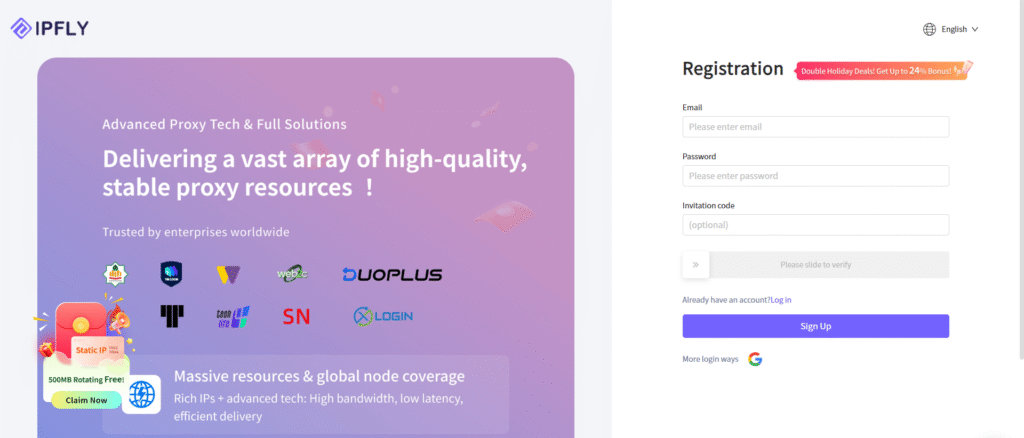
Step One: Register an Account
Begin at the IPFLY homepage and create an account.
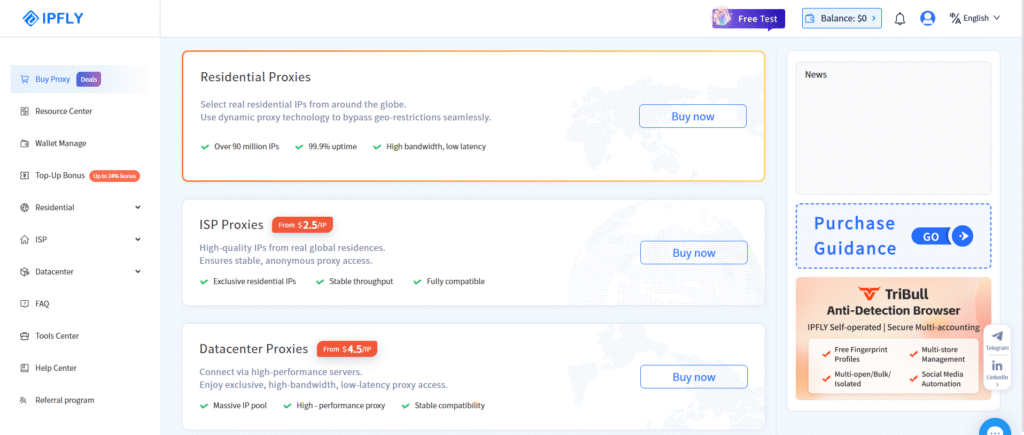
Select the type of IP you need based on your requirements.
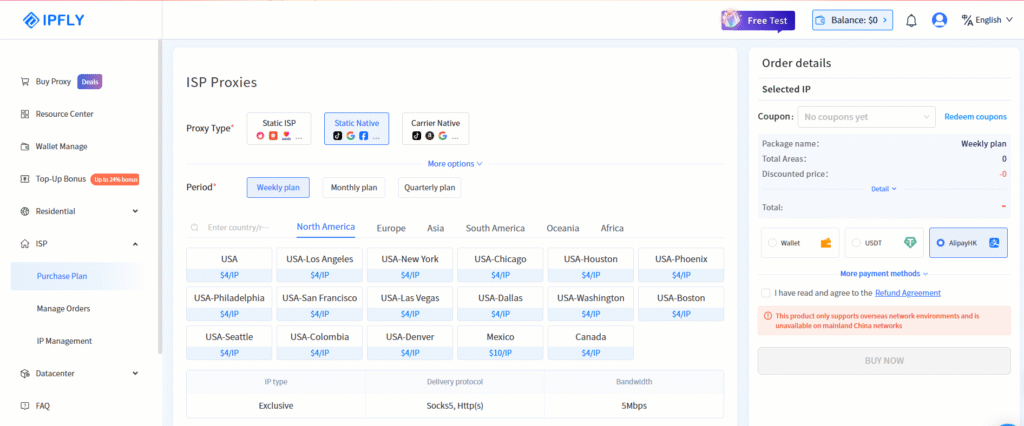
Step Three: Configure the Plan Parameters
Select the IP address you need based on your destination country.Pay the order amount to receive it.
Step Four: Complete the Purchase and Retrieve Credentials
After completing checkout, the purchased proxy credentials appear in the platform’s IP management area. For dynamic residential proxies, credentials are generated through the account authentication extraction interface. The platform provides the proxy host, port, username, and password as a connected set of parameters.
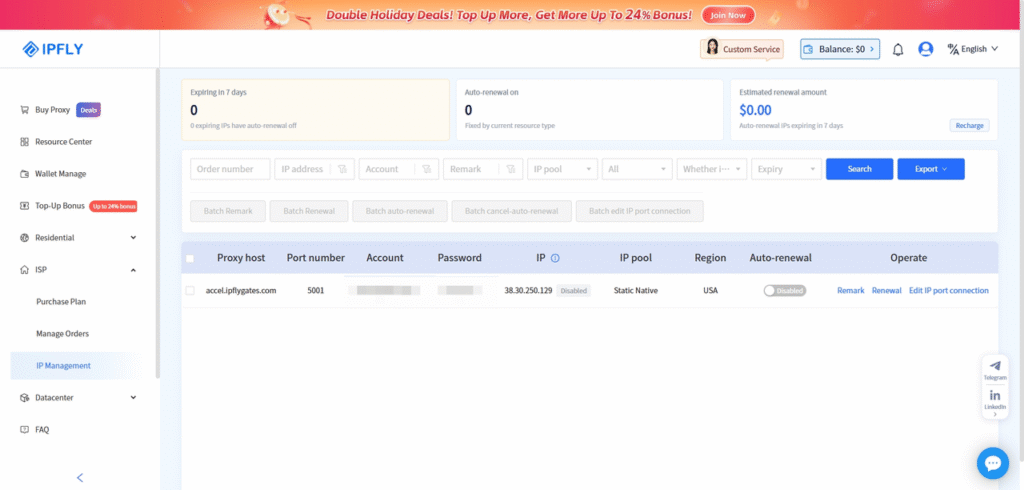
Step five: Integrate with Your Application
The extracted credentials are inserted into the target application’s proxy configuration. For browser-based workflows, the host, port, username, and password are entered into the browser’s proxy settings or a browser profile manager. For programmatic access, the same parameters are passed to the HTTP client library. IPFLY’s platform supports HTTP, HTTPS, and SOCKS5 protocols, with API-based rotation control for workflows that require dynamic IP switching.
Configuring Rotation Correctly After Purchase
Matching Rotation Mode to Workflow Type
The single most consequential post-purchase decision is rotation mode selection. Independent, stateless requests benefit from per-request rotation: each request exits through a different residential IP, distributing load across the pool and preventing any single address from accumulating a suspicious request pattern. Sequential workflows—login, navigation, form submission, checkout—require sticky sessions that hold one IP address for the duration of the sequence.
Session Duration and Request Distribution
Sticky session duration should be set to the minimum time required to complete the workflow. A session that persists longer than necessary holds an IP address out of rotation and increases the risk of overloading that address. After the workflow completes, the session should expire and the IP should return to the pool. This keeps the effective pool size large and the per-IP request rate within human patterns.
Geographic Signal Alignment
When targeting a specific country or city, the application layer must be configured to match. Language headers should correspond to the target locale. Browser timezone settings should reflect the IP address’s geographic location. Currency and region parameters should align with the target market. A residential IP in one location paired with application settings from another location creates the exact contradiction that anti-bot systems are trained to detect.
Summary: Buy With Verification, Configure With Discipline
Buying residential proxies is not a transaction that ends at checkout. The purchase delivers access to a pool of IP addresses; whether those addresses produce usable data depends on the quality of the pool and the discipline of the configuration. The pitfalls that cause first-time purchases to fail fall into two categories: acquisition errors, where the buyer pays residential prices for non-residential or contaminated IPs, and configuration errors, where the buyer routes traffic through good IPs in patterns that trigger detection regardless of IP quality.
The verification steps that prevent acquisition errors are ASN checking, blacklist screening, and pool reuse assessment. The configuration disciplines that prevent detection are correct rotation mode selection, session duration control, and geographic signal alignment. IPFLY’s residential proxy platform provides the pool diversity, city-level targeting, and session management controls required to apply these disciplines, with a purchase and extraction workflow that moves from account registration to tested proxy credentials without unnecessary steps.
Start Your Residential Proxy Setup with IPFLY
If you are ready to move from reading about residential proxies to configuring a working setup, IPFLY’s platform provides the infrastructure and the controls. The registration process takes minutes, the credential extraction interface generates connection parameters immediately after purchase, and the platform’s rotation and session settings allow you to match IP behavior to your actual workflow rather than adapting your workflow to the proxy.
Create your IPFLY account → and proceed to the Dynamic Residential Proxies page for rotation-ready pools with per-request and sticky session control. For workflows that require a dedicated, persistent ISP-registered address, explore Static Residential Proxies for unlimited traffic on a fixed IP. If your operations prioritize speed and concurrency on targets that do not enforce strict residential verification, Datacenter Proxies provide low-latency performance at scale.