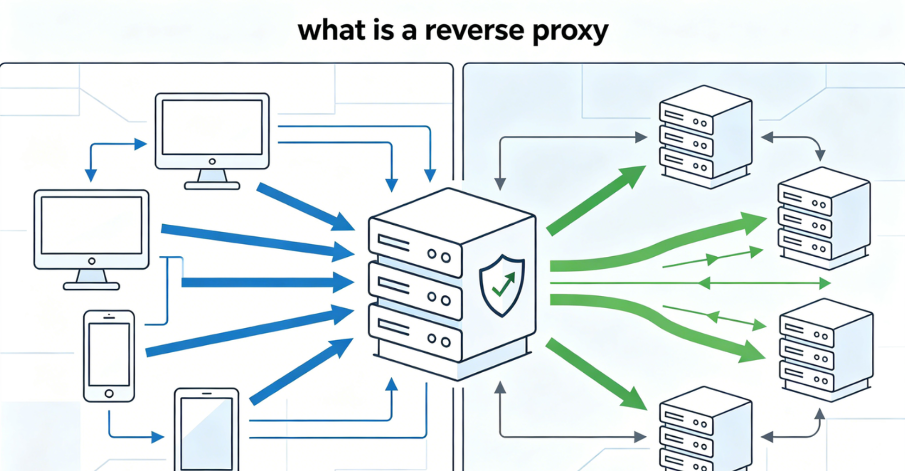
Imagine a busy reception desk at a large corporate office. Visitors arrive, state their business, and the receptionist directs them to the appropriate department or person. The visitors never interact directly with the employees; the receptionist handles everything on the front end, managing traffic, ensuring security, and keeping things running smoothly.
That’s essentially what a reverse proxy does for web servers.
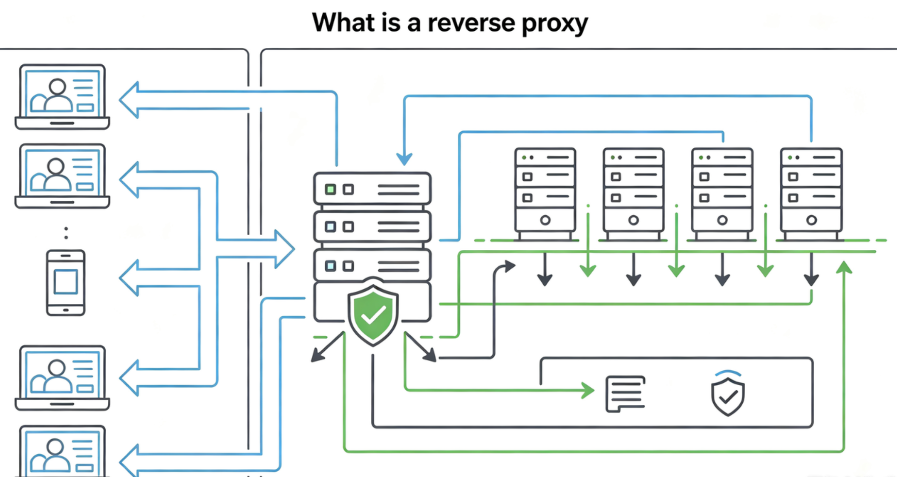
A reverse HTTP proxy is a type of proxy server that sits between clients (such as web browsers) and backend servers. Unlike a forward proxy, which represents clients to the internet, a reverse proxy represents servers to clients. When a user visits a website that uses a reverse proxy, their request first goes to the proxy server. The proxy then evaluates the request and forwards it to the appropriate backend server based on predefined rules. The server processes the request, sends the response back to the reverse proxy, and the proxy forwards it to the client. From the client’s perspective, the reverse proxy is the server.
This seemingly simple intermediary role unlocks powerful capabilities: load balancing, caching, SSL termination, enhanced security, and seamless scalability.

Reverse Proxy vs. Forward Proxy: Understanding the Difference
Before diving deeper into reverse proxies, it helps to understand the distinction between a reverse proxy and a forward proxy.
A forward proxy sits between client devices and the internet. When a client makes a request to a website, the request is first sent to the forward proxy, which then forwards it to the web server on behalf of the client. Individuals often use forward proxies to bypass content filters, access geo-restricted content, or browse anonymously. In essence, a forward proxy hides the client.
A reverse proxy, on the other hand, hides the server. It sits between client devices and web servers. Clients connect to the reverse proxy, unaware that there are multiple backend servers handling their requests. Reverse proxies are typically used by web applications to improve performance, increase security, and provide scalability.
| Feature | Forward Proxy | Reverse Proxy |
| Who It Represents | The client | The server |
| Visibility | Hides the client’s identity | Hides the server’s identity |
| Primary Users | Individuals | Web applications and websites |
| Common Uses | Bypassing restrictions, anonymity | Load balancing, caching, security |
How a Reverse Proxy Works
The mechanics of a reverse proxy are straightforward yet powerful. Here is the step-by-step flow:
- Client Request: A user’s browser sends a request to a website (e.g.,
https://www.example.com). Unbeknownst to the user, the request is actually directed to a reverse proxy server that sits in front of the backend web servers. - Request Interception: The reverse proxy intercepts the incoming request.
- Evaluation and Routing: The reverse proxy evaluates the request based on predefined rules. These rules can include load balancing algorithms, URL path routing, server health checks, or request type.
- Forwarding to Backend: The proxy forwards the request to the appropriate backend server.
- Response Processing: The backend server processes the request and sends the response back to the reverse proxy.
- Response to Client: The reverse proxy evaluates the response (if needed) and forwards it back to the client.
This flow happens in milliseconds, enabling websites to handle massive traffic volumes while maintaining performance and security.
Key Benefits of Using a Reverse Proxy
Reverse proxies offer a range of benefits that make them indispensable for modern web architecture.
1. Load Balancing
One of the most significant advantages of a reverse proxy is load balancing. By distributing incoming traffic across multiple backend servers, a reverse proxy ensures that no single server becomes overwhelmed. This improves performance, prevents downtime, and allows applications to scale horizontally.
Load balancers can also perform health checks on backend servers, automatically removing any servers that are not responding. This ensures that traffic is only routed to healthy servers.
2. Caching for Improved Performance
Reverse proxies can store cached copies of frequently accessed content. When a request comes in for cached content, the reverse proxy serves it directly without forwarding the request to the backend server. This reduces the load on the web server, speeds up response times, and improves the overall user experience.
Popular reverse proxy software like Nginx and Apache are widely used for caching.
3. SSL/TLS Termination
SSL/TLS termination is another critical function of reverse proxies. The proxy handles the encryption and decryption of SSL/TLS traffic, offloading this computationally intensive task from the backend servers. This improves the performance of the backend servers and simplifies certificate management.
4. Enhanced Security
Reverse proxies act as a buffer between clients and web servers, protecting the server from malicious requests. They can filter incoming requests, block malicious traffic, and protect against DDoS attacks. By hiding the identity and architecture of backend servers, reverse proxies also make it harder for attackers to target the infrastructure directly.
5. Scalability
Reverse proxies enable horizontal scaling by distributing traffic among multiple servers. This makes it possible to handle large amounts of traffic without overloading any single server. As traffic grows, you can simply add more backend servers, and the reverse proxy will route traffic accordingly.
6. Centralized Logging and Monitoring
Since all traffic passes through the reverse proxy, it provides a centralized point for logging, monitoring, and analytics. This makes it easier to track traffic patterns, identify issues, and gain insights into user behavior.
Popular Reverse Proxy Software
Several open-source and commercial reverse proxy solutions are widely used in production environments.
Nginx
Nginx is a high-performance, open-source reverse proxy server that is widely used for load balancing and caching. It is known for its event-driven architecture, which allows it to handle a large number of concurrent connections with low resource consumption. Nginx is the reverse proxy of choice for many high-traffic websites, including Reddit.
Apache HTTP Server
Apache is another open-source reverse proxy server that is commonly used for load balancing and caching. While not as lightweight as Nginx, Apache is highly configurable and widely supported.
HAProxy
HAProxy is a high-performance reverse proxy and load balancer that is popular for its scalability and reliability. It is often used in high-traffic environments where performance and uptime are critical. Airbnb uses HAProxy as its reverse proxy server to handle high volumes of traffic during peak booking periods.
Custom Solutions
Some companies build custom reverse proxy solutions tailored to their specific needs. Netflix, for example, uses a custom-built reverse proxy and load balancer called Zuul, which allows it to manage and route API requests for its streaming service.
Common Use Cases and Real-World Applications
Reverse proxies are used in a wide variety of applications to improve performance, scalability, and security.
Content Delivery Networks (CDNs)
CDNs use reverse proxies to cache and serve content to users from servers located closer to them, improving performance and reducing latency. When you access a website that uses a CDN, your request is routed to the nearest edge server, which acts as a reverse proxy for the origin server.
E-Commerce Websites
E-commerce websites use reverse proxies to handle high volumes of traffic during peak shopping periods, improving website performance and reliability. The reverse proxy distributes traffic across multiple servers, ensuring that the site remains responsive even during traffic spikes.
Clear Step-by-Step Proxy IP Tutorials
Master proxy setup, integration and performance optimization quickly with IPFLY guides
API Gateways
Reverse proxies are commonly used as API gateways to manage and secure API requests. The reverse proxy routes requests to the appropriate backend service based on request type, user authentication, or other criteria. This simplifies the architecture and provides a single entry point for all API traffic.
Microservices Architectures
In microservices architectures, reverse proxies are often used as the entry point for routing requests to different services. They handle service discovery, load balancing, and authentication, making it easier to manage complex distributed systems.
How to Set Up a Reverse Proxy
Setting up a reverse proxy is a relatively straightforward process. Here are the general steps you can follow:
Step 1: Choose a Reverse Proxy Server
Select a reverse proxy server that meets your needs. Popular options include Nginx, Apache, and HAProxy. Install it on your server following the official documentation.
Step 2: Configure the Reverse Proxy
Configure the reverse proxy server to intercept requests and forward them to the appropriate backend server. This involves setting up rules and algorithms to determine which backend server to forward requests to based on factors like load balancing, server health, and request type.
Step 3: Test the Reverse Proxy
After configuring the reverse proxy, test it to ensure that it is working correctly. Send requests to the reverse proxy and verify that they are being forwarded to the backend server as intended.
Step 4: Implement Best Practices
- Use SSL/TLS encryption: Secure the communication between the client and the reverse proxy server, as well as between the reverse proxy and the backend server.
- Use caching: Cache frequently accessed content to improve performance.
- Monitor your reverse proxy: Regularly monitor your reverse proxy server to ensure it performs as expected and identify any potential issues before they become critical.
Common Pitfalls to Avoid
Configuration Errors: Misconfiguration is one of the most common pitfalls when setting up a reverse proxy. Carefully review your configuration settings and test thoroughly before deploying in a production environment.
Inadequate Security: Reverse proxies can help improve security, but only if they are configured correctly. Ensure your reverse proxy is configured with the latest security updates and follow best practices for securing web servers.
How IPFLY Complements Reverse Proxy Infrastructure
While reverse proxies handle traffic routing and server-side optimization, the quality of the underlying network infrastructure—particularly the IP addresses used for backend services and outbound communications—is equally important. IPFLY provides the clean, reliable IP infrastructure that complements reverse proxy deployments.
IPFLY Static Residential Proxies (ISP Proxies)
For businesses that need to manage multiple backend services, authenticate users, or access geo-restricted APIs, IPFLY’s static residential proxies provide dedicated, ISP-registered IP addresses that remain fixed over time. Each IP is used exclusively by a single user, ensuring a clean reputation and consistent identity.
Key advantages for reverse proxy environments:
- ISP-registered authenticity – Each IP is formally assigned by an Internet Service Provider, appearing as a genuine residential connection
- 100% dedicated IP – Exclusive use with no sharing; no risk of inheriting poor reputation from other users
- Stable and consistent – The IP remains unchanged, providing consistent identity for backend services, API integrations, and authentication workflows
- Geographic targeting – Choose IPs from specific countries and cities to match regional requirements
- Full protocol support – HTTP, HTTPS, and SOCKS5 compatibility
Static residential proxies are ideal for businesses that require consistent IP identity for API gateways, backend authentication, or region-specific content delivery.
👉 Explore IPFLY Static Residential Proxies
IPFLY Dynamic Residential Proxies
For applications that require geographic flexibility or IP rotation—such as web scraping, data collection, or ad verification—IPFLY’s dynamic residential proxies offer real residential IPs with automatic rotation capabilities from a pool covering 190+ countries.
Key advantages:
- Real residential IPs – From a pool of residential addresses, ensuring high availability and low detection risk
- Automatic rotation – Distribute access across diverse IPs to avoid pattern detection
- Sticky session support – Maintain a consistent IP for hours or days when needed
- Geographic flexibility – Access content from virtually any region
- Full protocol support – HTTP, HTTPS, and SOCKS5
- High success rate – Over 99% connection stability
Dynamic residential proxies are ideal for data collection pipelines that feed into backend services behind a reverse proxy.
👉 Explore IPFLY Dynamic Residential Proxies
IPFLY Datacenter Proxies
For speed-critical operations where residential authenticity is less important, IPFLY’s dedicated datacenter proxies offer high-performance connectivity.
👉 Explore IPFLY Datacenter Proxies
The Future of Reverse Proxies
As more businesses and websites look to improve their online performance, security, and scalability, the adoption of reverse proxies continues to grow. With the rise of microservices, cloud-native architectures, and edge computing, reverse proxies will play an increasingly central role in modern web infrastructure.
Whether you are managing a small website or a large-scale enterprise application, a reverse proxy is an essential tool for delivering fast, secure, and reliable web experiences.
The Power of the Reverse Proxy
A reverse proxy is a powerful intermediary that sits between clients and backend servers, managing traffic, enhancing security, and improving performance. Unlike a forward proxy, which hides the client, a reverse proxy hides the server.
Key takeaways:
- A reverse proxy represents the server to clients – Clients connect to the reverse proxy, unaware of the backend servers
- Load balancing distributes traffic – Ensures no single server is overwhelmed
- Caching improves performance – Reduces load on backend servers and speeds up response times
- SSL/TLS termination offloads encryption – Improves backend server performance
- Enhanced security protects backend servers – Filters malicious traffic and hides server architecture
- Scalability enables horizontal growth – Add more servers as traffic grows
- Popular options include Nginx, Apache, and HAProxy – Each with different strengths
Whether you are load balancing traffic across multiple servers, caching content for faster delivery, or securing your backend infrastructure, a reverse proxy is an indispensable component of modern web architecture.
Build a Complete Infrastructure with IPFLY
Reverse proxies handle traffic routing and server-side optimization. IPFLY provides the clean, reliable IP infrastructure that complements your reverse proxy setup—whether for API authentication, data collection, or regional content delivery.
IPFLY offers flexible proxy solutions for every use case:
- Static Residential Proxies – Dedicated, ISP-registered IPs with consistent identity. Perfect for API authentication, backend services, and long-term operations.
- Dynamic Residential Proxies – Real residential IPs from 190+ countries with automatic rotation. Ideal for data collection, ad verification, and geographic flexibility.
- Datacenter Proxies – High-performance IPs for speed-critical operations.
Get started today: Register for an IPFLY account and explore the full product lineup on the IPFLY homepage. Build a complete, reliable infrastructure that powers your web applications from the front end to the back end.