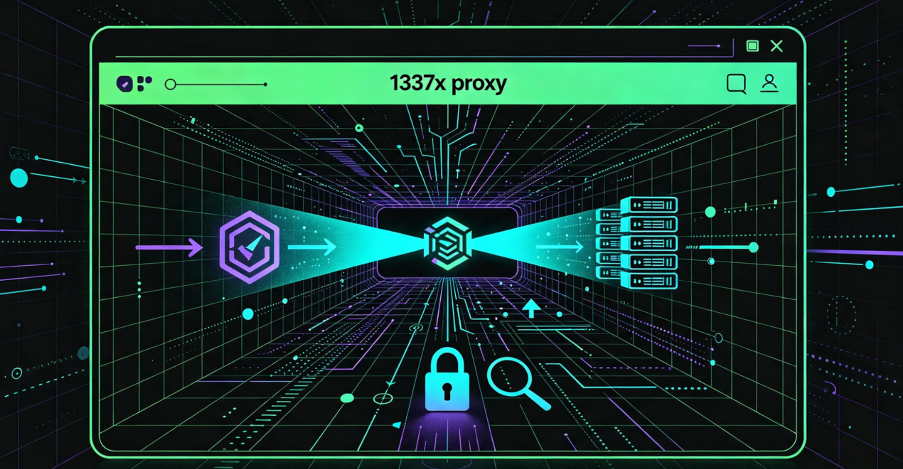
1337x remains one of the most active torrent index sites in 2026, with a massive user base across many regions. However, entering 2026, many users face a recurring and increasingly frustrating problem: 1337x is not just “occasionally unreachable” but “frequently inaccessible.” Pages are blocked, DNS is hijacked, pages load extremely slowly, and sometimes a site opens for a few days before failing again.
If you encounter any of the following while accessing 1337x, the issue is usually not your personal network:
- Browser shows “This site can’t be reached”
- Pages load for a long time but content does not appear
- Home page opens, but torrent pages fail to load
- Different networks produce inconsistent results
This guide explains why 1337x faces frequent access issues in 2026, lists working mirror and proxy options, and—most importantly—shows you how to establish a stable, long-term access solution that doesn’t require constantly hunting for new links.
Part 1: Why Is 1337x Often Unreachable in 2026?
The main reasons fall into three categories:
1. ISP-Level Site Blocking
Many ISPs block the 1337x main domain via DNS or IP-level restrictions, intercepting requests at the network layer.In 2026, Internet Service Providers employ sophisticated filtering techniques to restrict access, driven by copyright enforcement, governmental mandates, and ISP traffic management.
When you type 1337x.to into your browser, your ISP’s DNS server may return a block page instead of the actual IP address. In some cases, the ISP may simply drop the connection entirely, resulting in a timeout error. This is why even when the site is technically online, you may not be able to reach it.
2. Main Domain Under Monitoring
1337x’s main site and some older mirror domains are flagged long-term, making access prone to detection and restriction.When a primary 1337x domain is seized or blocked, the community deploys mirrors and proxies to bypass the restrictions, remaining operational until those secondary nodes are eventually identified and filtered.
The platform is listed in multiple categories including Torrents, P2P File Sharing, and Adult/Pornography, which triggers automatic filtering on many networks. This constant cat-and-mouse game means that even when you find a working link today, it may be blocked tomorrow.
3. Low Reputation of Access IP
Many users rely on public proxies, causing IP blocks. Even normal access can be flagged due to IP reputation.In risk control systems, heavily shared free proxies and datacenter IPs are themselves considered high-risk sources.
When your IP address has been used by others for torrenting, or if it comes from a datacenter range that is easily identifiable as proxy traffic, 1337x’s security systems will treat your connection with suspicion. This is why many users turn to 1337x proxies or mirror sites.

Part 2: 1337x Proxy and Mirror List (2026 Working Links)
The following options are suitable for temporary or testing purposes but are not ideal for long-term use.
Verified 1337x Mirrors and Proxies (2026)
Based on multiple sources, the following domains were accessible at the time of writing:
| URL | Type |
| https://1337x.unblockninja.com/ | Proxy |
| https://1337x.proxyninja.net/ | Proxy |
| https://1337x.proxyninja.org/ | Proxy |
| https://1337x.torrentsbay.org/ | Mirror |
| https://1337x.torrentbay.st/ | Mirror |
| https://www.1377x.is/ | Mirror |
| https://www.1337x.pro/ | Mirror |
| https://www.1337x.tw/ | Mirror |
| https://1337x.pages.dev/ | Proxy |
| https://1337x-official.com/ | Mirror |
| https://1337x.st/ | Mirror |
| https://1337x.to/ | Mirror |
| https://1337x.se/ | Mirror |
| https://x1337x.ws/ | Mirror |
| https://1337x.unblockall.org/ | Proxy |
Note: Availability can change frequently depending on region and enforcement policies. Always verify a domain before using it.
Common 1337x Mirror Sites – What They Are and Why They Fail
These sites copy the original content under a different domain, offering immediate access with low entry barriers, but short lifespans and high risk of blocking.
How mirror sites work:
- Use alternative top-level domains (e.g., .to, .ws, .st)
- Newly registered domains may be accessible briefly
- Content may sync with the main site immediately or with delay
The challenges of mirror sites:
- Uncertain uptime
- Frequent fake or phishing sites
- Confusing search engine rankings, hard for newcomers to verify
The mirror vs. proxy distinction: Mirrors just use a different domain to access the same content and can be blocked once detected. Proxies route requests through another server, making IP reputation the key factor.In 2026, mirrors are short-term solutions; proxies are better for long-term use.
Free Web Proxy Access – Why It’s a Trap
Free web proxies route requests through a proxy server to bypass regional blocks. Some web proxies allow entering 1337x domains directly in the address bar.
Limitations of free web proxies:
- Very slow speed
- Incomplete HTTPS support
- Requests can be tampered with
- High IP reuse and easy to block
Free web proxies are recommended only for testing if the site can open, not for actual use.
Part 3: Why Free 1337x Proxies and Mirrors Fail
Most free or public IPs have high reuse. Multiple users accessing similar sites can easily get the IP blocked.
Free proxy sites rely on heavily shared IP pools. Once too many people use the same address, 1337x starts flagging it, leading to CAPTCHA loops, slow loading, and blocked sessions. A proxy that works today may stop working a week later.
Failure is usually due to the IP being flagged as high-risk, not the site itself.
The Datacenter IP Detection Problem
Datacenter IPs—the kind used by most free proxy services—originate from cloud servers and hosting providers. They are easily identifiable through IP-to-ASN lookups. When 1337x sees a datacenter IP, it knows the traffic is coming from non-residential infrastructure. The result? Immediate blocking.
Many proxies use datacenter IPs, which are highly recognized and often blocked.
Security Risks of Free Tools
Free proxy sites can also expose users to:
- Malware and malicious scripts – Many torrent proxy sites contain malicious scripts that can inject malware, steal login credentials, or use your device for cryptocurrency mining
- Data logging and privacy exposure – Free proxy operators can see every unencrypted HTTP request that passes through
- Fake clones and phishing sites – Domains that mimic the look of 1337x while pushing aggressive ads, browser notification prompts, and fake download buttons
- Unreliable performance – Free proxies are typically overloaded with users, resulting in slow speeds and frequent disconnections
Part 4: Why Residential Proxies Are the Only Reliable Long-Term Solution
The problem is not whether you use a proxy but what type. In 2026, the following almost guarantees IP or account blocking:
- Using heavily shared free proxies
- Datacenter IPs frequently accessing the same type of site
- Same IP accessed repeatedly in short periods
- IP history concentrated on torrent or mirror sites
The Residential Proxy Advantage
High-quality residential proxies provide IPs that come from real home networks.This means:
- Behavior resembles normal users, offering long-term stability
- Less likely to be blocked by ISPs or sites
- Flexible rotation per region or request frequency, reducing detection risk
Why Residential Proxies Work
A residential proxy uses an IP address assigned by an Internet Service Provider (ISP) to a real household. To any website, you appear as an ordinary home user—not a datacenter or automated script. This is the fundamental difference that makes residential proxies far less likely to trigger blocks.
High-quality residential proxies mimic home networks, appear more natural, and have a lower block probability.
For sites like 1337x with strict restrictions, residential proxies are more time-efficient and controllable than constantly chasing new mirrors.
The Problem with Datacenter Proxies
Datacenter proxies—the kind used by most free proxy services—originate from cloud servers and hosting providers. They are easily identifiable through IP-to-ASN lookups. When 1337x sees a datacenter IP, it knows the traffic is coming from non-residential infrastructure. The result is immediate blocking.
What to Look for in a Residential Proxy
When choosing a residential proxy for 1337x access, consider:
- ISP-registered authenticity – IPs should be formally assigned by ISPs
- Dedicated, non-shared IPs – Exclusive use prevents inheriting poor reputation from other users
- Stable and consistent – IPs that remain unchanged provide consistent identity
- Geographic targeting – Choose IPs from specific countries to match your needs
- Full protocol support – HTTP, HTTPS, and SOCKS5 compatibility
Part 5: How IPFLY Powers Reliable 1337x Access
IPFLY provides the residential proxy infrastructure that enables consistent, uninterrupted access to 1337x and similar platforms.
IPFLY Static Residential Proxies (ISP Proxies)
IPFLY’s static residential proxies are 100% dedicated, ISP-registered IP addresses that remain fixed over time. Each IP is used exclusively by a single user, ensuring a clean reputation and preventing association with other users’ activity.
Key advantages for 1337x access:
- ISP-registered authenticity – Each IP is formally assigned by an Internet Service Provider and appears as a residential broadband connection. To 1337x, you look like an ordinary household user, not a server in a data center.
- 100% dedicated IP – Exclusive use with no sharing; no risk of inheriting poor reputation from other users.
- Stable and consistent – The IP remains unchanged, providing consistent identity for ongoing access. This stability is critical for avoiding the detection that comes with frequent IP changes.
- Geographic targeting – Choose IPs from specific countries and cities to match your needs.
- Full protocol support – HTTP, HTTPS, and SOCKS5 compatibility.
- Low latency – Delays as low as 50ms for fast browsing.
- 99.9% uptime – Enterprise-grade reliability for uninterrupted access.
Static residential proxies are ideal for users who need consistent, long-term access to 1337x without interruptions or detection.
👉 Explore IPFLY Static Residential Proxies
Clear Step-by-Step Proxy IP Tutorials
Master proxy setup, integration and performance optimization quickly with IPFLY guides
IPFLY Dynamic Residential Proxies
For users who need geographic flexibility or IP rotation, IPFLY’s dynamic residential proxies offer real residential IPs with automatic rotation capabilities from a pool of over 90 million addresses covering 190+ countries.
Key advantages:
- Real residential IPs – From a pool of residential addresses, ensuring high availability and low detection risk
- Automatic rotation – Distribute access across diverse IPs to avoid pattern detection
- Sticky session support – Maintain a consistent IP for hours or days when needed
- Geographic flexibility – Access 1337x from virtually any region
- Full protocol support – HTTP, HTTPS, and SOCKS5
- High success rate – Over 99% connection stability
Dynamic residential proxies are ideal for users who need geographic diversity or who prefer to rotate IPs for additional privacy.
👉 Explore IPFLY Dynamic Residential Proxies
IPFLY Datacenter Proxies
For speed-critical operations where residential authenticity is less important, IPFLY’s dedicated datacenter proxies offer high-performance connectivity.
👉 Explore IPFLY Datacenter Proxies
How IPFLY Compares to Free Solutions
| Feature | Free Web Proxy / Mirror | IPFLY Residential Proxy |
| IP Type | Datacenter or shared | Real residential ISP IPs |
| Detection Risk | High – easily flagged | Low – authentic consumer traffic |
| IP Pool | Limited or shared | 90M+ dedicated residential IPs |
| Geographic Coverage | Limited | 190+ countries |
| Privacy | Unknown logging, ads | No logging, private browsing |
| Security | Malware and tracking risks | Secure, vetted infrastructure |
| Reliability | Unpredictable, frequently down | Consistent, long-term access |
| Session Stability | Breaks frequently | Stable, uninterrupted sessions |
Part 6: How to Set Up IPFLY for 1337x Access
Setting up IPFLY for 1337x access is straightforward:
- Obtain your IPFLY credentials from the IPFLY console
- Choose your proxy type:
- Static Residential for long-term, consistent access
- Dynamic Residential for geographic flexibility
- Configure your browser or system with the IPFLY proxy settings
- Verify your new IP address matches your target region
- Access 1337x through your configured connection
- Enjoy stable, uninterrupted access
Browser Configuration (Quickest)
- Obtain your IPFLY proxy credentials from the IPFLY console
- Configure your browser’s proxy settings with the IPFLY proxy address and port
- Browse 1337x as usual—your traffic is now routed through the residential proxy
System-Wide Proxy Configuration
Windows:
- Open Settings → Network & Internet → Proxy
- Under “Manual proxy setup,” enable “Use a proxy server”
- Enter the IPFLY proxy address and port
- Save and restart your applications
macOS:
- Open System Preferences → Network
- Select your active connection and click Advanced
- Go to the Proxies tab
- Configure Web Proxy (HTTP) or SOCKS Proxy
- Enter the IPFLY proxy details and apply
Part 7: Best Practices for Accessing 1337x Safely
1. Use a Residential Proxy, Not a Free Proxy
Free proxies are insecure, unreliable, and often operated by malicious actors. Residential proxies from trusted providers like IPFLY provide the security and reliability that free proxies cannot match.
2. Verify the Domain
Before accessing any 1337x proxy or mirror, verify that the domain is legitimate and not a phishing site. Be cautious of domains with unusual spellings or excessive ads.
3. Avoid Entering Personal Information
1337x does not require you to log in or submit personal data. If a proxy asks for login or payment, leave immediately. It is likely a scam or phishing site.
4. Use an Ad Blocker
Many mirror sites have excessive ads that can lead to malicious redirects. Use a reputable ad blocker to reduce risk.
5. Maintain Geographic Consistency
Ensure your IP location matches your browser and system settings. Geographic inconsistencies can trigger additional scrutiny.
6. Use Encrypted Connections
Ensure your browsing is encrypted. HTTPS and SOCKS5 proxies provide better protection than unencrypted connections.
7. Consider Legal Alternatives
If the risks outweigh the benefits for you, consider legal alternatives like public domain content or legitimate streaming services.
Part 8: Frequently Asked Questions
Q1: What is the difference between 1337x Proxy and 1337x Mirror?
Mirrors just use a different domain to access the same content and can be blocked once detected. Proxies route requests through another server, making IP reputation the key factor.
Q2: Why do some 1337x proxies fail after a few uses?
Most free or public IPs have high reuse. Multiple users accessing similar sites can easily get the IP blocked. Failure is usually due to the IP being flagged as high-risk, not the site itself.
Q3: What’s the difference between using a proxy for 1337x?
Many proxies use datacenter IPs, which are highly recognized and often blocked. High-quality residential proxies mimic home networks, appear more natural, and have a lower block probability. This explains why proxies may sometimes be less stable than proxies.
Q4: Will using a 1337x proxy expose my real IP?
It depends on the proxy quality. Low-quality web proxies may have incomplete HTTPS support, tampered requests, or logging. Reliable proxy services with proper encryption reduce the risk of IP exposure.
Q5: How often should I change my proxy IP for 1337x?
The frequency depends on your usage pattern. For regular access, a static residential IP provides consistent identity. For high-volume operations, dynamic rotation with sticky sessions offers the best balance of stability and anonymity.
Stop Chasing Mirrors – Build a Stable Access Solution
1337x remains one of the most popular torrent indexes in 2026, but accessing it has become increasingly difficult. ISP blocks, domain seizures, and IP reputation issues have created a perpetual cycle where users constantly hunt for working mirrors and proxies—only to have them fail days or weeks later.
Free mirrors and web proxies offer temporary relief, but they come with significant trade-offs: uncertain uptime, slow speeds, security risks, and frequent blocking. The fundamental problem is not finding a working link—it’s the reputation of your access IP.
The solution is residential proxies. By routing your traffic through real, ISP-assigned residential IPs, you appear to 1337x as an ordinary home user—not a datacenter or automated script. This dramatically reduces the risk of blocking and provides the long-term stability that free tools cannot match.
Key takeaways:
- ISP blocks and domain monitoring make 1337x frequently inaccessible – The problem is not your network
- Free mirrors and web proxies are short-term fixes – They fail quickly due to detection and blocking
- Datacenter IPs are easily identified – They trigger immediate suspicion from 1337x’s security systems
- Residential proxies are the gold standard – They use real home IP addresses that are nearly impossible to block
- IPFLY residential proxies provide secure, undetectable access – With real consumer IPs, stable sessions, and no logging
- Build a systematic solution, not a trial-and-error approach – Stop chasing mirrors and invest in reliable infrastructure
In short: mirror sites solve “Can I open it once?” while high-quality proxies solve “Can I use it reliably long-term?” For temporary access, mirrors or web proxies are acceptable. For frequent or long-term use, stable residential proxies are essential.
If you’ve struggled with 1337x’s repeated failures, it’s time to upgrade from trial-and-error to a systematic solution.

Access 1337x Reliably with IPFLY
Stop wasting time hunting for working 1337x mirrors that fail within days. Build a stable, long-term access solution with clean, residential IPs that appear as genuine consumer traffic.
IPFLY offers flexible residential proxy solutions for every use case:
- Static Residential Proxies – 100% dedicated, ISP-registered IPs with fixed identity. Perfect for consistent, uninterrupted 1337x access.
- Dynamic Residential Proxies – Real residential IPs from 190+ countries with automatic rotation. Ideal for geographic flexibility and high-volume access.
- Datacenter Proxies – High-performance IPs for speed-critical operations.
Get started today: Register for an IPFLY account and explore the full product lineup on the IPFLY homepage. Access 1337x with confidence, knowing your connection is stable, private, and secure.