

What It Is and Why It Matters for APIs
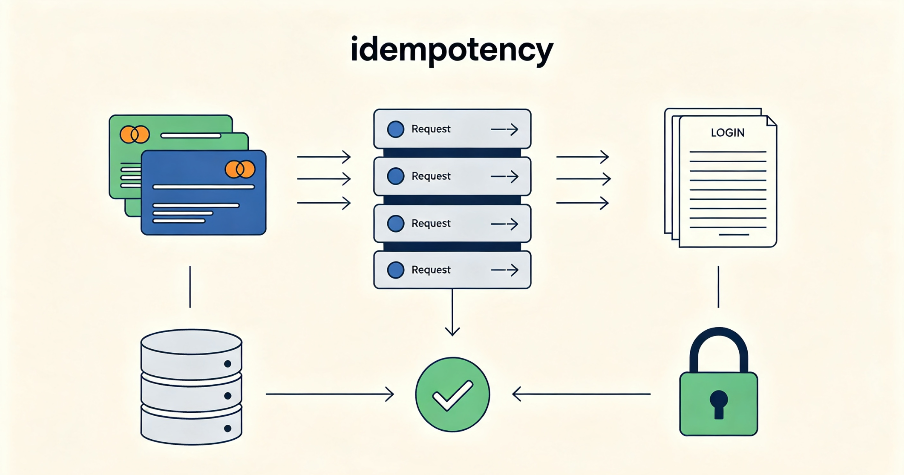
Imagine you are transferring money from your bank account to a friend’s. You click “Send.” The page spins. You are not sure if it went through, so you click again. Then again. A few minutes later, you check your account and realize you have sent the same amount three times.
This is a classic example of what happens when an operation is not idempotent—repeating it produces different, unintended results.
Now imagine the opposite: you click “Send” multiple times, but only one transfer goes through. The system recognizes that the second and third clicks are duplicates and safely ignores them. This is idempotency in action.
This guide explains everything you need to know about idempotency in 2026—what it is, why it matters, how it works in APIs and distributed systems, and how to design idempotent operations that make your applications more reliable and predictable.
What Is Idempotency?
Idempotency is the property of certain operations where performing the same operation multiple times produces the same result as performing it once.
In simpler terms, an idempotent operation is one you can run over and over without changing the outcome beyond the first execution. The second, third, and hundredth attempts have no additional effect.
This concept is crucial in ensuring that repeated requests or operations do not cause unintended side effects or changes, making systems more reliable and predictable.
Idempotency in Everyday Terms
Think of a vending machine. If you press the button for a snack once, it dispenses one snack. If you press it again, it dispenses another. That is not idempotent—repeating the action changes the result.
Now think of a light switch. If you flip it to “on,” the light turns on. If you flip it to “on” again, the light stays on. Flipping it to “on” multiple times does not change the result beyond the first flip. That is idempotent—the operation can be repeated without changing the outcome.
Why Idempotency Matters
Idempotency is a foundational concept in computing, particularly in web services, API design, and distributed systems. Here is why it matters.
Reliability
Ensuring that repeated operations do not produce unexpected outcomes is essential for fault-tolerant systems. When networks fail, clients time out, or servers crash, retries are inevitable. Idempotency ensures that these retries do not corrupt data or produce unintended side effects.
Predictability
Idempotency makes systems more predictable, as repeated actions yield the same result, simplifying error handling. Developers can confidently retry failed operations without worrying about duplicate effects.
Fault Tolerance
In distributed systems, failures are normal. Idempotency enables safe retries, making systems more resilient to network issues and temporary outages.
Simplified Error Handling
When operations are idempotent, error handling becomes simpler. Instead of implementing complex logic to detect and prevent duplicates, you can safely retry operations until they succeed.
Idempotency vs. Related Concepts
To fully understand idempotency, it helps to distinguish it from related terms.
Idempotency vs. Idempotent Method
Idempotency is the property itself. An idempotent method is a specific operation that exhibits this property, meaning it can be repeated without changing the result.
For example, idempotency is the concept; an HTTP PUT request is an idempotent method.
Idempotency vs. Retries
While retries involve repeating an operation to handle failures, idempotency ensures that the result remains consistent and unchanged regardless of how many times the operation is retried.
Retries are a strategy. Idempotency is a property that makes retries safe.
Idempotency vs. Safety
In HTTP, safe methods (like GET and HEAD) are idempotent by definition—they do not change server state. However, not all idempotent methods are safe. PUT and DELETE are idempotent but can change server state (they modify or remove resources).
Idempotency in HTTP Methods
HTTP methods have specific idempotency characteristics that are important for API design.
Idempotent HTTP Methods
GET – Idempotent and safe. Fetching the same resource multiple times does not change it.
HEAD – Idempotent and safe. Same as GET but returns only headers.
PUT – Idempotent. Replacing a resource with the same data multiple times results in the same state. An HTTP PUT request to update a user’s profile is idempotent because sending the same request multiple times will not change the result beyond the first application. The user’s profile will be updated to the same state, regardless of how many times the update request is made.
DELETE – Idempotent. Deleting a resource once removes it; subsequent DELETE requests have no additional effect.
OPTIONS – Idempotent. Returns information about communication options.
TRACE – Idempotent. Echoes the received request.
Non-Idempotent HTTP Methods
POST – Not idempotent. Submitting the same form data multiple times can create multiple resources (e.g., duplicate orders or comments).
PATCH – Not inherently idempotent, though it can be implemented to be idempotent in some cases. Partial updates can produce different results if applied multiple times.
Idempotency in Distributed Systems
In distributed systems, idempotency becomes even more critical. Network failures, timeouts, and retries are common, and without idempotency, these can lead to data corruption, duplicate transactions, and inconsistent state.
The Retry Problem
When a client sends a request and does not receive a response—due to a network timeout, server crash, or other failure—it may retry the request. If the original request succeeded but the response was lost, the retry could cause a duplicate operation. Idempotency ensures that this retry does not produce unintended side effects.
Idempotency Keys
A common pattern for achieving idempotency in distributed systems is the idempotency key. The client generates a unique key for each operation and sends it with the request. The server stores the key and the result of the operation. If the same key is received again, the server returns the stored result without re-executing the operation.
This pattern is widely used in payment processing, order management, and other systems where duplicate operations would be costly.
Real-World Examples
Payment Processing – When you click “Pay Now,” the payment system should process the charge only once, even if you click multiple times or the network retries the request.
Order Management – Submitting an order multiple times should not create duplicate orders.
Inventory Management – Decreasing inventory levels should happen exactly once, not multiple times.
Pros and Cons of Idempotency
Like any design pattern, idempotency has trade-offs.
Pros
Reliability – Ensures that repeated operations do not produce unexpected outcomes, which is essential for fault-tolerant systems.
Predictability – Makes systems more predictable, as repeated actions yield the same result, simplifying error handling.
Ease of Implementation – Reduces the need for complex checks to prevent duplicate operations, as idempotent operations inherently handle them.
Fault Tolerance – Enables safe retries, making systems more resilient to failures.
Cons
Implementation Complexity – Designing operations to be idempotent can add complexity, especially in systems where actions typically produce side effects.
Overhead – Ensuring idempotency might require additional logic or checks, potentially introducing performance overhead.
Limited Use Cases – Not all operations can or should be idempotent, particularly those that naturally involve side effects, like financial transactions.
Full-Industry Proxy IP Application Solutions
Power scalable growth for every cross-border business scenario with IPFLY’s reliable global proxy network
How to Design Idempotent Operations
Designing idempotent operations requires careful consideration of your system’s behavior and state management.
1. Use Idempotent HTTP Methods
When designing APIs, choose HTTP methods that are inherently idempotent when appropriate. Use PUT for updates and DELETE for deletions. Use POST only when the operation naturally produces side effects (like creating a new resource).
2. Implement Idempotency Keys
For non-idempotent operations (like POST requests), use idempotency keys. The client generates a unique key, and the server stores it along with the result. Subsequent requests with the same key return the stored result.
3. Make Operations State-Based
Design operations so that they are based on the current state rather than on previous actions. For example, a “set status to active” operation is idempotent because setting an already-active status to active has no additional effect.
4. Use Versioning or Timestamps
In distributed systems, versioning or timestamps can help ensure that operations are applied only once. For example, a “delete if version matches” operation ensures that a resource is deleted only if it has not been modified since the version was read.
5. Avoid Operations That Accumulate
Avoid operations that accumulate values (like “add to cart” or “increment counter”) unless you have mechanisms to prevent duplicates. These operations are inherently non-idempotent.
Common Idempotency Pitfalls and How to Avoid Them
Even experienced developers can make mistakes when designing idempotent systems. Here are common pitfalls and how to avoid them.
Pitfall 1: Assuming POST Is Never Idempotent
While POST is not inherently idempotent, you can make it idempotent using idempotency keys. Do not assume that all POST requests must be non-idempotent.
Pitfall 2: Forgetting to Store Idempotency Keys
If you use idempotency keys, you must store them along with the result of the operation. If you only check for duplicates but do not store the result, you cannot return the correct response on subsequent requests.
Pitfall 3: Not Handling Expired Idempotency Keys
Idempotency keys should have a limited lifetime. If a key is too old, the server should treat it as invalid and return an error.
Pitfall 4: Ignoring Distributed Systems Challenges
In distributed systems, ensuring idempotency across multiple services is challenging. Use distributed consensus protocols or centralized idempotency stores to maintain consistency.
Pitfall 5: Overcomplicating Simple Operations
Not every operation needs to be idempotent. For operations that are rarely retried or have low impact, the overhead of implementing idempotency may not be worth it.
How IPFLY Supports Idempotent API Design
Reliable API design depends on consistent, stable infrastructure. IPFLY provides the residential proxy infrastructure that enables developers to build and test idempotent systems with confidence.
Why Network Quality Matters for Idempotent Operations
Idempotent operations depend on reliable communication between clients and servers. If network connections are unstable, clients may retry requests unnecessarily, increasing the load on servers and complicating idempotency management.
How IPFLY Helps
IPFLY’s residential proxies provide clean, ISP-registered IP addresses that ensure stable, consistent connectivity for:
- API testing – Verifying idempotent behavior from different geographic locations
- Production deployments – Ensuring reliable communication between services
- Monitoring and troubleshooting – Diagnosing issues with idempotency implementations
IPFLY Static Residential Proxies offer dedicated, ISP-registered IP addresses that remain consistent over time—ideal for long-term API integrations.
IPFLY Dynamic Residential Proxies provide real residential IPs with automatic rotation, adding flexibility for testing and monitoring scenarios.
👉 Explore IPFLY Residential Proxies
Frequently Asked Questions
What is idempotency in simple terms?
Idempotency means that doing the same operation multiple times has the same effect as doing it once. If you press a button once or five times, the result is the same.
Why is idempotency important for APIs?
Idempotency ensures that repeated requests—due to network issues, retries, or user errors—do not cause unintended side effects, making APIs more reliable and predictable.
Is POST idempotent?
POST is not inherently idempotent. However, you can make POST operations idempotent using idempotency keys.
What is an idempotency key?
An idempotency key is a unique identifier that a client sends with a request. The server stores the key and the result of the operation. If the same key is received again, the server returns the stored result without re-executing the operation.
Is PUT idempotent?
Yes. PUT replaces a resource with the provided data. Sending the same PUT request multiple times results in the same resource state.
Is DELETE idempotent?
Yes. Deleting a resource once removes it; subsequent DELETE requests have no additional effect.
What is the difference between idempotency and safety?
Safe methods (like GET) do not change server state and are always idempotent. Idempotent methods (like PUT and DELETE) can change state but produce the same result when repeated.
The Power of Idempotency
Idempotency is a foundational concept in computing that enables reliable, predictable, and fault-tolerant systems. By ensuring that repeated operations produce the same result as a single execution, idempotency simplifies error handling, enables safe retries, and protects against data corruption.
Key takeaways:
- Idempotency means repeating an operation produces the same result – The second, third, and hundredth attempts have no additional effect.
- Idempotency is essential for APIs and distributed systems – It enables safe retries and fault tolerance.
- HTTP methods have specific idempotency characteristics – GET, PUT, and DELETE are idempotent; POST is not.
- Idempotency keys enable idempotent POST requests – Clients generate unique keys to prevent duplicate processing.
- Idempotency has trade-offs – It improves reliability but can add implementation complexity and performance overhead.
- Not all operations should be idempotent – Some operations naturally involve side effects that cannot be made idempotent.
Whether you are designing REST APIs, building distributed systems, or handling financial transactions, understanding idempotency is essential for creating reliable, robust applications. By designing operations to be idempotent where possible and using patterns like idempotency keys where necessary, you can build systems that handle failures gracefully and protect against duplicate operations.
Build Reliable APIs with IPFLY
Idempotent API design depends on stable, consistent infrastructure. IPFLY provides the residential proxy solutions that enable developers to build, test, and deploy reliable systems.
IPFLY offers flexible proxy solutions for every use case:
- Static Residential Proxies – Dedicated, ISP-registered IPs for consistent, long-term API integrations.
- Dynamic Residential Proxies – Real residential IPs with automatic rotation for testing and monitoring.
- Datacenter Proxies – High-performance IPs for speed-critical operations.
Get started today: Register for an IPFLY account and explore the full product lineup on the IPFLY homepage. Build reliable, idempotent systems with confidence.