In today’s digital world, platform security is changing fast. Because of this, IP Reputation (IP Purity) has become one of the most critical variables for business stability, account safety, and high connection success rates.
From a technical standpoint, IP reputation is no longer just a simple network setting. Instead, it is a long-term scoring system that global platforms use to judge the trust level of your digital identity.
This scoring system directly decides whether your business accounts trigger extra security checks, get placed on high-risk watchlists, or face instant access restrictions.
In this comprehensive guide, we will look deep into the structure of automated risk management models. We will break down exactly what IP reputation means, how it works, and how it impacts your daily business operations.
- What is IP Reputation? (A Dynamic Risk Grading System)
IP Reputation is a trust score. It is created by platforms and automated risk management systems. These systems look at an IP address’s history, its network type, and its current environment to create a single score. This score measures how closely an IP address matches the online behavior model of a “real, organic human user.”
The Core of IP Purity: Dynamic Risk Tiers
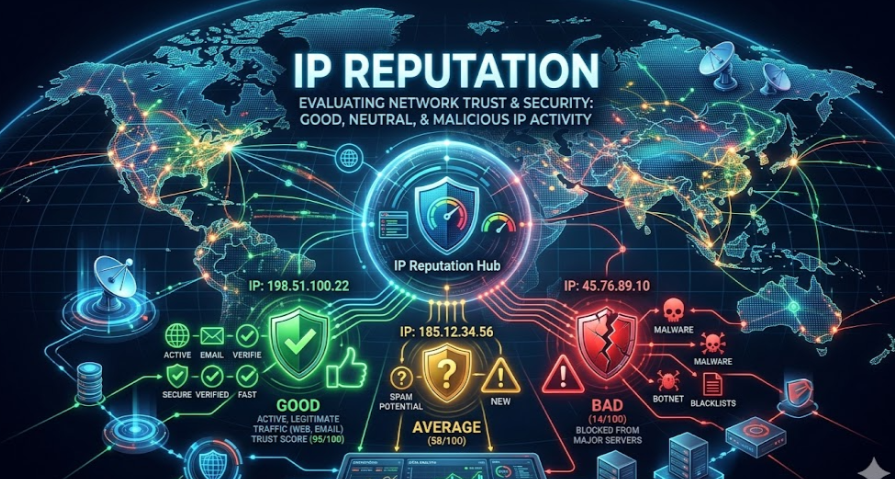
In modern security systems, an IP address is never simply labeled as “clean” or “dirty.” Instead, it moves within a fluid, data-driven risk scale. Platforms generally sort connections into three tiers:
- Low Risk (High Trust): The network is verified. Your team and tools get instant access.
- Medium Risk (Suspicious): The platform sees minor anomalies. It triggers extra verification prompts, like Captchas or phone codes.
- High Risk (Threat Detected): The system flags the network. Access is restricted immediately to protect the platform.
Because this grading system is dynamic, the same IP address can have different trust scores on different platforms, at different times, or during different business activities.
The Key Dimensions of IP Reputation
An IP trust score is built from a cluster of background variables, not just one feature. Security systems look at:
- Network Ownership (ASN Type): Who owns the IP infrastructure?
- Historical Activity Logs: What did users do on this IP in the past?
- Usage Frequency and Concurrency: How many connections are active at the exact same time?
- Sharing and Recycling Patterns: Is the IP being shared by unrelated networks?
- Blacklist and Threat Database Status: Is the IP listed on public or private security watchlists?
- Behavioral Models: Does the current traffic look natural or like a fast bot?
- Why Do Brand-New Proxies Often Fail on Day One?
Many enterprises notice a frustrating pattern. They buy a brand-new proxy IP, but the moment they use it to log into a global marketplace, they face instant verification prompts or restrictions.
This is rarely an issue with your account credentials. Instead, it happens because the IP address already carries historical risk attributes before you even connect.
IPs Are Never “Blank Slates”—They Have History
IP addresses are recycled infrastructure resources. Before an IP is assigned to your business, it may have gone through many different internet scenarios. Past users might have used it for:
- Aggressive market research automation
- Bulk automated registration setups
- Irregular ad traffic generation
- High-frequency API requests
- Unoptimized automated bot testing
Security systems log all of these past actions. That bad history stays attached to the IP address, dragging down its trust score for the next user.
In low-quality shared proxy networks, multiple users connect through the same IP at the same time. This causes massive issues:
- It confuses the platform’s behavioral models.
- It prevents the system from building a stable user identity.
- It causes different risky behaviors to stack up together.
As a result, even if your team follows perfect compliance rules, the bad actions of other users on that shared node will pull your trust score down into the high-risk zone.
- Comparing Network Architectures: ISP Residential vs. Data Center IPs
Different network types have completely different baseline trust levels within automated security frameworks. These differences come from how the network infrastructure is structurally built.
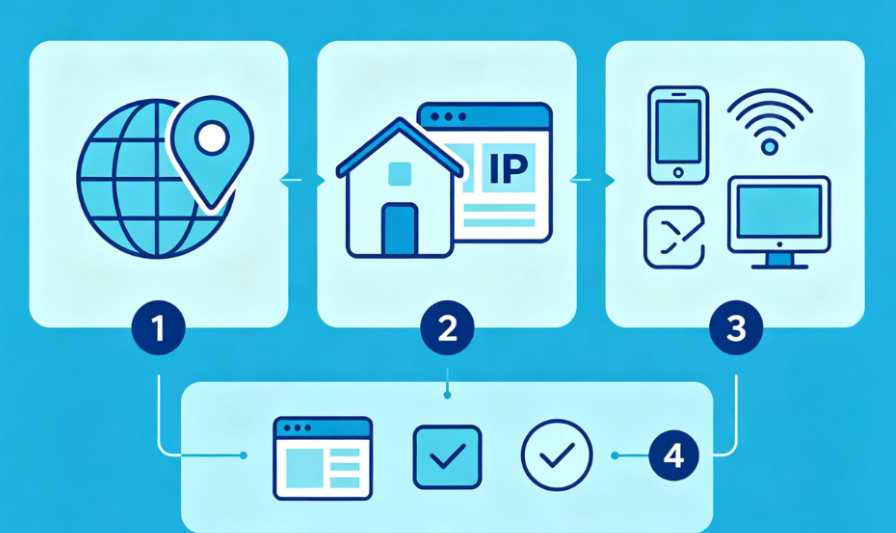
Dedicated ISP Residential Proxies—High-Trust Environments
ISP Residential IPs come directly from local Internet Service Providers, like AT&T, Comcast, or BT. These connections are linked directly to real consumer homes and contract lines.
- Their traffic patterns look perfectly natural to platforms.
- They provide excellent long-term connection stability.
- Security models can verify them with very low operational costs.
Because of this, dedicated ISP proxies naturally sit in the low-risk category on almost every global platform. At IPFLY, we focus heavily on delivering this level of premium, static ISP infrastructure.
Standard Residential Proxies—Trust Depends on Control
Standard residential proxies use real residential IP space, but their trust level varies wildly based on how they are managed. If a provider shares them across a chaotic network, mixes sessions, or allows erratic traffic, their risk score will quickly drop to the level of low-grade networks.
Data Center IPs—High Performance, Structural Limitations
Data center IPs originate from cloud hosting networks and corporate server rooms.
- They offer massive bandwidth and great speeds for heavy data processing.
- They are easily identified as corporate server traffic, not real people.
- They start with a very low baseline trust score in identity-sensitive systems.
Therefore, data center networks are excellent for high-volume backend tasks, but they are not built for long-term account management.
- How Global Platforms Identify Anomalous IP Variables
Modern security models on platforms like TikTok, Meta, and Google no longer look at an IP address by itself. They use advanced, multi-signal identity verification.
An IP is just the Front Door, Not the Whole Story
Security systems cross-reference your IP address with your entire digital footprint. They look at:
- The IP’s structural network category (ASN verification)
- The alignment between your current login location and your past history
- The exact match of your hardware device fingerprint
- The continuity of your session tokens
- Whether your navigation path matches organic human behavior
The Trigger: “Multi-Signal Stacking”
An IP is rarely restricted because of one minor issue. Instead, security systems flag a connection when multiple negative signals appear at the exact same time:
- The IP location changes across states or countries too fast.
- The login device fingerprints do not match past sessions.
- The user path across the website looks mechanical and unnatural.
- The connection drops and reconnects constantly (broken session continuity).
When these negative signals stack up, the system automatically tags the connection as an unverified identity and restricts access.
- The Mechanics of IP Contamination
IP contamination is a slow, downward spiral. It happens when an IP address is used for irregular or heavy automated tasks over a long period, causing its trust score to drop continuously.
Contamination is the Cumulative Stacking of Risk
IP networks become contaminated due to clear operational mistakes:
- Running high-frequency, unoptimized automated scripts
- Allowing multiple users to share a single network node
- Suffering from network abuse or security leaks
- Remaining listed on security blacklists for too long
Every time these events happen, risk weights are added to the IP’s permanent file in platform databases.
Risk Trajectories Have a “Time-Weighted Delay”
Even if you stop all heavy automation and use a contaminated IP perfectly, the risk score does not reset to zero immediately. Reputation systems are built on time-weighted models. Past negative history impacts current trust scores for weeks or months. This creates a lag time before the network can ever be viewed as trusted again.
- Why High-Purity Network Identities Are Increasingly Scarce
Today, high-purity enterprise network identities have become structurally scarce. This resource shortage is driven by three major industry shifts:
- Limited Total ISP Assets: High-quality, dedicated consumer broadband lines cannot be expanded instantly. The physical infrastructure owned by regional ISPs is fixed and strictly regulated.
- Expanding Blacklist Coverage: Risk management systems are growing smarter. They keep records longer and share threat data across platforms faster, shrinking the pool of unflagged public IPs.
- The Filtering of Low-Quality Assets: As shared, low-grade proxy pools get heavily used for high-frequency tasks, they are permanently filtered out by platform security models.
Because of this, premium, clean network infrastructure has become a highly valuable corporate asset.
- Why Shared Proxies Inevitably Break Identity Isolation Models
Using low-quality shared proxies is the fastest way to damage your identity protection and cause account association issues.
Behavior Overlap Destroys Isolation
When multiple independent business tasks run on the exact same shared IP address, platform security systems observe a chaotic mix of signals:
- Completely different accounts acting from the same origin point
- Scattered, conflicting geographic and temporal data
- Broken, unstable session mappings
In a secure risk model, one clean network identity should map to one stable user profile. The moment a shared proxy breaks this 1:1 relationship, security systems automatically raise the risk tier for every single account connected to that node.
- Rules for Evaluating High-Purity Network Infrastructure
To ensure high operational ROI and protect your digital assets, your technical team should evaluate proxy infrastructure using four clear rules:
- Verify True ISP Origins: Ensure the IP address maps to a genuine residential broadband contract, not an enterprise cloud server.
- Audit Historical Threat Logs: Check the network identity against global private and public blacklists to ensure zero risk accumulation.
- Test Session Continuity Capabilities: Confirm that the network architecture can maintain a stable, dedicated connection for extended periods without frequent IP rotation.
- Ensure Exclusive Resource Isolation: Make sure the IP address is dedicated to your enterprise alone, completely protecting you from shared user contamination.
- Why IP Reputation is Becoming a Core Enterprise Competency
As automated risk platforms continue to upgrade, proxy networks are no longer just temporary work tools. They have evolved into the core foundation of digital network identity.
We see this structural shift clearly across high-value business use cases:
- Cross-border e-commerce account management
- Global social media marketing matrix operations
- Localized ad verification systems
- Enterprise data collection and RAG (Retrieval-Augmented Generation) automation
The uptime and safety of these systems depend entirely on the trust score of your network identity. Because of this, leading industries are shifting away from buying random bulk proxies. Instead, they are investing in long-term, stable network identity infrastructure.
IP Reputation is a long-term, evolving credit system that dictates your business’s freedom on the global web. As platforms move toward identity-driven and behavior-driven risk models, your choice of network infrastructure determines your operational success.
This is where premium global providers like IPFLY deliver true enterprise value. By building clean, dedicated, global static residential ISP infrastructure, IPFLY ensures your network identity remains perfectly consistent, stable, and trusted over time. In 2026 and beyond, the market is no longer about who has the highest volume of cheap links. It is about who owns the highest-purity network identity infrastructure. Build your digital assets on solid ground with IPFLY.