Langflow has rapidly become one of the most compelling open‑source platforms for building AI agents. It wraps the complexity of LangChain in a visual drag‑and‑drop interface, turning what would be hundreds of lines of Python into a canvas of connected nodes. A developer can drag in a chat model, wire it to a search tool, add a memory component, and export the whole graph as a working API—all without leaving the browser. For rapid prototyping, Langflow is unmatched. It lets teams experiment with retrieval‑augmented generation, multi‑step reasoning, and tool‑calling agents at a speed that pure‑code approaches cannot match.
Yet the moment a Langflow agent is asked to do something the real world demands—fetch live pricing from a competitor’s website, read the text of a geo‑restricted public document, or verify whether an ad is still running in a particular city—the visual elegance collides with an invisible wall. The web is not a neutral data source. It is a collection of servers that inspect every incoming request and decide, within milliseconds, whether to serve data or a CAPTCHA. Langflow’s built‑in web tools, like the WebBaseLoader or a custom requests node, faithfully dispatch HTTP requests. They do not, however, control the IP address from which those requests originate. And in the modern web’s security architecture, the IP address is the single most decisive trust signal.
That is where a residential proxy network becomes not an accessory to a Langflow flow but its foundation. By replacing the default data‑center IP of a cloud deployment with a genuine home broadband IP, a proxy like IPFLY transforms a Langflow agent from a blocked bot into a trusted visitor. This article explores the Langflow platform, the web‑access challenge that its users encounter when scaling beyond a demo, and the specific ways IPFLY’s residential proxy infrastructure—90 million IPs, city‑level targeting, sticky sessions, and SOCKS5—integrates with Langflow to keep AI agents online, geo‑accurate, and undetectable.
Langflow: A Visual Operating System for AI Agents
Langflow sits on top of LangChain, the most widely used framework for composing large language models with tools, memory, and retrieval. What LangChain does through code, Langflow does through a browser‑based graph editor. Each node in the graph represents a component—a language model provider, a vector store, a web search tool, a prompt template, a Python function. Users connect the nodes to define data flow, then run the graph interactively or export it as a FastAPI endpoint.
Components, Flows, and the Tool Ecosystem
The platform ships with dozens of pre‑built components: OpenAI, Anthropic, and Hugging Face models; document loaders for PDFs, web pages, and CSVs; text splitters; vector stores like Pinecone and Chroma; and an ever‑growing list of tools. A developer can drag a ChatOpenAI node onto the canvas, connect it to a WebBaseLoader that reads a specific URL, pipe the output into a RecursiveCharacterTextSplitter, and store the chunks in a Chroma vector database—all in under a minute. This visual flow is self‑documenting, easy to explain to a non‑technical stakeholder, and trivially shareable as a JSON file.
Custom Components and the Python Node
For anything that does not come as a pre‑built node, Langflow provides a PythonFunction component. This is a canvas‑embedded editor where you can write arbitrary Python code that receives input from upstream nodes and passes output downstream. The Python node has access to the full Langflow runtime, so you can import requests, httpx, BeautifulSoup, or any other library and execute it as part of the flow. This is the integration point where a residential proxy enters the picture, because the Python node is where you define how your agent reaches the web.
The Web Access Problem That Langflow Inherits
Langflow’s web tools and custom Python nodes do not contain any special networking logic. They use the same HTTP libraries that a script running on a cloud server would use. When that script runs on AWS, Google Cloud, or a similar provider, its outbound IP is a data‑center address. Commercial IP intelligence databases categorize those addresses as hosting infrastructure, and platforms from e‑commerce sites to social media networks apply blanket distrust. The Langflow agent, no matter how sophisticated its reasoning, never sees the data because the request never reaches the server in a trusted state.
IP Reputation, Geo‑Blocking, and Rate Limiting
Three distinct mechanisms converge to block an agent. IP reputation checks flag data‑center ranges before the application‑layer request is even inspected. Geo‑blocking prevents access to content that is licensed or published only for specific regions; a Langflow agent querying a local news archive from a Frankfurt data center will be redirected or denied because its IP does not geolocate to the expected country. Rate limiting, even on sites that do not outright block data‑center IPs, kicks in much sooner for addresses that belong to hosting providers, because those addresses are not expected to generate the volume of traffic that residential users do.
When a Langflow flow is tested locally on a developer’s home Wi‑Fi, the web calls succeed because the IP is residential. Deploy that same flow to a production server, and it breaks. The Langflow graph is unchanged; the network identity has collapsed.
How Residential Proxies Complete Langflow’s Web Capabilities
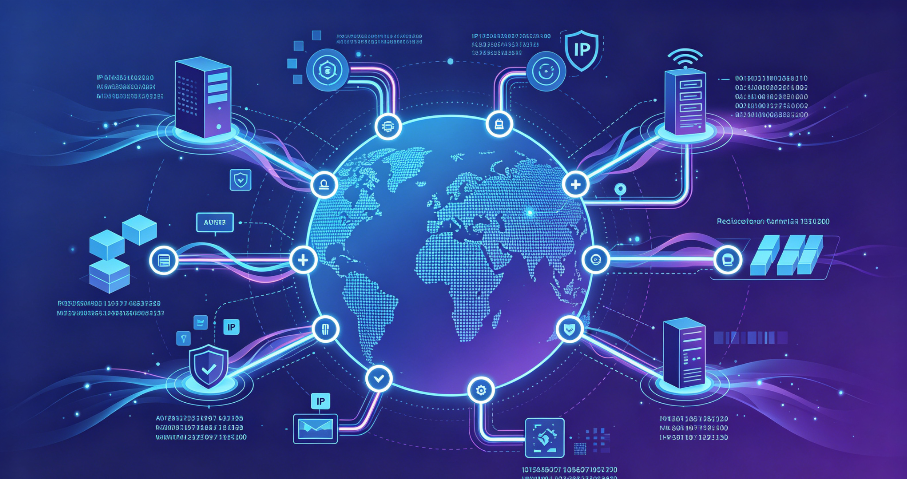
A residential proxy changes the source IP of the agent’s requests from a data‑center address to an IP issued by a consumer internet service provider to an actual household. To any web server, the traffic now originates from a home broadband connection—the ISP name is a recognized provider, the geolocation is a real city, and the IP has no history of automated activity.
The IPFLY Difference: Pool Depth, Targeting, and Session Control
IPFLY operates a pool of over 90 million residential IPs across more than 190 countries, all ethically sourced from consenting participants. This scale means that a Langflow flow can rotate through a new IP for each domain or each session without detectable reuse, and a single instance of the agent can query multiple regional sites simultaneously by using different proxy credentials.
City‑level and ISP‑level targeting is critical for Langflow agents that need to verify localized content. A price‑monitoring agent that queries an e‑commerce site must see the prices that a local customer sees. Through the IPFLY dashboard, you set the target city and ISP—say, a residential IP on Jio in Mumbai—and every request from the Langflow Python node carrying that credential exits from that precise location. There is no country‑level blur that causes subtle but costly data inaccuracies.
Sticky sessions keep the same IP for a configurable duration. If the Langflow agent needs to log into a portal, navigate through a multi‑page report, and then download a CSV, the IP must remain constant for the entire session. IPFLY’s sticky session feature holds the IP for minutes or hours, matching the expected lifespan of the Langflow flow run. The session cookie stays valid, and the multi‑step workflow completes without interruption.
SOCKS5 support ensures that DNS queries are routed through the proxy along with the application data. Langflow’s Python node, if configured with a SOCKS5 proxy, will not leak the target domain to the local network’s DNS resolver. This is essential when the agent operates on a monitored corporate network or needs to access a site that is blocked at the DNS level.
Full-Industry Proxy IP Application Solutions
Power scalable growth for every cross-border business scenario with IPFLY’s reliable global proxy network
Integrating IPFLY Proxies into a Langflow Flow
There is no dedicated IPFLY node in Langflow’s standard component library, but integration takes exactly as long as it takes to write a few lines of Python. The pattern is to replace the default web‑request logic inside a PythonFunction node with requests that pass through an IPFLY proxy gateway.
A Custom Web Loader Node with IPFLY
Below is a minimal example of a Langflow Python node that fetches web content through an IPFLY residential proxy. In practice, the proxy credentials would be injected as environment variables or Langflow global parameters, not hard‑coded.
Python
import requests
from langflow.custom import CustomComponent

class IPFLYWebLoader(CustomComponent):
    def build(self, url: str) -> str:
        proxy_url = "http://user:pass@gateway.ipfly.io:8080"
        proxies = {"http": proxy_url, "https": proxy_url}
        resp = requests.get(url, proxies=proxies, timeout=15)
        resp.raise_for_status()
        return resp.text
This component can be dragged onto the Langflow canvas and wired directly to a text splitter, a summarization chain, or a data‑extraction prompt. The geographic exit point and session stickiness are configured in the IPFLY dashboard, so the Langflow graph itself remains environment‑agnostic.
Adding Async and Multi‑Region Fetching
For agents that need to query multiple regional endpoints concurrently, the Python node can use httpx with AsyncClient and a dictionary of proxy credentials. Each async request can carry a different IPFLY credential—one for the US, one for Germany, one for Japan—allowing the agent to collect a global dataset in a single flow run. The visual graph does not change; the complexity is encapsulated in the node’s code.
Practical Langflow + IPFLY Workflows
The combination of a visual agent builder and a trusted residential IP network is not a theoretical advantage. It solves concrete problems that block AI agents in production.
Competitive Pricing Intelligence A Langflow flow is triggered every morning to scrape product pages from a dozen regional e‑commerce sites. The PythonFunction node uses IPFLY rotating residential IPs with city‑level targeting so that each marketplace is scraped from a local IP. The extracted prices are fed to a language model that summarizes changes and pushes a report to Slack. Without the residential proxy layer, the same flow would be blocked by the second or third marketplace.
Ad Verification for Global Campaigns
A brand that runs digital ads in 30 cities needs to confirm that the correct creatives are being served. A Langflow agent uses IPFLY residential IPs targeted to each city to load the publisher’s page, take a screenshot (via a headless browser node), and pass the image to a vision model for analysis. The entire pipeline is orchestrated through the Langflow canvas, but the network layer ensures that the verification data is genuine—not a geo‑redirected approximation.
Multi‑Account Content Verification A social media agency uses Langflow to coordinate content verification across client accounts. Each client account is assigned a dedicated IPFLY sticky IP, and the Langflow flow uses a PythonFunction node to log in, fetch post performance, and aggregate metrics into a dashboard. The consistent residential IP prevents the security challenges that would otherwise break the login flow, and the agency’s entire reporting pipeline runs without manual oversight.
Responsible Automation and the Ethical IP Layer
Langflow and IPFLY give professionals the tools to build intelligent, automated web interactions. The ethical boundary lies in what those interactions target and how aggressively they operate. A Langflow agent that respects robots.txt, limits its request rate to a human‑like cadence, and accesses only publicly available data for legitimate business purposes—market research, brand protection, competitive analysis—operates within well‑established professional norms. IPFLY’s residential IPs are ethically sourced from participants who have consented to share their bandwidth, and the network is designed for transparent, lawful access. Users bear the responsibility for ensuring their Langflow agents comply with the terms of service of the platforms they access.
The Visual Flow That Never Hits a Block
Langflow puts AI agent development within reach of teams that cannot afford to write and maintain thousands of lines of LangChain code. Its visual canvas accelerates experimentation, its component library covers the most common AI patterns, and its export options make it production‑ready. What it cannot do—because no AI framework can—is control how the web perceives the agent’s network identity. A brilliant prompt, a perfectly tuned vector store, and a clever multi‑step reasoning chain are all wasted if the web request never returns data.
IPFLY’s residential proxy network completes Langflow’s architecture by providing the trust layer that the web demands. Over 90 million residential IPs, city‑ and ISP‑level targeting, sticky sessions that hold an IP for hours, and SOCKS5 encapsulation ensure that every HTTP call from a Langflow node arrives with a clean, geo‑accurate, and stable identity. The Langflow canvas defines what the agent does; the IPFLY network defines where it appears to be from—and in the modern web, that distinction is the difference between a blocked agent and an operational one.
Ready to give your Langflow agents unrestricted, trusted web access? Explore IPFLY’s residential proxy plans and equip your visual AI workflows with over 90 million clean, geo‑targeted residential IPs and sticky sessions. Start with a trial endpoint and see how a trusted network identity keeps your agents online, on‑task, and undetectable.