An AI agent that cannot browse the web is an intelligence trapped inside a static knowledge base. Give it a reasoning engine, a chain of thought, even a code interpreter, and it will still lack the single capability that most real-world tasks demand: the ability to retrieve fresh, live information from the internet. AI agent frameworks—the modular toolkits that developers use to build autonomous assistants—have responded by integrating web browsing as a core tool. Agents search, scrape, read pages, and extract structured data, all without human intervention. Yet the moment they do so at scale, they collide with a reality that the framework documentation rarely addresses: the web is not a neutral, accessible resource. It is a fortress of IP reputation checks, rate limiters, geo-fences, and bot-detection systems that classify automated traffic with millisecond precision. An agent that retrieves a single page in a demo environment may succeed flawlessly; the same agent, looping over a hundred product pages on an e-commerce site, will find itself served CAPTCHAs, blank responses, or a permanent IP ban.
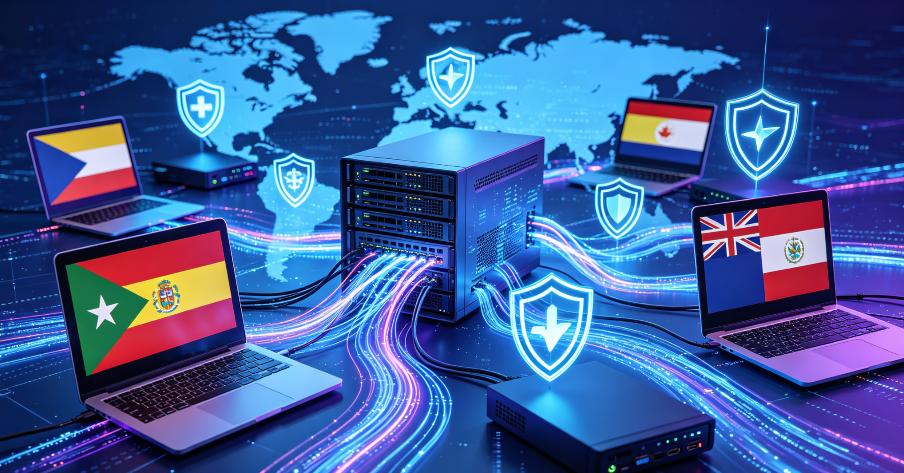
The missing piece in most AI agent architectures is not smarter prompting or larger context windows. It is a network identity that the web trusts—a residential IP address that makes each request indistinguishable from a real person browsing from home. This is the infrastructure layer that turns a blocked agent into a productive, always-on worker. This article examines the intersection of AI agent frameworks and residential proxy technology, illustrating how IPFLY’s globally distributed residential IP network provides the clean, geo-targeted, and session-stable connectivity that autonomous web agents require to operate reliably at scale.
What Are AI Agent Frameworks and Why Do They Need the Web?
An AI agent framework is a software library or platform that enables developers to combine a large language model with tools, memory, and planning logic to create autonomous digital assistants. Instead of merely answering a question, an agent decomposes a complex goal into steps, decides which external resources to call, executes those calls, interprets the results, and adjusts its plan accordingly. The agent’s intelligence emerges not from the model alone but from the loop between the model and the external world.
The Core Components of an Agent: Tools, Memory, and Planning
Three architectural components define a modern AI agent. Tools are the functions and APIs the agent can invoke—web searches, database queries, code execution, image generation, or custom business logic. Memory gives the agent continuity across turns, whether through a persistent vector store of past interactions or a short-term buffer of recent observations. Planning is the agent’s ability to sequence actions, often through techniques like ReAct (reasoning and acting in an interleaved loop) or tree-of-thought exploration. The framework provides the scaffolding; the developer provides the tools and the prompt that binds them together.
Popular frameworks such as LangChain, CrewAI, AutoGPT, and Semantic Kernel have converged on a plug-in architecture where web browsing is treated as a first-class tool. A LangChain agent can be equipped with a WebBaseLoader or a custom requests-based retriever. A CrewAI crew can assign a web research task to a specialized agent that searches and scrapes. In every case, the agent eventually makes an HTTP request to a remote server. It is at this exact point—the network request—that the agent framework’s built-in capabilities end and the infrastructure challenge begins.
Web Browsing as a Critical Tool for Autonomous Agents
The tasks that enterprises assign to AI agents routinely depend on live web data. A competitive intelligence agent monitors pricing on competitor sites. A supply chain agent checks inventory availability from vendor portals. A travel assistant compares flight options across multiple airline sites. A financial research agent extracts earnings call transcripts from investor relations pages. In each scenario, the agent’s value is proportional to the freshness and completeness of the web data it can ingest. If the target website blocks the agent’s requests, the agent’s utility drops to zero, regardless of how sophisticated its reasoning pipeline may be.
The Web Access Bottleneck: Why AI Agents Get Blocked
Websites do not block agents because they are intelligent. They block them because the network identity they present looks like a bot. The distinction between a genuine user and an automated agent is not made at the application layer—it is made at the IP layer, often before a single request header is inspected. Understanding this layer is essential for any team that deploys web-browsing agents in production.
How Websites Identify and Block Automated Traffic
When an agent sends an HTTP request, the destination server evaluates the source IP address through multiple lenses. The first is IP reputation: is this address associated with a cloud hosting provider, a known data center service? Commercial threat intelligence databases flag entire IP ranges belonging to AWS, Google Cloud, DigitalOcean, and similar providers as non-residential. A request from such a range is immediately suspect. The second is behavioral analysis: how many requests has this IP made in the last minute, the last hour, the last day? An IP that fetches fifty product pages in three seconds is not a human shopper. The third is geographic coherence: does the IP’s location match the expected user base? A request from a Frankfurt data center to a U.S. retailer’s local pricing API may be geo-blocked outright.
When any of these signals crosses a threshold, the server responds not with the requested data but with a challenge. The agent receives a CAPTCHA it cannot solve, a 403 block, an empty JSON body, or a redirect to a warning page. The framework’s retry logic kicks in, firing more requests from the same flagged IP, compounding the problem until the IP is permanently banned. The agent fails silently, its task incomplete, while the developer struggles to diagnose a problem that the agent’s own logs describe only as a timeout or a parse error.
How Residential Proxies Transform Agent Reliability
A residential proxy changes the source IP of the agent’s request from a data center address to an IP assigned by a consumer internet service provider to an actual household. To the destination server, the request now originates from a home broadband connection in a specific city—a connection with no history of automated traffic, no presence on proxy blacklists, and an ISP name that matches ordinary users. The CAPTCHA rate drops to near zero. The geo-fenced content becomes accessible. The agent can retrieve the data it was designed to collect.
Residential proxies do not alter the agent’s logic, its prompts, or its tool definitions. They operate entirely at the transport layer, intercepting the outbound HTTP connection and forwarding it through a residential exit node. This means that every AI agent framework—whether it is written in Python, TypeScript, or any other language—can benefit from residential IP routing without code changes to the framework itself. The proxy is configured once, in the HTTP client or at the operating system level, and all subsequent agent requests inherit the trusted identity.
The IPFLY Advantage for Agent Frameworks
IPFLY’s residential proxy network is architected specifically for high-volume, geo-distributed web access—the exact pattern that AI agent workloads generate. With a pool of over 90 million residential IPs spanning more than 190 countries, the network provides the depth, geographic precision, and session control that keep autonomous agents running without interruption.
Full-Industry Proxy IP Application Solutions
Power scalable growth for every cross-border business scenario with IPFLY’s reliable global proxy network
90+ Million Residential IPs to Distribute Requests
The single greatest threat to an agent’s web access is IP reuse. If the same residential IP fetches hundreds of pages from the same domain within a short window, the destination server will eventually rate-limit it, even if the IP is residential. A pool of 90 million addresses eliminates this risk mathematically. An agent that rotates through fresh IPs for each new domain or each new session can run continuously without revisiting the same address within a detectable timeframe. The pool is continuously refreshed as participating devices connect and disconnect, so the supply of clean IPs remains dynamic.
City-Level Targeting for Localized Search Results
Many web sources serve different content depending on the visitor’s geographic location. A price comparison agent that queries an e-commerce site from a U.S. IP will see U.S. prices in dollars; the same query from a German IP will display euro prices and potentially a different product assortment. IPFLY’s city-level targeting allows an agent to specify the exact metropolitan area from which each request should appear to originate, ensuring that the retrieved data reflects the target market. This is indispensable for agents performing competitive pricing analysis, local inventory checks, or region-specific news monitoring.
Sticky Sessions for Stateful Tasks
Not all agent tasks are stateless. An agent that logs into a vendor portal, navigates through a multi-page form, or maintains a shopping cart must preserve session cookies and a consistent IP across the entire sequence. IPFLY’s sticky session feature holds the same residential IP for a configurable duration—minutes or hours—matching the lifespan of the agent’s task. The session remains coherent, the login stays valid, and the multi-step workflow completes without interruption. Once the task finishes, the IP is released back to the pool.
SOCKS5 Support for Full Protocol Coverage
For agent frameworks that use headless browsers or tools that require non-HTTP protocols, a SOCKS5 proxy provides full TCP encapsulation. DNS queries are resolved through the proxy, eliminating DNS leaks that would otherwise reveal the destination domain to the local network. IPFLY supports SOCKS5 alongside HTTP and HTTPS, giving development teams the flexibility to select the protocol that best matches their agent’s tooling.
Integrating IPFLY Proxies into Popular Agent Frameworks
The integration of residential proxies into an AI agent stack is a configuration change at the HTTP client level, not a framework modification. Most frameworks allow developers to pass a custom requests.Session or a proxy URL to their web tools. The following patterns illustrate the approach.
LangChain and Custom Tool Configuration
In a LangChain agent, a web retrieval tool built on top of Python’s requests library can be configured to use an IPFLY residential proxy by setting the proxies parameter. The proxy URL includes the gateway host, port, and authentication credentials. This single configuration ensures that every HTTP GET or POST issued by that tool routes through the residential network. The same principle applies to LangChain’s WebBaseLoader and any custom Tool subclass that performs web requests.
python
import requests
from langchain.tools import tool

PROXY_URL = "http://user:pass@gateway.ipfly.io:8080"

@tool
def fetch_page(url: str) -> str:
    resp = requests.get(url, proxies={"http": PROXY_URL, "https": PROXY_URL}, timeout=15)
    return resp.text
Using Proxies with AutoGPT and CrewAI
AutoGPT and similar autonomous agent platforms typically expose a configuration file where proxy settings can be specified globally. Setting the http_proxy and https_proxy environment variables to an IPFLY endpoint ensures that all outbound traffic from the agent’s browsing tools uses the residential network. In CrewAI, agents that are assigned to web research tasks can be instantiated with a custom requests session that carries the proxy configuration, isolating their traffic from other agents if different geographic targets are needed.
Best Practices for Running Unblockable AI Agents
Residential IPs eliminate the primary cause of blocking, but a robust agent deployment incorporates additional operational practices that maintain access over the long term.
Rotate IPs and Respect Rate Limits
Even with a residential IP, an agent should not fire requests at maximum speed. Configuring the agent’s tool execution to include delays between requests—randomized intervals of a few seconds—mimics human browsing rhythm and prevents the server from deploying more aggressive rate limiting. IPFLY’s rotation capability can be used to assign a fresh IP to each new task or domain, further distributing the traffic footprint.
Monitor for Blocks and Implement Fallback
An agent should be able to detect when a response is a block page or a CAPTCHA, not the expected data. Implementing a validation step that checks the response content for known block indicators allows the agent to log the failure and retry with a different residential IP. IPFLY’s pool makes a retry with a fresh IP a fast, automated recovery path rather than a dead end.
Ethical Considerations and Responsible Use
Residential proxies provide a trusted network identity, not a license to violate terms of service or to scrape personally identifiable information. IPFLY’s IPs are ethically sourced from participants who have consented to share their bandwidth, and the network is designed for transparent, lawful data access. AI agent deployments that use residential proxies should target publicly available information, respect robots.txt directives, and operate at a request rate that does not degrade the target server’s performance for genuine users. The goal is to empower agents with the same access a human user would have, not to overwhelm or exploit the platforms they interact with.
The Infrastructure for Autonomous Web Interaction
AI agent frameworks have made it possible to build digital assistants that reason, plan, and act on the web. What they have not solved is the network identity crisis that arises the moment an agent moves from a demo to a production workload. The IP addresses that most agent deployments use—data center IPs, cloud server addresses—are precisely the addresses that the web’s anti-automation infrastructure is designed to block. No amount of prompt engineering or tool refinement can overcome a blocked IP.
A residential proxy network transforms this dynamic by replacing the untrusted data center identity with a genuine residential IP that websites recognize as legitimate. IPFLY’s infrastructure—over 90 million IPs across 190 countries, city-level targeting, sticky sessions, SOCKS5 support—provides the connectivity layer that allows AI agents to browse, search, and extract web data as reliably as a human user. For enterprises that are deploying agents to monitor markets, gather competitive intelligence, or automate research, this network layer is not an optional add-on. It is the foundation on which successful autonomous web interaction is built.
Ready to unblock your AI agents? Explore IPFLY’s residential proxy plans and equip your agent stack with over 90 million clean, geo-targeted residential IPs. Start with a trial endpoint and see how a trusted network identity keeps your agents online, on-task, and undetectable.