
Puppeteer has reshaped what developers can accomplish with a headless browser. The Node.js library, maintained by the Chrome DevTools team, provides a high-level API to control a full instance of Chromium—launching it, navigating to pages, clicking buttons, filling forms, capturing screenshots, and extracting rendered content that a static HTTP client would never see. For tasks that require JavaScript execution, Single Page Application crawling, or pixel-perfect PDF generation, Puppeteer is the default choice. A developer can script a complete user journey in a few dozen lines of code and run it on a server without ever opening a visible window.
Yet the moment a Puppeteer script moves from a local demo to a production workload that touches real websites, it collides with a dense layer of defenses that were designed precisely to detect and block automated browsers. The same Chromium instance that renders pages flawlessly on a developer’s laptop becomes a magnet for CAPTCHAs, IP bans, and silent blocks when it runs in a data center. The browser is not broken. The network identity it presents is untrusted. Solving that trust gap does not require abandoning Puppeteer; it requires connecting Puppeteer to an upstream network layer that presents the IP address of a genuine home broadband user. This article examines how Puppeteer works, why it gets blocked at scale, and how integrating IPFLY’s residential proxy network—with its 90‑million‑strong IP pool, city‑level targeting, sticky sessions, and SOCKS5 support—transforms a blocked automation script into a reliable, production‑grade data collection engine.
What Puppeteer Is and Why Developers Depend on It
Puppeteer is not a scraping library; it is a browser automation framework. The distinction matters because it defines where Puppeteer excels and where it introduces complexity. Unlike an HTTP client that sends a request and receives raw HTML, Puppeteer controls a real browser that parses HTML, executes JavaScript, applies CSS, and builds a Document Object Model identical to what a human user would see. This capability makes Puppeteer indispensable for several categories of tasks that simpler tools cannot handle.
The Architecture: Chromium, DevTools Protocol, and Automation
Puppeteer operates by communicating with a Chromium instance through the Chrome DevTools Protocol, a WebSocket‑based interface that exposes fine‑grained control over the browser’s internals. A Puppeteer script can launch a browser with specific flags, create a new page (tab), navigate to a URL, wait for particular elements to appear, and then interact with the page as a user would—typing into input fields, clicking buttons, scrolling, and reading the page’s fully rendered state. The library can also intercept network requests, modify headers, and emulate different device viewports and user agents. This architecture gives developers programmatic access to a complete browsing environment, making it the tool of choice for taking screenshots, generating PDFs, testing web applications, and scraping content that loads dynamically after the initial HTML response.
The Headless Mode Advantage and Its Limitations
By default, Puppeteer runs in headless mode—no visible window, no GPU acceleration, and a lower memory footprint. Headless mode is ideal for server environments where a graphical interface is unavailable. It is also the mode that most distinctly identifies the browser as automated. Although Puppeteer’s newer headless mode (launched with Chrome 112) significantly reduces the fingerprinting gap between headless and headed Chrome, websites still detect automation by examining the absence of a screen, the lack of certain rendering artifacts, and the presence of properties like navigator.webdriver. These signals can be suppressed with arguments that hide the automation indicator, but they cannot be eliminated entirely at the application layer. More critically, even if the browser fingerprint passes inspection, the IP address from which the browser connects is evaluated first—and a data center IP will often trigger a block before any JavaScript fingerprinting code even loads.
Why Puppeteer Gets Blocked: The Multi‑Layer Detection Stack
Websites do not block Puppeteer because they detect the library name. They block the combination of signals that automated browsers emit, and they do so at multiple layers. Understanding each layer clarifies why residential proxies are the decisive fix rather than a supplementary one.
IP Reputation and Data Center Blacklisting
Every Puppeteer session begins with an HTTP request, and that request carries the IP address of the machine that launched the browser. In a cloud deployment, that IP belongs to a data center range—AWS, Google Cloud, DigitalOcean, or a similar provider. Commercial IP intelligence services categorize these ranges as hosting infrastructure, and many websites apply blanket distrust to any connection originating from a data center. A Puppeteer script that runs perfectly on a local residential connection can fail instantly when deployed to a cloud server, not because the browser configuration changed but because the IP reputation collapsed.
Behavioral Signals and Timing Analysis
Even when a data center IP is not immediately blocked, the behavioral patterns of an automated browser can trigger detection. Human users scroll incrementally, move the mouse along curved paths, and pause between actions. A Puppeteer script that fires page.click() and page.type() in rapid succession, without emulating human‑like delays, produces a sequence of events that no genuine user would generate. Websites instrument their pages with JavaScript that measures mouse movement, click timing, and scroll velocity, and they flag sessions whose behavioral fingerprint falls outside the human envelope.
Browser Fingerprinting Beyond the User Agent
Puppeteer allows the user agent to be customized, but the user agent is only one of dozens of signals that fingerprinting scripts examine. The list of installed plugins, the canvas and WebGL renderer output, the screen resolution, and the presence of the navigator.webdriver property all contribute to a composite fingerprint that can identify a headless browser even when the user agent claims to be a standard Chrome installation. While these signals can be patched—plugins can be disabled, navigator.webdriver can be suppressed with the --disable-blink-features=AutomationControlled flag, and the viewport can be set to a common resolution—the maintenance burden grows with every fingerprinting evolution. A network‑layer solution that prevents the IP address from attracting scrutiny reduces the likelihood that fingerprinting defenses are deployed against the session in the first place.
The Residential Proxy Layer: How IPFLY Restores Trust
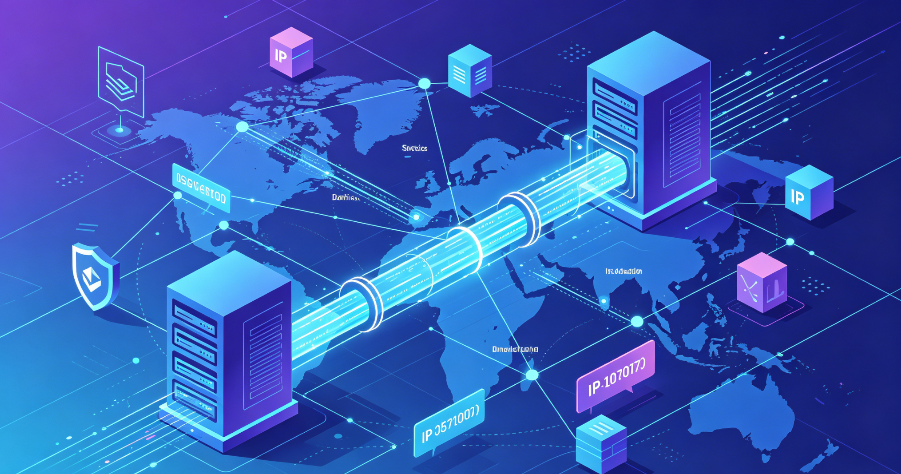
The common denominator across the detection stack is that every signal is evaluated against the originating IP address. A residential proxy changes that IP from a data center address to an IP assigned by a consumer internet service provider to an actual household. The request now appears to come from a home broadband connection in a specific city, with no history of automated traffic and no association with any cloud hosting provider. This single change at the transport layer neutralizes the IP‑based detection vectors and dramatically reduces the probability that behavioral or fingerprinting defenses are triggered.
90‑Million‑Strong IP Pool for Rotation Without Reuse
A single residential IP that makes a thousand requests to the same website in an hour will eventually be rate‑limited, regardless of its residential status. A pool containing only a few hundred thousand IPs will recycle addresses quickly under sustained Puppeteer sessions, creating the reuse patterns that anti‑bot systems learn to detect. IPFLY’s pool of over 90 million residential IPs, sourced from real ISP connections in more than 190 countries, provides the mathematical depth necessary to rotate IPs without detectable repetition. A Puppeteer script that launches a new browser instance for each target domain, each assigned a fresh residential IP, can operate continuously without any single address exceeding the request threshold that triggers a challenge.
Clear Step-by-Step Proxy IP Tutorials
Master proxy setup, integration and performance optimization quickly with IPFLY guides
City‑Level and ISP‑Level Geographic Targeting
Content that a website serves often depends on the visitor’s geographic location. An e‑commerce site may display different prices, inventory, and shipping options to users in different cities. A search engine may return localized results. A streaming catalog may vary by country. Puppeteer scripts that need to capture geo‑specific data must present an IP address that geolocates to the correct region, not merely to the correct country. IPFLY provides targeting granularity down to the city and ISP level, allowing each Puppeteer instance to be configured with an exit point that matches the exact market being researched. This precision is managed through the IPFLY dashboard, not through Puppeteer’s launch arguments, so changes to geographic targeting do not require script modifications.
Sticky Sessions for Stateful Workflows
Many automation workflows require a consistent IP across multiple pages. A Puppeteer script that logs into a portal, navigates through a multi‑step checkout, or fills a form that spans several pages depends on cookies and session state that are bound to the originating IP. If the proxy rotates the IP mid‑session, the cookies become invalid, the login is lost, and the workflow fails. IPFLY’s sticky session feature maintains the same residential IP for a configurable duration—long enough to complete the entire stateful journey. Once the task is finished, the IP is released, and a fresh address can be assigned for the next session. This capability gives Puppeteer scripts the session continuity of a home broadband connection with the anonymity of a rotating proxy pool.
SOCKS5 Protocol Support for Complete Traffic Encapsulation
Puppeteer uses the Chrome DevTools Protocol, which operates over WebSocket connections, and it may also initiate non‑HTTP traffic such as DNS lookups and WebRTC. An HTTP proxy forwards web traffic but may leave DNS queries or WebSocket handshakes on the local network, creating side channels that reveal the target domains to the local firewall. A SOCKS5 proxy encapsulates the entire TCP stream, routing all traffic—DNS, WebSocket, HTTP—through the proxy server. IPFLY supports SOCKS5 across its residential gateways, and Puppeteer can be launched with a --proxy-server flag that accepts SOCKS5 URLs. This configuration eliminates the possibility of DNS leaks and ensures that every packet leaving the Chromium instance exits from the residential IP.
Integrating IPFLY Proxies into a Puppeteer Workflow
Connecting Puppeteer to an IPFLY residential proxy requires a single line of configuration at browser launch. The following pattern is sufficient for most use cases, with optional authentication handled through the proxy URL.
Javascript
const puppeteer = require('puppeteer');

(async () => {
  const browser = await puppeteer.launch({
    headless: 'new',
    args: [
      '--proxy-server=socks5://user:pass@gateway.ipfly.io:1080',
      '--no-sandbox',
      '--disable-setuid-sandbox',
    ],
  });

  const page = await browser.newPage();
  await page.goto('https://example.com');
  // Extraction or automation logic
  await browser.close();
})();
For HTTP/HTTPS proxies, the --proxy-server argument accepts an http:// URL. The geographic exit point and session persistence are managed through the IPFLY dashboard, not the code, so the same script can be pointed at different regions simply by changing the proxy credentials.
Scaling Puppeteer Deployments Without Being Blocked
A single Puppeteer instance with a residential proxy is reliable; a fleet of hundreds is an infrastructure challenge. IPFLY’s architecture supports high concurrency without per‑account throttling, and its pool depth ensures that each instance receives a unique IP. For large‑scale data collection pipelines, Puppeteer instances can be orchestrated through a job queue, with each job fetching fresh proxy credentials from an IPFLY endpoint. Rotation can be applied per session, per domain, or per time interval, depending on the site’s tolerance. The combination of a distributed proxy layer and Puppeteer’s browser automation gives development teams the ability to scrape JavaScript‑heavy sites, fill and submit forms, capture screenshots, and extract real‑time data at a scale that would be impossible with either component alone.
Responsible Automation and Ethical Boundaries
Puppeteer and residential proxies are powerful tools; they are also neutral ones. Their legitimacy depends entirely on the use case. Automating logins to accounts that belong to the developer, testing a web application during development, capturing publicly available pricing information for competitive research, and verifying that advertisements render correctly are all legitimate activities that benefit from the trust a residential IP confers. Scraping personal data, overwhelming a website with requests, or circumventing paywalls crosses the line into unethical and potentially illegal territory. IPFLY’s residential IPs are ethically sourced from participants who have consented to share their bandwidth, and the network is designed for transparent, lawful access. Users are responsible for ensuring that their automation adheres to the terms of service of the websites they interact with and operates at a request rate that respects the target infrastructure.
Automating the Web Without the Blocked Pages
Puppeteer gives developers the power to control a real browser from code. What it cannot provide is the network identity that the web’s anti‑automation infrastructure is willing to accept. A headless Chromium instance running on a cloud server presents a data center IP that is, by default, suspicious. No amount of user‑agent customization or fingerprint suppression can fully compensate for an IP address that belongs to a flagged hosting range. The fix is not to abandon headless browsers but to route them through a network layer that presents the IP address of a genuine home user.
IPFLY’s residential proxy network provides that layer. With over 90 million residential IPs in more than 190 countries, city‑level and ISP‑level geographic targeting, sticky sessions for stateful workflows, and SOCKS5 support for complete traffic encapsulation, it gives Puppeteer scripts the trusted network identity they need to operate without blocks. Integration requires a single launch argument, and the result is a headless browser that is no longer headless in the eyes of the websites it visits—it is simply another visitor, indistinguishable from millions of others, loading pages and extracting data without a CAPTCHA in sight.
Ready to unblock your Puppeteer automation? Explore IPFLY’s residential proxy plans and equip your scripts with clean, geo‑targeted residential IPs. Start with a trial endpoint and see how a trusted network identity keeps your headless browsers online, on‑task, and undetectable.