What Is a Virtual Machine?
The term “virtual machine” (VM) gets thrown around a lot. But what exactly is it? Whether you are a developer, a system administrator, or someone exploring cloud computing, understanding virtual machines is essential. They are the backbone of modern IT infrastructure, powering everything from cloud platforms to software development.
This guide explains everything you need to know about virtual machines in 2026—what they are, how they work, the different types, their benefits and limitations, and how they are used in the real world.

Part 1: What Is a Virtual Machine?
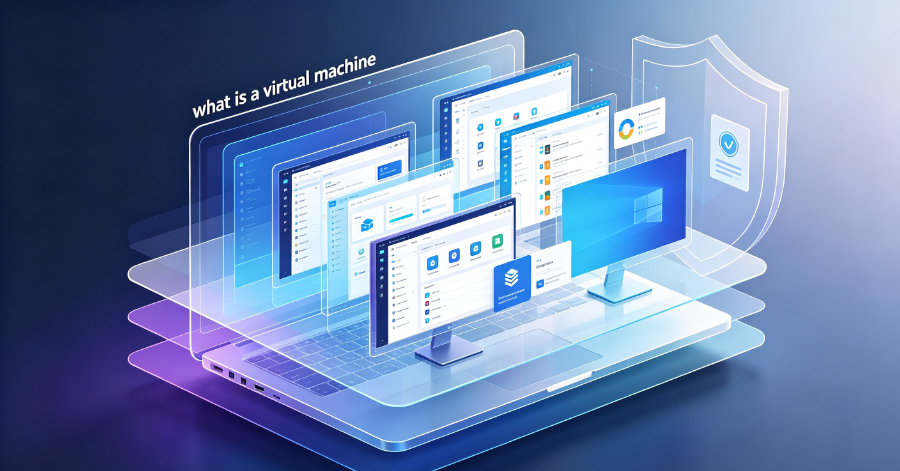
In simple terms, a virtual machine (VM) is a software-based computer. It runs on a physical machine but acts like a separate computer with its own operating system, storage, and applications.
A VM is a software-based emulation of a physical computer that runs an operating system (OS) and applications, operating as if it were a standalone physical server. The key idea is that VMs abstract physical hardware, allowing multiple virtual servers to run on a single physical server, each isolated and independent.
Think of a VM like a self-contained apartment within a larger building (the physical server). Each apartment has its own rooms, furniture, and utilities (OS, apps, and resources), and operates independently of the others.
What a VM Is Not
It is important to distinguish a VM from other concepts:
- A VM is not a physical computer—it is software that emulates one
- A VM is not a container—containers share the host OS kernel, while VMs have their own complete OS
- A VM is not an emulator—VMs use hardware virtualization for near-native performance, while emulators simulate entirely different hardware architectures
Part 2: How Does a Virtual Machine Work?
A virtual machine relies on software called a hypervisor. The hypervisor creates a virtual environment on a physical computer, often called the host machine. This allows multiple virtual machines, known as guests, to run on the same hardware.
For example, you could have one VM running Windows and another running Linux on the same physical machine, even though they are completely independent of each other.
The Role of the Hypervisor
The hypervisor is the software layer that creates, manages, and runs VMs by allocating physical resources. It translates VM requests—such as CPU instructions and disk I/O—to the physical hardware.
The hypervisor performs several critical functions:
- Resource allocation: Divides physical resources (CPU, RAM, storage) among VMs
- Isolation: Ensures each VM runs independently, so crashes or issues in one VM do not affect others
- Management: Handles VM creation, configuration, and monitoring
VM Components
A virtual machine consists of several key components:
| Component | Description |
| Guest Operating System | The OS running inside the VM (e.g., Windows Server, Ubuntu, CentOS) |
| Virtual CPU (vCPU) | Emulated processor allocated to the VM |
| Virtual Memory | Portion of physical RAM assigned to the VM |
| Virtual Storage | Virtual disk files (e.g., VMDK or VHD) mapped to physical storage |
| Virtual Network Interface | Connects the VM to virtual or physical networks |
| Configuration File | Defines the VM’s settings (CPU count, RAM size, disk capacity, etc.) |
Part 3: Types of Hypervisors
Hypervisors are categorized into two main types, with a third informal category for cloud environments.
Type 1 Hypervisor (Bare-Metal)
A Type 1 hypervisor runs directly on the physical hardware, acting as the main operating system. It manages VMs without needing a host OS. This type is very secure and efficient.
Because it interacts directly with the hardware, it provides better performance and is commonly used in enterprise environments.
Examples:
- VMware ESXi
- Microsoft Hyper-V
- XenServer
- Proxmox
Type 2 Hypervisor (Hosted)
A Type 2 hypervisor runs on top of an existing OS like Windows or Linux. It relies on the host OS for hardware access, making it easier to install but slightly less efficient.
Type 2 hypervisors are great for testing or personal use because they are simple to set up.
Examples:
- VMware Workstation
- Oracle VirtualBox
- Parallels Desktop
Cloud VMs (Informal “Type 3”)
Some people refer to fully managed cloud VMs as “Type 3” because users don’t manage the hypervisor directly. Instead, they get a virtualized runtime environment.
These run on Type 1 hypervisors but are managed at a higher level by cloud providers.
Examples:
- Azure VMs → uses Microsoft Hyper-V (Type 1)
- AWS EC2 → uses Xen (older) or Nitro (KVM-based) (Type 1)
- Google Cloud VMs → uses KVM (Type 1)
- Oracle Cloud VMs → uses Xen, KVM, and their own hypervisor (Type 1)
Part 4: Types of Virtual Machines
Virtual machines can be categorized by their purpose and architecture.
System VMs
System VMs emulate a full computer system with its own OS. They are used for:
- Server virtualization
- Cloud computing
- Desktop virtualization
Example: A VM running Windows Server on VMware ESXi.
Process VMs
Process VMs run a single application in an isolated environment. They are less common in server virtualization.
Example: The Java Virtual Machine (JVM), which runs Java applications.
Part 5: Key Features of Virtual Machines
Virtual machines offer several powerful features that make them indispensable in modern IT:
Isolation – Each VM operates independently, enhancing security and stability. Issues in one VM do not affect others.
Portability – VMs can be moved or copied between physical hosts (e.g., via live migration).
Snapshots – Capture a VM’s state at a point in time for backup or recovery.
Cloning – Create duplicates of a VM for scaling or testing.
Resource Allocation – Dynamically assign CPU, memory, and storage based on workload needs
Clear Step-by-Step Proxy IP Tutorials
Master proxy setup, integration and performance optimization quickly with IPFLY guides
Part 6: Benefits of Virtual Machines
Virtual machines are used for a wide range of reasons:
Resource Efficiency – Run multiple VMs on one physical server, reducing hardware costs.
Flexibility – Support diverse operating systems and applications on the same hardware.
Testing and Development – Developers can test software in different environments without needing multiple physical computers.
Cost Savings – Since multiple VMs can run on a single machine, businesses save money on hardware.
Disaster Recovery – VMs can be easily copied, moved, or restored, making them great for disaster recovery.
Scalability – Easily add or remove VMs to meet demand.
Isolation – VMs are isolated from each other, so issues in one VM don’t affect others.
Part 7: Limitations and Challenges of Virtual Machines
While VMs are powerful, they have some limitations:
Performance Overhead – The hypervisor introduces slight resource usage compared to bare-metal servers.
Resource Contention – VMs may compete for CPU, memory, or storage, requiring careful resource management.
Management Complexity – Configuring and monitoring VMs requires technical expertise.
Security Risks – Vulnerabilities in the hypervisor or misconfigured VMs can pose risks.
Resource Limits – Running multiple VMs on one machine can slow things down if resources like CPU or RAM are limited.
Part 8: Common Use Cases for Virtual Machines
Virtual machines are used across a wide range of scenarios:
Server Consolidation
Run multiple server workloads—such as web servers, database servers, and file servers—on one physical machine.
Cloud Computing
VMs form the basis of Infrastructure as a Service (IaaS) platforms like AWS, Azure, and Google Cloud.
Development and Testing
Developers can create isolated environments for testing software without affecting production systems.
Legacy Application Support
Run legacy operating systems on new hardware.
Disaster Recovery
Simplify backups and recovery with snapshots and VM replication.
Desktop Virtualization
Provide virtual desktops to users, allowing them to access their workspace from any device.
Part 9: Virtual Machines in Cloud and Enterprise
Modern IT infrastructure relies heavily on virtual machines. In enterprise environments, VMs enable efficient use of hardware resources, reduce costs, and provide the flexibility needed to adapt to changing workloads.
Cloud providers like AWS, Azure, and Google Cloud offer virtual machines as a core service. Users can provision VMs in minutes, scale them up or down as needed, and pay only for what they use. This has democratized access to powerful computing resources, enabling startups and enterprises alike to build and deploy applications at scale.
The Power of Virtualization
A virtual machine is a software-based computer that runs on a physical machine but acts like a separate computer with its own operating system, storage, and applications. Virtual machines rely on a hypervisor to create and manage virtual environments, allowing multiple VMs to run on the same hardware.
Key takeaways:
- VMs abstract physical hardware – Allowing multiple virtual servers to run on a single physical server, each isolated and independent
- Hypervisors are the foundation – Type 1 (bare-metal) for enterprise, Type 2 (hosted) for personal use, and cloud VMs for managed environments
- VMs offer isolation, portability, and flexibility – Making them ideal for server consolidation, testing, and cloud computing
- There are limitations – Performance overhead, resource contention, and management complexity require careful planning
Whether you are consolidating servers, developing software, or building cloud-native applications, virtual machines provide the foundation for modern computing.
Power Your Virtual Infrastructure with IPFLY
Virtual machines are at the heart of modern IT infrastructure, but managing them effectively requires reliable network connectivity. Whether you are deploying VMs in the cloud, running a private data center, or managing remote desktops, the quality of your network infrastructure directly impacts performance, security, and reliability.
IPFLY offers flexible solutions to support your virtual infrastructure:
- Static Residential Proxies – Dedicated, ISP-registered IPs for consistent, secure access to your VMs and cloud management consoles.
- Dynamic Residential Proxies – Real residential IPs with automatic rotation for distributed workloads and global access.
- Datacenter Proxies – High-performance IPs for speed-critical operations.
Get started today: Register for an IPFLY account and explore the full product lineup on the IPFLY homepage. Build a virtual infrastructure that performs at its best.