
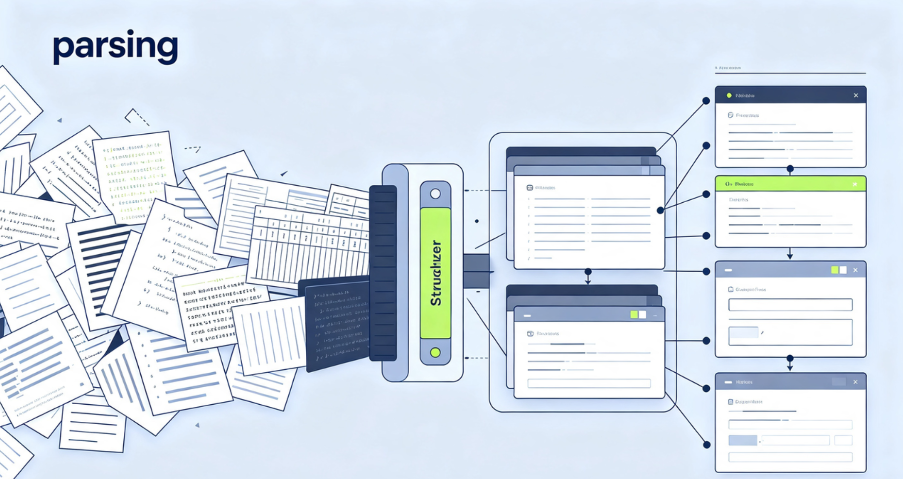
Every time you visit a website, send a message, or run a program, data is being transformed behind the scenes. Raw, unstructured data—whether it is HTML, JSON, or plain text—is converted into something meaningful that computers can understand and act upon. This essential transformation is called parsing.
Parsing is a fundamental concept in computing that underpins everything from web development to artificial intelligence. Yet, for many, it remains a vague and technical term. This guide explains everything you need to know about parsing in 2026—what it is, how it works, why it matters, and how it is used in real-world applications.
What Is Parsing?
At its core, parsing is the process of analyzing a string of data—such as text, code, or a file—to break it down into structured, readable components. In simpler terms, parsing is the act of taking raw, often chaotic input and converting it into a format that a computer can understand and work with.
Parsing is the activity of determining whether an input string has the proper syntax (form) according to a set of rules. It is the process of converting a stream of input into a structured representation, such as a tree or a data structure that shows how the different parts of the input relate to one another.
Whenever a program receives input—whether it is HTML, JSON, URLs, sentences, configuration files, or code itself—it must parse that input to understand what it represents. The parser is the program that performs this conversion, taking a linear string of input words and producing a structured representation that shows how the phrases (substructures) are related.
Parsing in Plain English
Think of parsing like diagramming a sentence in grammar school. Just as you would break a sentence down into its parts—subject, verb, object—a parser breaks down a string of data into its components according to a set of rules. The goal is to uncover the structure that is hidden within the raw input.
For example, when you receive a JSON string like {"name": "Alice", "age": 30}, a parser reads this text and converts it into a data structure that your program can use—such as an object with properties name and age. The raw string is illegible to a program, but after parsing, it becomes usable.
How Parsing Works
Parsing is not a single step but a process that typically involves two main stages: lexical analysis and syntax analysis (often simply called parsing).
1. Lexical Analysis (Tokenization)
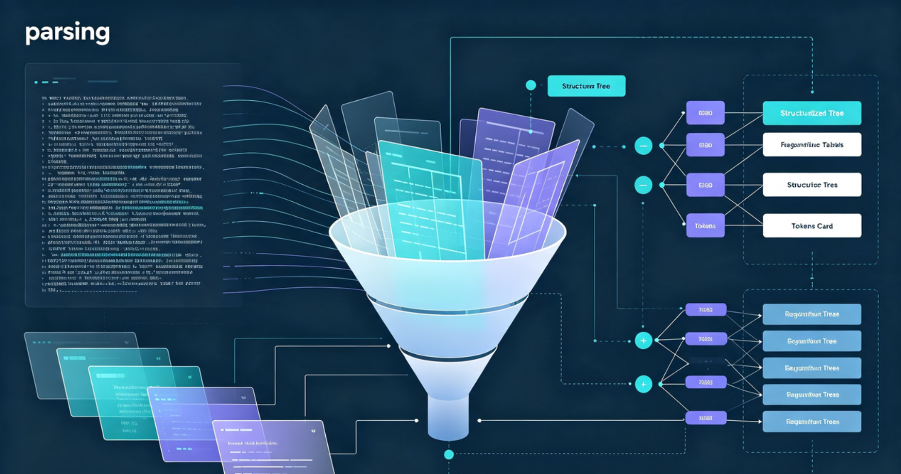
The first stage of parsing is lexical analysis, also known as tokenization. During this phase, the parser scans the raw input and breaks it down into meaningful chunks called tokens.
Tokens are the smallest units of meaning in the input. For example, in a programming language, tokens might include keywords (like if or return), identifiers (like variable names), operators (like + or =), and literals (like numbers or strings).
The lexical analyzer (or lexer) reads the stream of characters and groups them into these tokens, discarding any whitespace or comments that are not meaningful.
2. Syntax Analysis (Parsing Proper)
The second stage is syntax analysis, which is the process of applying the rules of a grammar to determine which sequence of tokens are legal and how they are grouped together. This is where the parser checks whether the sequence of tokens follows the rules of the language.
The parser takes the stream of tokens from the lexical analyzer and attempts to build a parse tree (or syntax tree) that represents the grammatical structure of the input. If the input is valid according to the grammar, the parser constructs this tree. If the input is invalid, the parser reports a syntax error.
The Output: A Parse Tree
The output of parsing is often a parse tree or an abstract syntax tree (AST) . This tree structure shows how the tokens are grouped according to the rules of the grammar. The tree captures the hierarchical relationships between the different parts of the input, making it easier for the program to understand and process the data.
For example, in a compiler, the parse tree represents the grammatical structure of the source code. The compiler can then traverse this tree to generate machine code or perform optimizations.
Types of Parsing Algorithms
Parsing algorithms can be broadly categorized into two main types: top-down parsing and bottom-up parsing.
Top-Down Parsing
Top-down parsing starts from the top of the parse tree (the root) and works its way down to the leaves. The parser attempts to derive the input string from the start symbol of the grammar by applying production rules.
Common top-down parsing techniques include:
- Recursive descent parsing – The parser is built directly from the recursive rules of the grammar, with one function for each non-terminal.
- LL parsing – A class of top-down parsers that read input from left to right and produce a leftmost derivation.
Top-down parsers are generally easier to implement and understand, making them popular for educational purposes and smaller languages.
Bottom-Up Parsing
Bottom-up parsing starts from the leaves of the parse tree (the tokens) and works its way up to the root. The parser attempts to reduce the input string to the start symbol by applying production rules in reverse.
Common bottom-up parsing techniques include:
- LR parsing – A class of bottom-up parsers that read input from left to right and produce a rightmost derivation.
- SLR (Simple LR) and LALR (Look-Ahead LR) – Variations of LR parsing that are simpler to implement but less powerful.
Bottom-up parsers are more powerful than top-down parsers and can handle a wider range of grammars. They are commonly used in production compilers. In a practical compiler, the parser should be able to parse a source program in linear time.
Universal Parsing Algorithms
There are also universal parsing algorithms that can handle any context-free grammar. However, these algorithms have high time complexities and are not used in practical compilers. Instead, they are more common in natural language processing and other domains where the grammar is less predictable.
Why Parsing Matters
Parsing is essential across virtually every domain of computing. Here is why it matters.
1. Programming Languages and Compilers
One of the most fundamental applications of parsing is in compilers and interpreters. When you write code in a programming language, the compiler must parse your source code to understand its structure and meaning. The parser checks that your code follows the syntax rules of the language and builds a parse tree that the compiler can use to generate machine code or intermediate representations.
Without parsing, we could not write programs in high-level languages. Every compiler, interpreter, and code linter relies on parsing to do its job.
2. Web Scraping and Data Extraction
Parsing is a critical step in web scraping. When you scrape a website, you receive raw HTML—the code that web browsers read to display pages. This HTML is messy and unstructured. Parsing is the process that extracts the specific pieces of information you need—such as product titles, prices, or reviews—from that raw HTML.
If web scraping is like photocopying pages from a book, data parsing is like reading those pages and typing the important information into a spreadsheet.
3. Data Processing and APIs
Modern applications rely heavily on data interchange formats like JSON, XML, and CSV. When an API returns data in JSON format, your application must parse that JSON to convert it into usable data structures. Similarly, when you read a CSV file, you are parsing the comma-separated values into rows and columns.
Parsing enables applications to communicate with each other, exchange data, and process information efficiently.
4. Natural Language Processing
Parsing is also essential in natural language processing (NLP). In the context of NLP, parsing is the process of assigning structural descriptions to sequences of words in a natural language. This allows computers to understand the grammatical structure of sentences, enabling applications like machine translation, sentiment analysis, and chatbots.
5. Configuration Files and Data Formats
Almost every application reads configuration files, log files, or other data formats. Parsing is the process that turns these raw files into structured data that the application can use. Whether it is parsing a .ini file, a YAML configuration, or a log file, parsing is ubiquitous.
Parsing vs. Scraping: What’s the Difference?
One of the most common points of confusion is the difference between parsing and scraping. While they are related, they are not the same thing.
Scraping is the process of extracting data from a website or other source. It involves fetching the raw data—typically HTML from a web page—and making it available for further processing. Scraping is about retrieval.
Parsing is the process of analyzing that raw data to extract specific pieces of information and convert it into a structured format. Parsing is about transformation.
The key distinction is that scraping retrieves data, while parsing transforms it. In a typical web scraping pipeline, you first scrape the HTML (retrieve it), and then you parse the HTML (extract the specific information you need). The output being scraped was intended for display to an end-user, rather than as input to another program, and is therefore usually neither documented nor structured for convenient parsing.
Parsing is the step that turns the raw, chaotic mess of the internet into structured, usable data that fits neatly into your workflow.
Full-Industry Proxy IP Application Solutions
Power scalable growth for every cross-border business scenario with IPFLY’s reliable global proxy network
Common Parsing Tools and Libraries
There are many tools and libraries available for parsing different types of data.
HTML and XML Parsing
- Beautiful Soup (Python) – A popular library for parsing HTML and XML documents. It creates parse trees that make it easy to extract data from web pages.
- lxml (Python) – A powerful library for handling XML and HTML files, built on the C libraries libxml2 and libxslt.
- jsoup (Java) – A Java library for parsing HTML into a structured document and extracting elements using CSS selectors.
JSON Parsing
- JSON.parse() (JavaScript) – The built-in method for parsing JSON strings into JavaScript objects.
- json (Python) – The standard library for parsing JSON in Python.
XML Parsing
- DOM parsers – Parse the entire XML document into a tree structure in memory.
- SAX parsers – Parse XML sequentially, triggering events as elements are encountered.
Best Practices for Effective Parsing
Whether you are building a web scraper, processing API responses, or writing a compiler, following best practices will make your parsing more reliable and maintainable.
1. Handle Errors Gracefully
Parsing can fail for many reasons—malformed input, unexpected data formats, or changes in the source structure. Always implement error handling to catch parsing failures and respond appropriately, rather than crashing.
2. Use Robust Selectors
When parsing HTML, use stable selectors that are less likely to break when the source changes. IDs are generally more stable than class names, and class names are more stable than element positions.
3. Validate Parsed Data
After parsing, validate that the extracted data meets your expectations—numeric fields contain numbers, dates are in the correct format, and required fields are populated. Validation helps catch parsing errors early and prevents invalid data from entering your system.
4. Keep Parsing Logic Maintainable
Parsing logic can become complex. Keep your code well-organized and documented. Use clear, descriptive variable names and separate parsing logic from other parts of your application.
5. Test Parsing Logic Thoroughly
Test your parsing logic with a variety of inputs, including edge cases and potential failure scenarios. Automated tests can validate parsing logic against known inputs and expected outputs.
6. Monitor for Changes
When parsing data from external sources—especially websites—monitor for changes in the source structure. If a website redesigns its HTML, your parsing logic may break. Implement monitoring to detect failures early.
How IPFLY Supports Parsing Workflows
Parsing is only as effective as the data it receives. If a scraper cannot fetch the data because of IP-based blocks, rate limiting, or geographic restrictions, the parser has nothing to process. IPFLY provides the residential proxy infrastructure that enables reliable, uninterrupted data collection.
Why Network Quality Matters for Parsing
Parsing depends on consistent access to data sources. When websites block or restrict access—through IP-based rate limiting, geographic content restrictions, or request pattern detection—data collection fails, and parsing cannot proceed.
How IPFLY Helps
IPFLY’s residential proxies provide clean, ISP-registered IP addresses that ensure reliable connectivity for:
- Web scraping pipelines – Fetching HTML and JSON data from websites without being blocked
- API integrations – Accessing external APIs for data processing
- Geographic flexibility – Accessing region-specific content for parsing
- Load distribution – Balancing requests across multiple IPs to avoid rate limits
IPFLY Static Residential Proxies offer dedicated, ISP-registered IP addresses that remain consistent over time—ideal for long-term data collection pipelines.
IPFLY Dynamic Residential Proxies provide real residential IPs with automatic rotation, adding flexibility for high-volume data collection.
👉 Explore IPFLY Residential Proxies
Frequently Asked Questions
What is parsing in simple terms?
Parsing is the process of taking raw, unstructured data and converting it into a structured format that a computer can understand and use.
What is the difference between parsing and scraping?
Scraping retrieves raw data from a source (like a website). Parsing transforms that raw data into a structured format. Scraping is about retrieval; parsing is about transformation.
What is a parser?
A parser is a program that analyzes a string of input (such as code or text) and converts it into a structured representation, such as a parse tree.
Why is parsing important in web scraping?
Parsing is essential in web scraping because raw HTML is messy and unstructured. Parsing extracts the specific pieces of information you need—such as product titles, prices, or reviews—from that raw HTML.
What is lexical analysis?
Lexical analysis (or tokenization) is the first stage of parsing. It breaks raw input into meaningful chunks called tokens, which are the smallest units of meaning.
What is a parse tree?
A parse tree is a tree structure that represents the grammatical structure of an input string. It shows how the different parts of the input relate to each other according to the rules of a grammar.
What are the main types of parsing algorithms?
The two main types of parsing algorithms are top-down parsing (starting from the root and working down) and bottom-up parsing (starting from the leaves and working up).
Parsing as the Foundation of Data Processing
Parsing is one of the most fundamental concepts in computing. It is the process that turns raw, unstructured data into structured, usable information. From compilers that understand programming languages to web scrapers that extract product data, parsing is the essential bridge between raw data and actionable insights.
Key takeaways:
- Parsing is the process of converting raw input into a structured representation – It analyzes data and breaks it down into components that a computer can understand.
- Parsing involves two main stages – Lexical analysis (tokenization) and syntax analysis (building a parse tree).
- Parsing algorithms fall into two categories – Top-down parsing and bottom-up parsing.
- Parsing is used across many domains – Programming languages, web scraping, APIs, natural language processing, and configuration files.
- Parsing differs from scraping – Scraping retrieves data; parsing transforms it.
- Effective parsing requires robust error handling – Validate data, maintain parsing logic, and monitor for changes in source structure.
- Reliable data collection depends on reliable network infrastructure – Residential proxies ensure consistent access to data sources.
Whether you are a developer building a web scraper, a data scientist processing API responses, or a business analyst working with structured data, understanding parsing is essential for transforming raw information into value.
Power Your Parsing Workflows with IPFLY
Parsing depends on reliable data collection. IPFLY provides the residential proxy infrastructure that enables consistent, uninterrupted access to web data sources—ensuring that your parsing pipelines are fed with fresh, reliable data.
IPFLY offers flexible proxy solutions for every use case:
- Static Residential Proxies – Dedicated, ISP-registered IPs for consistent, long-term data collection.
- Dynamic Residential Proxies – Real residential IPs with automatic rotation for high-volume data collection.
- Datacenter Proxies – High-performance IPs for speed-critical operations.
Get started today: Register for an IPFLY account and explore the full product lineup on the IPFLY homepage. Build reliable data pipelines that turn raw information into actionable insights.