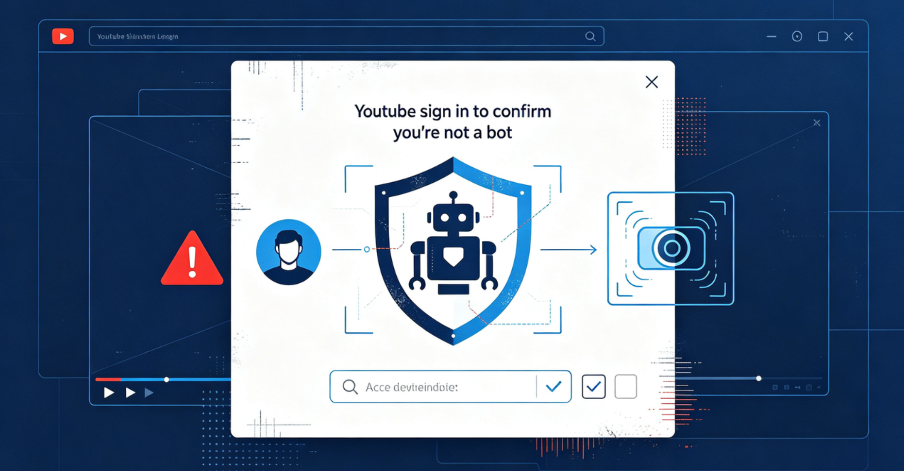
We have all been there. You are ready to watch one of your favorite content creators on YouTube when, out of the blue, a prompt blocks access and asks you to log in again.The message is abrupt and often confusing, especially if you are already signed in to your Google account.
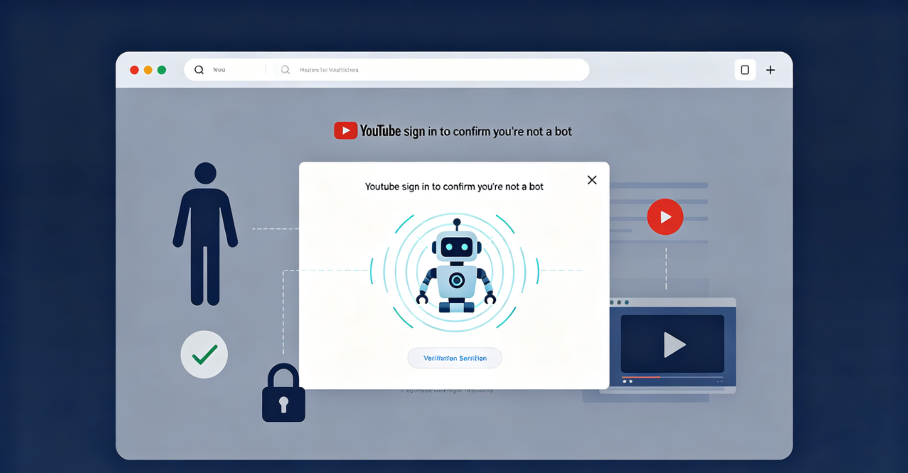
This prompt is YouTube’s “Sign in to confirm you’re not a bot” message, and it is a security measure designed to curb the use of automated tools on the platform.However, the verification process can cause significant frustration for users, often acting as a temporary barrier to the content they want to watch.This guide explains why this error appears, what causes it, and how to fix or avoid it.
Part 1: What Does “Sign in to confirm you’re not a bot” Mean?
This message is a security verification step implemented by YouTube to crack down on illegal bot usage. The platform employs strict security measures to scan incoming traffic and assess whether users may be using bots to inflate views, likes, shares, or spam comments.
Encountering this error means that YouTube’s automated traffic-based detection system has deemed your behavior suspicious.The message is essentially a test: it asks you to sign in again to confirm you are a human. It is intended to keep bots away while letting real users in.
Why Does This Happen?
Several factors can trigger this security measure. The most common causes include:
Proxy Traffic: Shared traffic behavior is one of the main triggers. Free proxies often route traffic from many users through a single address. If your IP address range happens to be shared with that of a known bot cluster, YouTube will likely deny access to it.
Suspicious or Shared IP Address: A situation with shared internet addresses can occur on public Wi-Fi networks, university campuses, or in apartment complexes where multiple users share the same connection. If several of these users access YouTube simultaneously, an access limitation is bound to happen.
Cookie or Browser Restrictions: Privacy blockers, ad-blockers, and extensions that prevent tracking or frequently delete cookies can interfere with YouTube’s security measures.
Unusual Network Activity: A large number of requests, the presence of automated tools, or extensions sending odd data can all fall within what YouTube considers robot behavior.
Part 2: How to Fix the “Sign in to confirm you’re not a bot” Error
If you are facing this error, there are several steps you can take to resolve it. The solutions range from simple quick fixes to more involved troubleshooting.
Try These Ideas First
Before diving into more complex solutions, try these basic troubleshooting steps:
- Turn off your proxy: If you are using a free proxy service, consider turning it off. Both Google and YouTube can often tell when you are behind these cheap, unreliable services.
- Switch to mobile data: If your home connection is not working, switch over to your phone’s mobile data. This simple change can sometimes be all it takes to avoid issues.
- Restart your router: This old tried-and-true method allows your router to get a new IP address, refreshing your online identity with the platform.
- Clear cookies/cache: A single clear when encountering the error can remove problematic or corrupted files that may be causing verification issues.
- Sign into Google temporarily: Simply log in to your Google account. This fulfills the platform’s request to confirm you are a human and will make the error go away.
Detailed Solutions
If the basic steps do not work, try these more targeted approaches:
1. Disable Proxy: While proxies are outstanding privacy tools, they can trigger the sign-in requirement on YouTube. If you are using a free alternative that logs data and shares the same address, your best bet is to switch to a quality provider that offers a dedicated proxy that only you can use.Additionally, YouTube may have blacklisted the specific proxy provider you are using. If that is the case, moving over to another provider is what you need to do.
2. Change Your Network: If YouTube is blocking traffic from a specific IP range, changing your network might be in your best interest. You can achieve this by switching from your standard home internet connection to your phone’s mobile carrier network. Alternatively, you can switch to a wholly different Wi-Fi network if possible.
3. Clear Browser Cache and Cookies: Corrupted cookies and cached files can sometimes interfere with YouTube’s security verification algorithms. Clearing your browser’s cache and cookies can resolve the error by refreshing all your stored data.
4. Enable Cookies for YouTube: The issue could also lie with your browser, which may not be storing the platform’s cookies by default. YouTube requires you to accept cookies for proper video playback. Enabling third-party cookies allows verification of your YouTube login when using embedded videos.
5. Sign into Your Google Account: If you have a free Google account, signing in will be enough to clear any instance of YouTube blocking access. It can be your Gmail account or your own YouTube account. Simply navigate to the login area, input your credentials, and the error will disappear.
6. Restart Your Router: Resetting your router allows the DHCP of your Internet Service Provider (ISP) to assign a new address to your connection. Once the device reboots, wait a couple of minutes for your ISP to assign you a new address.
7. Check Browser Extensions: Outdated or poorly built extensions can affect YouTube’s detection measures. To assess which extension may be causing trouble, consider turning them off one by one in your browser settings. Once you have isolated the extension, you can either remove it, update it, or replace it.
8. Update or Switch Browsers: If the program you use to surf the internet is outdated or its internal workings are incompatible with YouTube, issues are bound to appear. Updating your browser or switching to a new one altogether will make the problematic error go away.
9. Wait Out the Temporary Ban: These access issues are often temporary. They usually go away on their own after a few hours or a couple of days at worst.
Clear Step-by-Step Proxy IP Tutorials
Master proxy setup, integration and performance optimization quickly with IPFLY guides
Part 3: How to Avoid the “Not a Bot” Error in the Future
To keep this error from recurring, follow these strategies to ensure your traffic appears trustworthy to YouTube:
- Avoid constant switching: Adhering to a specific provider and server settings helps the platform avoid becoming suspicious of your traffic.
- Limit aggressive privacy blockers: Some ad blockers and tracker detectors can go a little too far. Consider using ones that won’t interfere with your YouTube experience.
- Keep a stable IP when possible: Frequent IP address changes from the same device alert the website to possible robot behavior. Sticking to a stable address tells YouTube your connection is trustworthy.
- Don’t run automation or download tools: Avoid using scripts or other automated software on the platform. Likewise, avoid the issues that come with downloading or collecting data from the website.
Part 4: How IPFLY Supports Reliable YouTube Access
While YouTube’s “Sign in to confirm you’re not a bot” prompt is designed to block suspicious traffic, legitimate users can often trigger it unintentionally through shared or low-quality connections. IPFLY provides the residential proxy infrastructure that enables secure, consistent access to YouTube.
Why Network Quality Matters
The prompt appears when YouTube’s automated traffic-based detection system flags your connection. As discussed, this is often triggered by a shared or suspicious IP address, or unusual network activity.However, even legitimate users can be caught in this net if they are on a shared network or using a low-quality proxy.
The solution lies in using a clean, dedicated residential IP. By routing your traffic through a real ISP-assigned residential IP, you appear to YouTube as a genuine user, dramatically reducing the chances of triggering the bot verification prompt.
IPFLY Residential Proxy Solutions
IPFLY’s residential proxies route your traffic through real consumer IPs, making your browsing activity indistinguishable from normal internet traffic.
Key advantages for YouTube access:
- Real residential IPs – From a pool of residential addresses, ensuring high availability and low detection risk
- ISP-registered authenticity – IPs appear as genuine consumer connections, not datacenter infrastructure
- Nearly undetectable – YouTube’s filters cannot distinguish IPFLY residential traffic from regular browsing
- Stable connections – Consistent, reliable access without the downtime of free proxies
- Clean IP reputation – No history of abuse or suspicious activity
- Full protocol support – HTTP, HTTPS, and SOCKS5
Residential proxies are ideal for users who need reliable, long-term access to YouTube for viewing, managing channels, or professional use.
👉 Explore IPFLY Residential Proxies
IPFLY Static Residential Proxies (ISP Proxies)
For users who need consistent, long-term access—such as managing a YouTube channel or needing stable viewing—IPFLY’s Static ISP proxies provide unparalleled stability.
Key advantages:
- 100% dedicated IP – Exclusive use with no sharing
- ISP-registered authenticity – IPs appear as genuine residential connections
- IP will not change – Consistent identity for long-term access
- Unlimited bandwidth – No traffic restrictions for extended sessions
- Full protocol support – HTTP, HTTPS, and SOCKS5
Static ISP proxies are perfect for YouTubers, content creators, and professionals who need consistent, reliable YouTube access.
👉 Explore IPFLY Static Residential Proxies
IPFLY Datacenter Proxies
For speed-critical operations where residential authenticity is less important, IPFLY’s dedicated datacenter proxies offer high-performance connectivity.
👉 Explore IPFLY Datacenter Proxies
How IPFLY Compares to Free Solutions
| Feature | Free Proxy | IPFLY Residential Proxy |
| IP Type | Datacenter or shared | Real residential ISP IPs |
| Detection Risk | High – easily flagged | Low – appears as normal traffic |
| Privacy | Unknown logging, ads | No logging, private browsing |
| Security | Malware and tracking risks | Secure, vetted infrastructure |
| Speed | Slow, throttled | Fast, stable connections |
| Reliability | Unpredictable, frequently down | Consistent, long-term access |
| Session Stability | Breaks frequently | Stable, uninterrupted sessions |
Keep Your YouTube Binge-Watching Going
YouTube’s “Sign in to confirm you’re not a bot” error is a security measure designed to protect the platform from automated abuse. While frustrating, it is often a temporary limitation that can be resolved with the right approach.
Key takeaways:
- The error is about your traffic, not your account – It is a temporary platform limitation designed to determine user trustworthiness.
- Shared IPs are common triggers – Free proxies that share a single address with many users are a major cause.
- Start with simple fixes – Turn off your switch to mobile data, restart your router, or sign into your Google account.
- Consider a residential proxy – For stable, long-term access, a dedicated residential IP ensures your traffic appears as a genuine user, preventing the bot verification prompt.
By following the strategies outlined in this guide, you can resolve this error and take steps to prevent it from recurring.
Access YouTube Reliably with IPFLY
YouTube’s bot verification prompt is often triggered by low-quality or shared network connections. The most reliable way to avoid this error is to use a clean, residential IP that appears as genuine consumer traffic.
IPFLY offers flexible proxy solutions for every use case:
- Residential Proxies – Real consumer IPs with stable sessions. Ideal for accessing YouTube without triggering verification prompts.
- Static Residential Proxies – 100% dedicated, ISP-registered IPs with consistent identity. Perfect for long-term YouTube access and channel management.
- Datacenter Proxies – High-performance IPs for speed-critical operations.
Get started today: Register for an IPFLY account and explore the full product lineup on the IPFLY homepage. Access YouTube with confidence, knowing your connection is stable, private, and secure.