What Is a Bing Rank Tracker?
A Bing rank tracker is a tool or data workflow that monitors where a website appears in Bing search results for specific keywords.
The basic idea is simple: enter a keyword, collect the Bing search results, identify the target website, and record its position.
The challenge starts when the tracking needs to cover hundreds or thousands of keywords across different markets.
A useful Bing rank tracker should be able to associate ranking data with the conditions under which the search was collected, including: Keyword, Ranking URL, Search location, Language, Device, SERP features, Timestamp, Historical position
This context matters because a search ranking is not always a universal number.
A page that ranks in one position in New York may appear somewhere else in London. Desktop and mobile results can also differ. Without consistent search conditions, historical ranking data can become difficult to compare.
For this reason, accurate Bing rank tracking is less about collecting a single position and more about creating a consistent measurement environment.
How Does a Bing Rank Tracker Work?
Most Bing rank tracking workflows follow four basic stages.
Keyword and Location Setup
The process begins with a defined keyword set and search environment.
For example:
Keyword: project management software Market: United States Location: New York Language: English Device: Desktop
The more precisely these conditions are defined, the easier it becomes to compare results over time.
Bing SERP Collection
The system then collects the Bing search results for each query.
Depending on the solution, the output may be a processed ranking position or structured SERP data containing URLs, titles, snippets, and other search-result elements.
Microsoft retired its Bing Search APIs on August 11, 2025, so teams that need programmatic Bing search data now need to work with alternative data collection or rank tracking solutions. (Decodo)
Ranking Extraction
The system identifies the target domain or URL within the returned results and records its position.
For example:
Keyword: running shoes

1. competitor-a.com
2. competitor-b.com
3. example.com
The target website would be recorded at position three.
Historical Tracking
The final step is storing the results.
A single ranking check provides a snapshot. Historical records show whether visibility is improving, declining, or fluctuating.
That makes historical tracking one of the most important functions of a Bing rank tracker.
What Makes Bing Rank Tracking Accurate?
A ranking number is only useful when the conditions behind it are consistent.
Several factors deserve particular attention.
Location
Location can significantly affect search results.
This is especially important for international and local SEO. If a company is targeting users in the United States but collects ranking data from another market, the results may not represent the intended audience.
A geographically targeted network environment can therefore be an important part of a Bing rank tracking workflow.
IPFLY’s residential proxy network provides residential IP resources across 190+ countries and regions, with geographic targeting options that can support market-specific SEO data collection.
IPFLY has also covered this issue in Rank Tracking Proxies: The Secret to Accurate SEO Monitoring, where geographic consistency is discussed as part of location-specific ranking measurement.
The key principle is straightforward:
The measurement environment should match the market being measured.
Device
Desktop and mobile search results can differ.
If a project tracks both, they should be stored separately rather than mixed into one ranking history.
Otherwise, a change from desktop to mobile could appear as a ranking change even when the underlying SEO performance has not changed.
Language
Language should also be consistent.
A keyword tracked in English should not later be compared with results collected under a different language setting.
For international SEO, country, location, language, and device should be treated as separate tracking dimensions.
SERP Context
Search results are not simply a list of ten organic links.
Depending on the query, a SERP can contain different result formats and enhanced search features.
A useful Bing rank tracker should therefore preserve enough SERP information to explain the ranking position rather than recording the number alone.
Why Location Matters for a Bing Rank Tracker
Location is one of the easiest variables to overlook and one of the most important for international SEO.
Consider a company tracking the same keyword across four markets:
| Market | Position | Ranking URL |
| United States | 4 | /product-a |
| United Kingdom | 7 | /product-b |
| Germany | 11 | /product-a |
| Japan | 15 | /product-c |
A single global ranking number would hide these differences.
A market-level dataset makes them visible.
This is particularly useful for:
- International SEO
- Local SEO
- Regional content analysis
- Competitor monitoring
- Market research
- Search visibility reporting
For geographically distributed tracking, IPFLY’s residential resources can be used alongside the ranking workflow when the collection environment needs to correspond to a specific country or city.
The relevant IP type depends on the workflow.
Dynamic residential IPs are suitable when the tracking system requires flexible access to residential resources across different markets.
Static residential IPs are more appropriate when maintaining a consistent residential network endpoint is an important part of the measurement setup.
The distinction is not about one type being universally better. It is about matching the network resource to the way ranking data is collected.
How to Choose a Bing Rank Tracker
Not every Bing rank tracker is designed for the same type of SEO workflow.
Before selecting a solution, consider five areas.
Geographic Targeting
Check whether the system supports the markets that matter to the SEO program.
For international projects, country-level coverage may be sufficient for some keywords, while city-level targeting may be important for local search.
Historical Data
A tracker should make it easy to compare current rankings with previous observations.
Historical data helps identify:
- Ranking trends
- Sudden changes
- Landing-page changes
- Market differences
- Competitor movement
Full-Industry Proxy IP Application Solutions
Power scalable growth for every cross-border business scenario with IPFLY’s reliable global proxy network
Tracking Frequency
Daily tracking is often sufficient for ongoing SEO monitoring.
More frequent checks can be useful when investigating a specific event, while established websites may not need constant collection.
The tracking frequency should follow the business question rather than simply maximizing the amount of data collected.
SERP Data Depth
If a website frequently ranks beyond the first page, tracking only the top results may provide an incomplete picture.
The required result depth should therefore be determined before selecting a data source.
API or Dashboard
There are two broad approaches.
All-in-one platforms provide dashboards, historical reports, and keyword management with little development work.
Data APIs provide more control over how search data is collected, processed, and integrated into internal systems.
The right choice depends on the team’s technical resources and reporting requirements.
Bing Rank Tracker vs. SERP Data API
These two concepts are related but not identical.
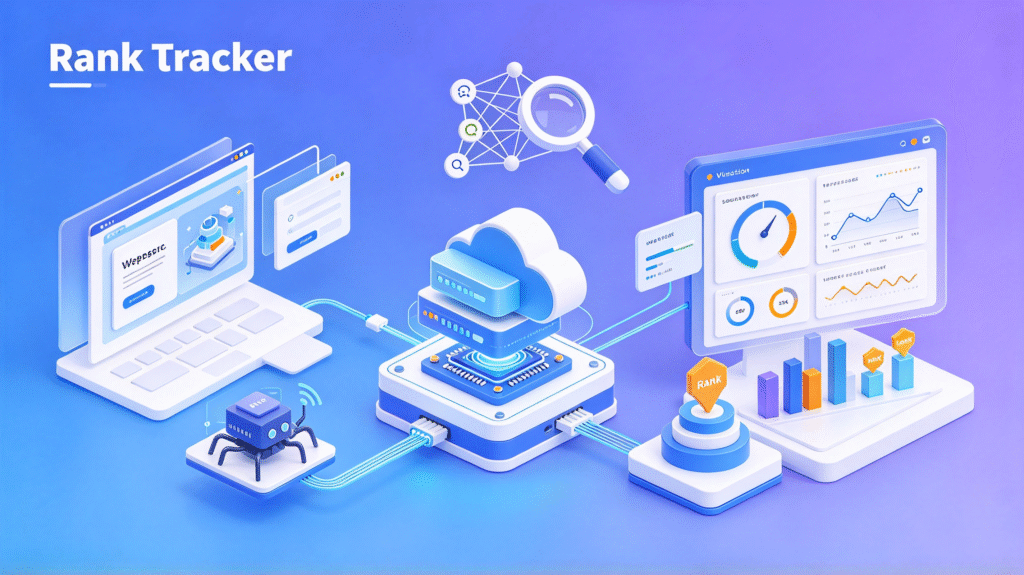
A SERP data API provides search-result data.
A Bing rank tracker turns that data into an ongoing ranking-monitoring system.
A custom workflow based on SERP data may need to handle:
- Keyword scheduling
- Result parsing
- Domain matching
- Position calculation
- Historical storage
- Reporting
- Error handling
A dedicated rank tracker usually provides these functions through a finished interface.
This creates a basic trade-off:
Choose a rank tracking platform for convenience and built-in reporting.
Choose a data API when greater control over the data workflow is required.
For enterprise SEO teams, the two approaches can also coexist.
Which IP Type Fits a Bing Rank Tracking Workflow?
IP infrastructure is not the same thing as a rank tracker.
The rank tracker determines what is being measured.
The IP resource can influence the geographic network environment from which the measurement is collected.
Dynamic Residential IPs
Dynamic residential resources can fit multi-market SEO research where the workflow needs flexible geographic coverage.
They are particularly relevant to:
- Regional SERP research
- International keyword monitoring
- Market research
- Large-scale search data collection
IPFLY’s dynamic residential proxy network provides access to 90M+ residential IPs across 190+ countries and regions.
Static Residential IPs
Static residential resources are more relevant when a tracking workflow needs a consistent residential network endpoint over time.
IPFLY’s static residential proxy network provides dedicated static residential IP resources for business scenarios where network continuity matters.
Datacenter IPs
For high-volume data workflows, network performance and throughput can become more important than residential network characteristics.
IPFLY’s datacenter proxy network is designed around dedicated IP resources, low latency, and high concurrency.
The appropriate choice should therefore follow the data collection requirements rather than the assumption that one IP type fits every Bing SEO workflow.
Common Bing Rank Tracking Mistakes
Tracking Every Market From One Location
This can produce ranking data that does not represent the target audience.
Mixing Desktop and Mobile Rankings
Different devices can produce different search results, so the two datasets should remain separate.
Recording Only Position
Position without location, device, timestamp, and ranking URL provides limited analytical context.
Comparing Inconsistent Search Conditions
If the tracking environment changes, a ranking change may reflect the measurement conditions rather than actual SEO performance.
Treating a Ranking Change as an Explanation
A rank tracker tells you what changed.
It does not automatically explain why.
Changes may result from competitors, SERP changes, content updates, ranking URL changes, or differences in the search environment.
Ranking data should therefore be treated as evidence for further SEO analysis rather than a complete explanation on its own.
A Practical Bing Rank Tracking Checklist
Before launching a Bing SEO monitoring workflow, confirm that it can answer these questions:
- Are the target keywords clearly defined?
- Are the target countries and cities specified?
- Is language tracked consistently?
- Are desktop and mobile results separated?
- Is the ranking URL recorded?
- Is historical data retained?
- Is the required SERP depth sufficient?
- Does the network environment match the target market?
- Is the collection frequency appropriate?
- Can the data be exported or integrated into existing SEO reporting?
If these conditions are satisfied, the resulting ranking dataset will be much more useful than a collection of isolated search positions.
Conclusion: Accurate Bing Rank Tracking Starts With Consistent Data
A Bing rank tracker is more than a tool that returns a number next to a keyword.
Reliable Bing rank tracking depends on collecting comparable search data under clearly defined conditions.
The most important variables are:
Keyword → Location → Language → Device → SERP → Time
Once these dimensions are controlled, ranking changes become easier to interpret and historical SEO analysis becomes more reliable.
Microsoft’s retirement of the Bing Search APIs in August 2025 also means that businesses building programmatic Bing tracking workflows need to pay closer attention to their data collection architecture. (Decodo)
For geographically distributed SEO monitoring, network location is another important part of that architecture. IPFLY provides dynamic residential, static residential, and datacenter IP resources that can be matched to different search-data collection requirements.
The objective is not to collect the largest possible amount of ranking data.
It is to collect consistent, relevant, and geographically appropriate data that can support better SEO analysis.
Build a More Accurate Bing Rank Tracking Workflow
When Bing SEO monitoring requires location-specific network resources, IPFLY provides residential and datacenter IP options for different data collection requirements.
Explore IPFLY to select the IP resources that match your Bing rank tracking workflow, or register for an IPFLY account and start evaluating the available network resources.