Few things are more frustrating than clicking on a link only to be met with a blank page, a CAPTCHA challenge, or the dreaded “Access Denied” message. Whether you are a researcher trying to access academic data, a business monitoring competitor prices, or a developer building automation workflows, web restrictions are a pervasive reality of the modern internet.
Traditional proxies offer a solution—but only a partial one. A raw proxy gives you a different IP address, but you still need to manage browser fingerprints, cookies, JavaScript rendering, retries, and any anti-bot challenges the target site throws your way. Enter the website unblocker (also known as a web unblocker or webmaster unblocker)—a managed service that takes a URL and returns rendered HTML, handling everything in between.
This guide explains everything you need to know about website unblockers in 2026—what they are, how they work, the different types available, why they matter, and how to choose the right solution for your needs.

Part 1: What Is a Website Unblocker?
A website unblocker is a managed request layer that sits between your application and the target website. Instead of handling proxy rotation, browser fingerprints, CAPTCHAs, and retries yourself, you send a single request. The service handles the complexity and returns the rendered HTML.
Think of it as the difference between buying ingredients and ordering the finished dish. Proxies are the most important ingredient, but an unblocker assembles the rest of the recipe for you.
Web Unblocker vs. Raw Proxy
The distinction is critical:
| Feature | Raw Proxy | Website Unblocker |
| What you get | A rotating IP | Finished page HTML |
| IP rotation | You build it | Built in |
| Browser fingerprinting | You build it | Built in |
| JavaScript rendering | You build it | Built in |
| CAPTCHA handling | You build it | Built in |
| Control | Full | Limited (it is a black box) |
| Cost at scale | Lowest (per GB/per IP) | Highest (per successful request) |
| Best for | Teams with a scraping stack | Speed to results, hardest targets |
A proxy only changes your IP address—you still handle fingerprinting and retries yourself. A web unblocker bundles the proxy with fingerprint matching, JavaScript rendering, and automatic retries behind one request, so you send a URL and get back the page content.
Part 2: Why Website Unblockers Matter in 2026
The web has changed dramatically in recent years. Anti-bot systems like Cloudflare, DataDome, and Akamai have made scraping and automated access significantly harder. Traditional proxies often fail because they lack the nuance needed to mimic real human users.
The Four-Layer Challenge
Modern anti-bot systems operate across multiple layers:
Network Layer – IP reputation checks identify datacenter IPs and flag them as suspicious. Residential IPs are trusted; datacenter IPs are blocked.
TLS Layer – The TLS fingerprint is emitted during the handshake, before any HTTP header is transmitted. Python’s requests library, curl, and other non-browser HTTP clients each produce recognizable signatures that anti-bot systems identify in milliseconds.
Browser Layer – JavaScript challenges probe the browser environment. Key signals include navigator.webdriver (set to true in automation contexts), canvas and WebGL rendering signatures, and screen resolution anomalies.
Behavioral Layer – Systems track inter-request timing patterns, scroll depth, mouse trajectory, and session duration. A scraper that requests pages at perfectly uniform intervals may pass all other checks and still be flagged.
The Web Unblocker Advantage
Website unblockers address all four layers automatically. Instead of stitching together proxies, browsers, and challenge-solving tools, you send a request to a single endpoint and get back the rendered HTML. The service handles the anti-bot infrastructure behind the scenes.
Part 3: Types of Website Unblockers
Website unblockers come in several forms, each suited to different use cases.
1. Web-Based Proxy Services (Consumer Grade)
These are the simplest form of website unblocker—browser-based tools that require no installation. You visit the proxy website, enter a URL, and the proxy loads the page for you.
Examples: CroxyProxy, ProxySite, BlockAway
Pros: No installation, works on any device, easy to use
Cons: Often slow, unreliable, and unsafe; free versions inject ads and track browsing activity; easily detected and blocked by advanced filters
2. Browser Extensions
Browser extensions offer a convenient way to unblock websites without leaving your browser. Some extensions route traffic through proxy servers, while others include built-in unblocking features.
Examples: 1Browser, Hide My IP
Pros: One-click activation, works within your existing browser
Cons: Only affects traffic within that specific browser; may be blocked by IT policies
3. API-Based Web Unblockers (Enterprise Grade)
For developers and businesses, API-based web unblockers provide programmatic access to unblocked content. You send a request to a single endpoint and receive rendered HTML or JSON.
Key players in 2026:
| Provider | Best For | Starting Price | Free Trial |
| Bright Data Web Unlocker | Enterprise, hardest targets | ~$1.5/1K requests | $5 credit |
| Oxylabs Web Unblocker | Geo-precise enterprise SLAs | $7/GB | 7-day |
| Zyte API | Mixed difficulty, Scrapy users | $1.15/1K requests | $5 credit |
| ScraperAPI | Solo developers | $49/mo | Free 1K/mo |
| Decodo Web Scraping API | Mid-market, structured output | $19/mo | Free plan |
All leading providers achieved >95% accuracy rates in multiple real-world tests. Bright Data led by a small margin overall, while Zyte showed the tightest confidence interval (more consistent results across runs).
4. Open-Source Unblockers
For developers who prefer to build their own solutions, open-source unblockers provide a foundation.
Examples:
- node-unblocker – A Node.js library with an Express-compatible API, allowing you to get your proxy up and running quickly
- InvisiProxy LTS (formerly Holy Unblocker LTS) – An experimental web proxy service that can bypass web filters regardless of whether the method of censorship is client-side or network-based
- searchts – A Python CLI and library with a fully open-source “unlocker” that gets through common bot-walls with no paid proxy and no API key
Part 4: The Hidden Dangers of Free Unblockers
Free website unblockers can be tempting—they cost nothing and require no setup. But they come with significant trade-offs that can compromise your privacy, security, and success.
Free proxy sites rely on heavily shared IP pools. Once too many people use the same address, websites start flagging it, which leads to CAPTCHA loops, slow loading, and blocked sessions. A proxy that works today may stop working a week later.
Data Tracking and Privacy Violations
Free proxy operators can see every unencrypted HTTP request that passes through. If the proxy server has not deployed SSL/TLS encryption (many free proxies have not), your request content can be read. Free proxies can also inject ads, track your browsing activity, and log your IP address.
Security Risks
Malicious actors often hide code behind free proxy tools that can turn visiting browsers into potential attack vectors. Free proxies can inject malware, steal login credentials, and use your device for malicious purposes. Using a free proxy to log into any real account—email, banking, social, or work—is an unnecessary risk.
Part 5: The Residential Proxy Advantage
While website unblockers handle the full anti-bot stack, the quality of the underlying proxy infrastructure remains critical. Residential proxies are the gold standard for unblocking because they use real IP addresses assigned by Internet Service Providers (ISPs) to actual households.
Complete Proxy IP Fundamentals
Build a full proxy knowledge framework — from core principles to protocol selection
Why Residential Proxies Are Superior
Higher Trust Scores – Residential IPs are associated with real households, not datacenters. Websites trust them more and are less likely to block them.
Lower Detection Risk – Residential proxies appear as genuine consumer connections, making them far less likely to be detected as proxy traffic.
Better Geographic Targeting – Residential proxies offer city-level precision across 190+ countries, allowing you to access region-specific content.
Cleaner Reputation – Residential IPs have no history of spam or automated activity, reducing the risk of association-based blocks.
The ISP Trust Signal
When a website queries an IP, it checks the Autonomous System Number (ASN):
- Datacenter IP: Returns “Amazon AWS” or “DigitalOcean” – immediate red flag
- Residential IP: Returns “Comcast,” “Verizon,” or “Orange” – green flag
This is why integrating a premium residential proxy network is essential for any serious unblocking operation.
Part 6: How IPFLY Powers Website Unblocking
IPFLY provides the residential proxy infrastructure that enables reliable, undetectable website unblocking. With over 90 million residential IPs across 190+ countries, IPFLY offers the scale, authenticity, and performance that successful unblocking operations require.
IPFLY Residential Proxy Solutions
Dynamic Residential Proxies
IPFLY’s dynamic residential proxies provide real residential IPs that change periodically or with each request. The system sources these from real user devices worldwide, ensuring authentic residential characteristics.
Key advantages for unblocking:
- Real residential IPs – From a pool of residential addresses, ensuring high availability and low detection risk
- Automatic rotation – Distribute requests across diverse IPs to avoid pattern detection
- Sticky session support – Maintain a consistent IP for hours or days when needed
- Geographic targeting – Choose IPs from specific countries and cities
- Full protocol support – HTTP, HTTPS, and SOCKS5
- 99% success rate – Industry-leading reliability for uninterrupted access
Dynamic residential proxies are ideal for high-volume unblocking operations, web scraping, and any scenario requiring IP rotation.
👉 Explore IPFLY Dynamic Residential Proxies
Static Residential Proxies (ISP Proxies)
For users who need consistent, long-term access—such as managing accounts or running regular unblocking workflows—IPFLY’s Static ISP proxies provide unparalleled stability.
Key advantages:
- 100% dedicated IP – Exclusive use with no sharing
- ISP-registered authenticity – IPs appear as genuine residential connections
- IP will not change – Low blocking rate with consistent identity
- Unlimited bandwidth – No traffic restrictions
- Full protocol support – HTTP, HTTPS, and SOCKS5
Static residential proxies are ideal for account management, e-commerce operations, and long-term unblocking workflows where consistent identity is critical.
👉 Explore IPFLY Static Residential Proxies
Datacenter Proxies
For speed-critical operations where residential authenticity is less important, IPFLY’s dedicated datacenter proxies offer high-performance connectivity.
👉 Explore IPFLY Datacenter Proxies
How IPFLY Supports Website Unblocking
| Challenge | IPFLY Solution |
| IP-based blocking | Residential IPs from real ISPs appear as genuine consumer traffic |
| Rate limiting | Dynamic rotation distributes requests across diverse IPs |
| Geographic restrictions | City-level targeting matches content requirements |
| IP reputation | 100% dedicated residential IPs with clean history |
| Session stability | Sticky sessions for consistent IP over extended operations |
| Scale | 90M+ IP pool across 190+ countries |
Part 7: How to Choose the Right Unblocking Solution
Choosing the right website unblocker depends on your specific needs, technical expertise, and scale requirements.
For Individuals and Students
If you need occasional access to blocked content—watching a video, reading a news article, or accessing educational resources—a web-based proxy or browser extension may be sufficient. However, be aware of the privacy and security risks. For safer access, consider a residential proxy solution.
Recommended: Free web proxies for casual use; IPFLY residential proxies for regular, private access.
For Developers and Small Teams
If you are building automation workflows, scraping data, or developing applications that require unblocked access, an API-based web unblocker or a residential proxy pool is the right choice.
Recommended: Start with a free trial of a managed unblocker (Bright Data, Oxylabs, Zyte) or build your own stack with IPFLY residential proxies.
For Enterprises and Large-Scale Operations
If you are running production-scale data collection, market research, or competitive intelligence operations, you need enterprise-grade infrastructure with high success rates, global coverage, and reliable support.
Recommended: Enterprise web unblockers (Bright Data, Oxylabs) combined with IPFLY residential proxy pools for cost optimization and flexibility.
From Proxies to Unblockers – The Evolution of Web Access
Website unblockers represent the next evolution in web access technology. Where traditional proxies simply hide your IP address, unblockers handle the entire anti-bot stack—IP rotation, browser fingerprinting, JavaScript rendering, CAPTCHA solving, and automatic retries—behind a single request.
Key takeaways:
- A raw proxy gives you an IP; a web unblocker gives you a successful response – The difference is the entire anti-block toolchain
- Modern anti-bot systems operate across four layers – Network, TLS, browser, and behavioral
- Free unblockers come with significant risks – Data tracking, malware, and unreliable performance
- Residential proxies are the gold standard – They appear as genuine consumer traffic and are far less likely to be blocked
- IPFLY provides the residential proxy infrastructure – With 90M+ IPs across 190+ countries, IPFLY powers reliable unblocking operations
- Choose the right tool for your needs – Web-based proxies for casual use, API unblockers for developers, enterprise solutions for large-scale operations
Whether you are a student trying to access educational resources, a developer building automation workflows, or a business conducting market research, the right unblocking infrastructure makes all the difference.
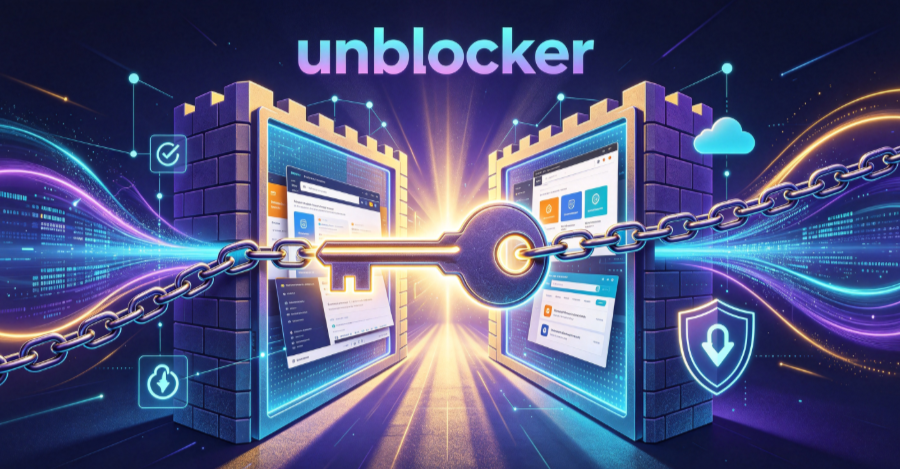
Unblock Websites with Confidence Using IPFLY
Free unblockers and web proxies come with significant risks—data tracking, malware, unreliable performance, and easy detection. IPFLY provides the residential proxy infrastructure that enables secure, undetectable website access from anywhere in the world.
IPFLY offers flexible proxy solutions for every use case:
- Dynamic Residential Proxies – Real residential IPs with automatic rotation. Ideal for high-volume unblocking, web scraping, and geographic flexibility.
- Static Residential Proxies – 100% dedicated, ISP-registered IPs with consistent identity. Perfect for account management and long-term operations.
- Datacenter Proxies – High-performance IPs for speed-critical operations.
Get started today: Register for an IPFLY account and explore the full product lineup on the IPFLY homepage. Access any website from anywhere, with the clean, trusted network environment that reliable unblocking requires.